Bitstamp Reportedly Rejects Crypto Deposits Over EUR1,000 from Third-Party Self-Custody Wallets
Key Takeaways
- •Bitstamp has reportedly started declining cryptocurrency deposits above EUR1,000 that arrive from third-party self-custody wallets, while deposits from a customer's own verified wallet are handled differently.
- •The reported restriction is based on a single-sourced report rather than a broadly confirmed policy, and its scope may vary by user or jurisdiction.
- •The EUR1,000 threshold matches the EU's Transfer of Funds Regulation, in force since December 2024, which obliges crypto-asset service providers to collect and verify originator and beneficiary information on transfers under the Travel Rule.
- •Bitstamp operates under a MiCA license granted by Luxembourg's financial regulator, allowing it to passport its services across the EU.
- •Until Bitstamp publishes a formal notice, customers sending self-custody deposits above the reported threshold should confirm current requirements directly with the exchange before moving funds.
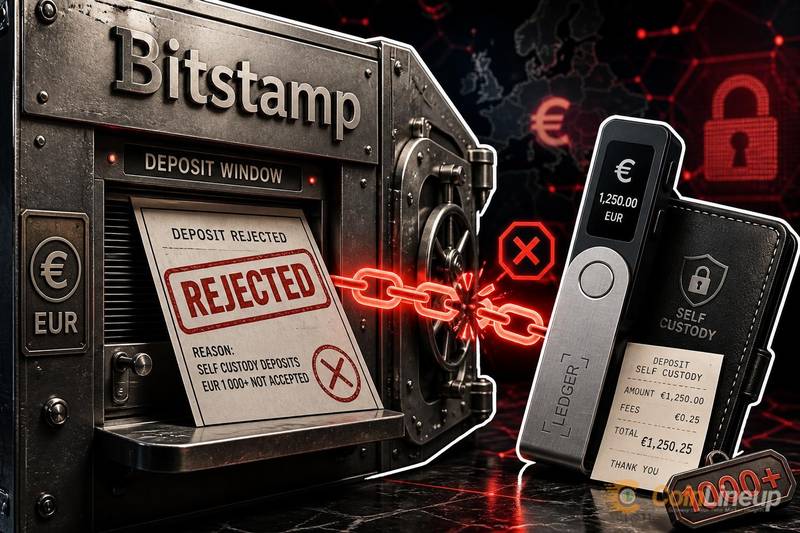
Bitstamp — one of the longest-running crypto exchanges, founded in 2011 and acquired by brokerage platform Robinhood in 2025 — has reportedly begun rejecting cryptocurrency deposits worth more than EUR1,000 when they arrive from third-party self-custody wallets, a change that would tighten how users move funds from personal wallets onto the exchange. The reported policy centers on distinguishing deposits sent from a customer's own verified wallet from funds sent by someone else.
What Bitstamp reportedly changed for self-custody wallet deposits
According to a report describing the shift, Bitstamp started declining crypto transfers above the EUR1,000 mark that originate from third-party self-custody wallets rather than from a user's own verified address.
The reported change is narrow in scope. It targets third-party self-custody wallets specifically, not every external wallet, meaning deposits from a customer's own documented wallet are treated differently from funds sent on someone else's behalf.
The word "reportedly" matters here. The account of this policy change should be read as a single-sourced report rather than a broadly confirmed, universal restriction, and the exact scope may vary by user or jurisdiction.
Why the EUR1,000 threshold could matter for crypto compliance
The EUR1,000 figure is the central decision point in the report, functioning as the line above which a self-custody deposit reportedly triggers stricter handling. That threshold aligns with how EU rules treat higher-value crypto transfers, which Bitstamp outlines in its own guidance on the Travel Rule in the EU.
The Travel Rule itself has a concrete source: it is the crypto extension of the Financial Action Task Force's Recommendation 16, which the EU made binding for crypto-asset service providers through its Transfer of Funds Regulation, in force since December 2024. Under those rules, providers must collect and verify originator and beneficiary details on transfers, with lighter treatment below EUR1,000. Bitstamp sits inside this regime, holding a MiCA license from Luxembourg's financial regulator that lets it passport services across the EU.
The distinction between first-party and third-party wallet activity points to wallet ownership checks. When a deposit arrives from a wallet that the sender cannot be verified to control, deposit verification becomes harder — the compliance context that the reported threshold appears designed to address.
The user impact is practical: customers moving larger sums out of self-custody and into a custodial platform may find those transfers held or declined unless ownership can be established. Similar compliance pressures have surfaced elsewhere in Europe, including the case in which Dutch prosecutors sold a defunct broker's remaining crypto as creditors faced losses.
What Bitstamp users and the wider market will watch next
A key open question is whether the reported restriction applies broadly or only in specific cases, since the available report does not establish a fully confirmed, uniform rollout across all accounts.
For customers, the immediate step is documentation: users may need to prove wallet ownership before sending larger self-custody deposits, echoing the verification demands that regulators increasingly place on exchanges. Broader compliance debates, such as the Treasury's proposed GENIUS Act stablecoin rules, show how quickly documentation expectations are shifting.
The exchange-comparison angle is worth tracking. Whether other platforms adopt similar treatment for higher-value self-custody transfers remains an open question, and past disclosures around how exchanges handle user data — such as reporting that Binance shared user data with investigators — illustrate how much scrutiny sits on custodial platforms. One point of certainty: the Transfer of Funds Regulation applies to every crypto-asset service provider licensed in the EU, so the divergence to watch is in implementation, not in whether the rules reach competitors.
Until Bitstamp publishes a formal notice detailing the scope, the practical takeaway is uncertainty about next steps: customers sending self-custody deposits above the reported threshold should confirm current requirements directly with the exchange before moving funds.
Disclaimer: This article is for informational purposes only and does not constitute financial or investment advice. Cryptocurrency and digital asset markets carry significant risk. Always do your own research before making decisions.

