BitMine Stock Extends Decline as Ethereum Slides Toward $1,800 Amid ETF Outflows and Rising Liquidations
Key Takeaways
- •BitMine Immersion Technologies closed at $17.58 on Nov. 13, down 4.72% from the prior session, after retreating from $21.73 on Nov. 4 during the broader crypto selloff.
- •Ethereum's slide from a September high of $2,800 to roughly $1,800 drove liquidations higher and pushed futures open interest down to $21 billion from $36 billion.
- •U.S. spot Ethereum ETFs recorded $764.1 million in net outflows through Nov. 13, a November pace that could exceed the $1.6 billion withdrawn last month.
- •BitMine holds more than 6 million ETH, equivalent to 4.96% of circulating supply, leaving its treasury value highly exposed to weakening Ethereum fundamentals.
- •Culper Research alleged that Ethereum's transaction counts are inflated by address poisoning and warned that network fees, down to $153 million this year from $523 million, could reduce staking rewards and raise inflation.
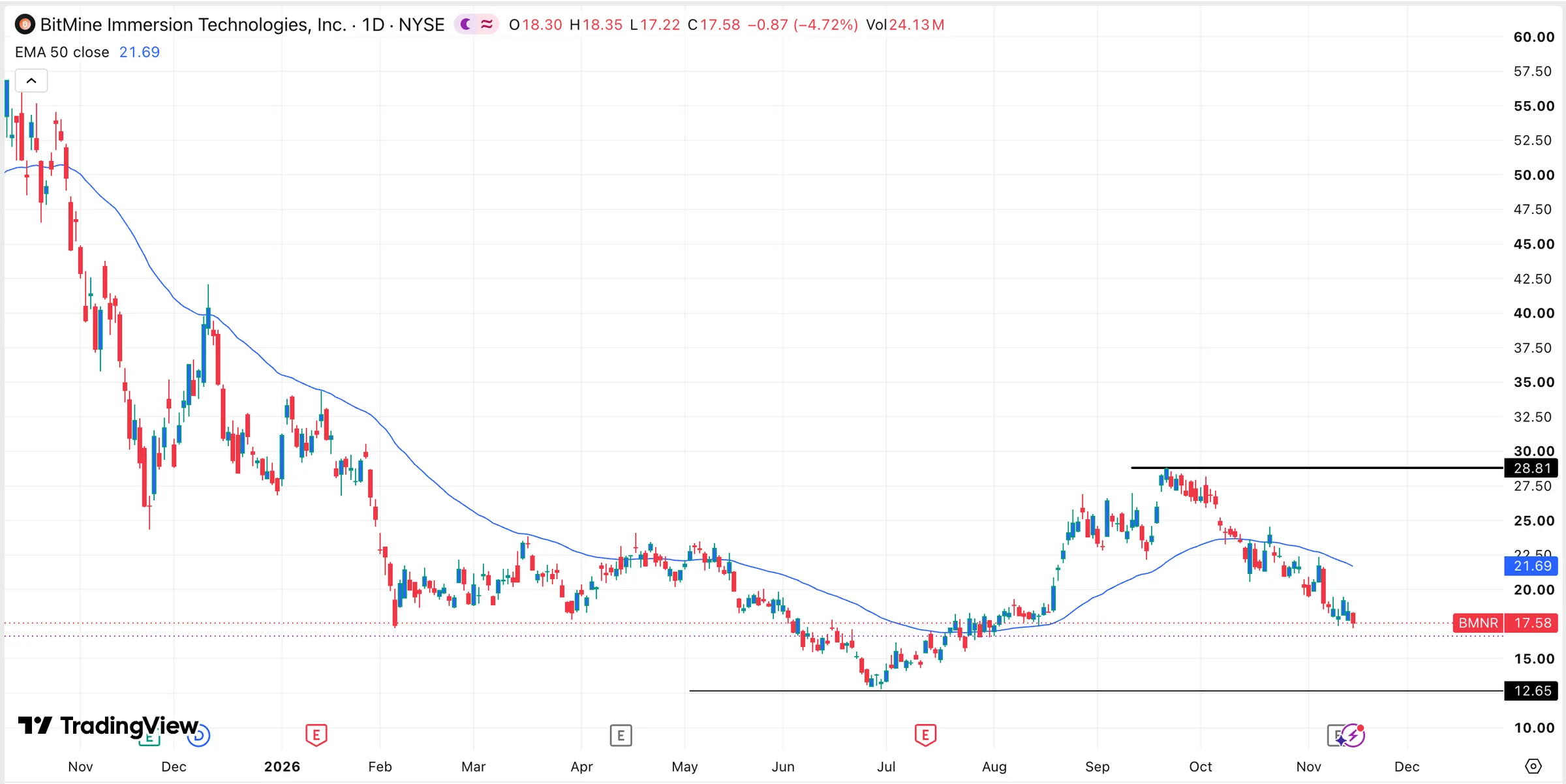
BitMine Immersion Technologies (BMNR) extended its downward trend last week as Ethereum faced renewed selling pressure, with liquidations climbing throughout the plunge. Liquidations occur when exchanges automatically close leveraged positions once losses exceed a trader's posted margin. Shares of the company closed at $17.58 on Nov. 13, down 4.72% from the prior session, according to historical trading data. The decline followed a broader cryptocurrency selloff that pushed Ethereum toward $1,800 during weekend trading. Meanwhile, U.S. spot Ethereum exchange-traded funds (ETFs) recorded $764.1 million in net outflows for November through Nov. 13, and falling ETH prices have placed additional pressure on BitMine's substantial cryptocurrency treasury.
BitMine's Ethereum Holdings Lose Value
Tom Lee's BitMine has become the biggest Ethereum holder in the world, with more than 6 million coins in its portfolio. Its holdings are now equivalent to 4.96% of all Ethereum in circulation.
The company benefits when ETH is rising, since higher prices typically increase the value of its holdings and support its staking revenue, the income earned by committing tokens to help validate transactions on Ethereum's proof-of-stake network. Recently, however, the firm has faced major headwinds as Ethereum continues a strong downtrend. ETH dropped from the September high of $2,800 to $1,800 during the weekend, a retreat that mirrored the performance of other major coins, including Bitcoin, XRP and Solana.
Ethereum's fundamentals have continued to worsen this month. Data shows that spot Ethereum ETFs have shed more than $764 million in assets so far in November, a net figure that reflects withdrawals exceeding new inflows. If the current pace continues, there is a likelihood that outflows will exceed the $1.6 billion lost last month.
A similar trend is visible in the futures market, where open interest, the combined value of derivative positions still open on exchanges, has continued to fall. CoinGlass data shows open interest has dropped to $21 billion from the September high of $36 billion — a sign that demand in the highly active futures market has continued to decline. Ethereum's liquidations have jumped as well, putting more pressure on the coin.
Culper Research Warned About Ethereum
These developments have accelerated after recent events at Nvidia that pushed Jensen Huang to resign. A report published by Culper Research in March warned about Ethereum's future after the Fusaka upgrade, a planned update to Ethereum's protocol.
The firm warned that Ethereum's transaction count was largely made up of address poisoning — in other words, the researchers alleged that most of these transactions and other on-chain metrics were not real. Address poisoning is a scheme in which scammers send transactions from copycat wallet addresses, leaving entries that inflate raw activity counts without representing genuine economic use. The number of active addresses has indeed jumped to 593,000 this year, up from 459,000 last year.
The researchers also cautioned that the Fusaka upgrade would lead to lower fees for the network, which in turn would reduce staking rewards and potentially drive higher inflation. Data compiled by DeFi Llama shows the network's fees dropped to $153 million this year from $523 million last year. Ethereum will need to generate more than $370 million over the remainder of the year to match its prior-year total.
These developments indicate that Ethereum's fundamentals have continued to decelerate. Data also shows the network is no longer the market leader by transaction count in the decentralized exchange (DEX) industry, where token swaps settle directly on blockchain networks; most transactions now take place on Hyperliquid Chain and Solana. Against that backdrop, the original analysis concluded there is a likelihood that BitMine stock will continue falling, because the fundamentals Tom Lee has consistently cited have not worked out.
BitMine Stock Price Analysis: Can BMNR Hold $15?
BitMine stock closed Nov. 13 at $17.58, compared with $18.45 in the previous session. The shares reached an intraday low of $17.22 before finishing the trading day lower. BMNR has also declined from $21.73 on Nov. 4, reflecting weakness over the preceding sessions.
The original technical analysis identified $15 as a possible downside reference. A sustained decline toward that level would extend the recent downward trend, and further weakness could bring the June trading lows into focus. However, the proposed $12.65 target requires confirmation against the original chart; historical market records placed the June 30 low near $12.80.
On the upside, the $18–$19 region represents recent trading territory that buyers would have to reclaim.
Ethereum's direction remains relevant because BitMine's treasury holds millions of ETH. Even so, BMNR shares also respond to company-specific financing, shareholder expectations, treasury management and broader equity-market conditions.
The next trading sessions will show whether BMNR stabilizes after Friday's decline. Fresh company disclosures will also clarify any additional Ethereum purchases.
This article provides market information, not investment advice. Cryptocurrency and equity investments carry substantial volatility and the potential for capital losses. Readers should consult a qualified financial professional before making investment decisions.
This article is based on a report originally published on The Market Periodical.

