BitMEX to Shut Down in September 2026 as Market Share, Legal History and Insurance Fund Questions Weigh on Exchange
Key Takeaways
- •BitMEX will shut down all operations on September 23, 2026, after pioneering the perpetual swap in 2014 and helping establish crypto derivatives as a major asset class.
- •The exchange's market share fell from 0.9% in August 2023 to below 0.01% recently, with daily volume of roughly $400,000, as trading activity concentrated on larger competitors.
- •BitMEX failed to secure a buyer despite seeking one since February 2025, with analysts attributing the difficulty partly to a large insurance fund valued at nearly $270 million that made the business unattractive to acquirers.
- •A class-action lawsuit filed the day after the shutdown announcement alleges BitMEX deliberately funneled forced liquidation proceeds into its insurance fund, with plaintiffs seeking approximately 623 BTC in restitution.
- •Neither BitMEX nor co-founder Arthur Hayes has disclosed what will happen to the insurance fund after the exchange closes, leaving the fate of approximately $270 million unresolved.
BitMEX, once one of the most influential venues in crypto derivatives trading, is preparing to shut down. The exchange, widely credited with inventing the perpetual swap, said it will close its operations on September 23, 2026, at 04:00:00 UTC.
The company has described the closure as a business decision following a review, but several factors appear to have contributed to the outcome. BitMEX lost the derivatives market it helped create, failed to secure a sale, and retained a large insurance fund that analysts say may have complicated any transaction.
BitMEX Lost the Market It Helped Build
BitMEX launched in 2014 and became known for the perpetual swap, a derivatives contract that does not expire. The product became a core part of crypto trading, and rival exchanges later adopted similar structures. Perpetual swaps are now the dominant instrument in crypto derivatives, accounting for the overwhelming majority of volume across centralized venues.
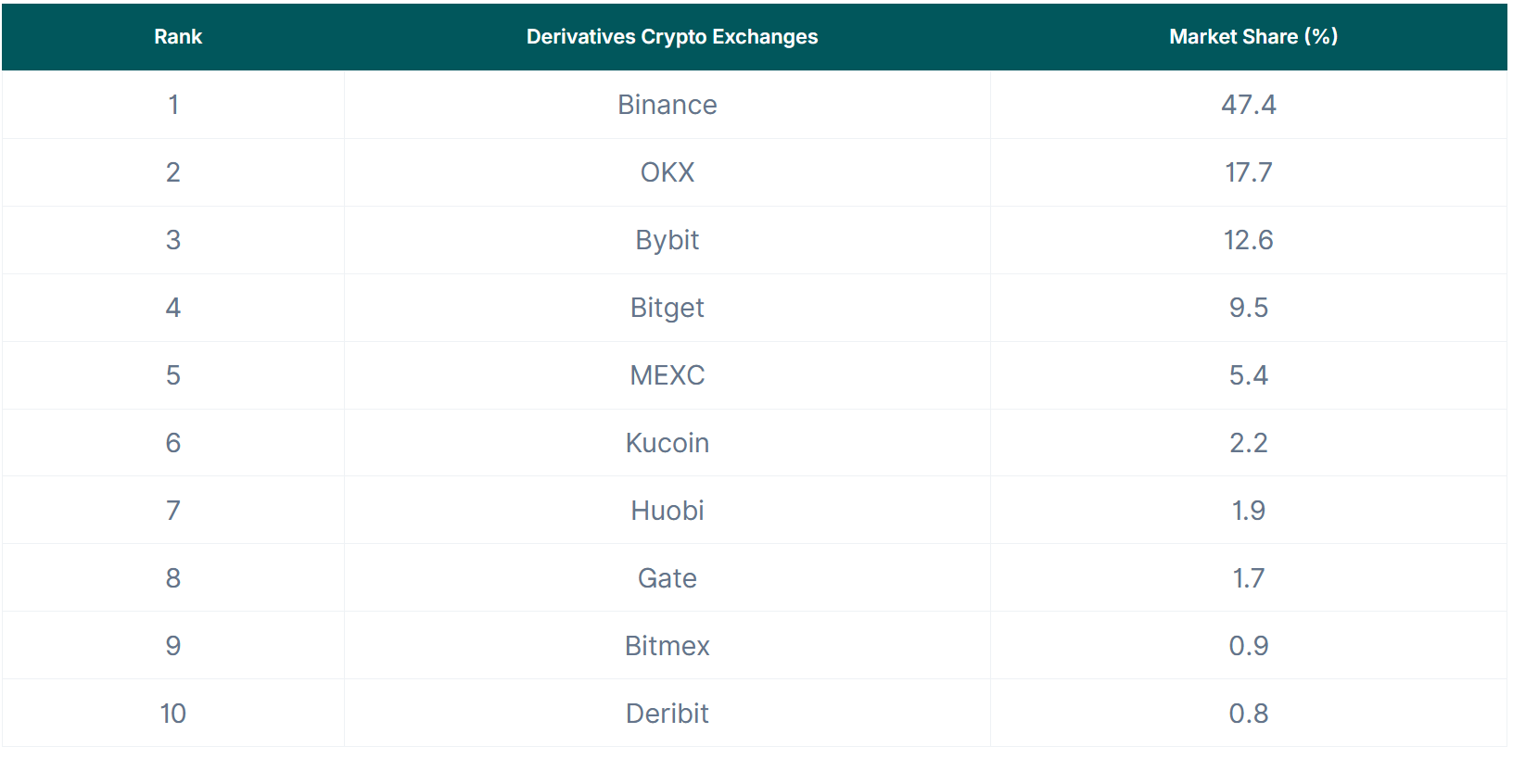
For several years, BitMEX was a leading venue for leveraged crypto trading. That position eroded as larger competitors captured liquidity. By August 2023, CoinGecko data ranked BitMEX ninth among derivatives exchanges, with 0.9% of trading volume. Binance held 47.4% at the time.
The decline continued. This month, market data provider Kaiko put BitMEX's market share below 0.01%, with daily volume of about $400,000, according to Reuters. As trading activity concentrated on larger venues, BitMEX lost the network effect that is central to derivatives markets, where traders typically follow liquidity.
BitMEX Could Not Complete a Sale
A weakened exchange can sometimes preserve value through a sale, but BitMEX did not reach a deal.
Crypto researcher Hasu has reportedly followed the company since 2018 and said BitMEX began seeking a buyer in February 2025. No transaction was completed. During the same period, rival exchanges continued to raise capital from major financial institutions.
Bitmex shutting down is truly an end of an era — but it had a very long, and sadly predictable windup. The story of why this shutdown happens, instead of an orderly sale that would preserve a storied brand and the jobs of probably dozens of employees, was seeded years ago. It… — Hasu⚡️🤖 (@hasufl) July 24, 2026
BitMEX's legal history also weighed on the business. In 2020, US regulators charged BitMEX and its founders over weak anti-money laundering controls. The case was among the earliest high-profile enforcement actions targeting a major crypto exchange and signaled a shift toward stricter oversight of offshore derivatives venues serving US users. The four defendants initially fought the case and later pleaded guilty. They paid fines and avoided prison.
The legal costs continued. In 2021, BitMEX reached a $100 million settlement with two US regulators. In January 2025, the exchange paid another $100 million in criminal fines and received two years of probation. President Donald Trump pardoned the founders in March. BitMEX announced its September shutdown this week.
Dear BitMEX Users, Today, we share with a very heavy heart that BitMEX exchange will shut down its operations, effective 23 September 2026 at 04:00:00 UTC. The owner and operator of BitMEX, HDR Global Trading Limited, has made the difficult decision to close operations… pic.twitter.com/oWuqlh547f — BitMEX (@BitMEX) July 23, 2026
A $270 Million Insurance Fund Became a Central Issue
Another major factor is BitMEX's insurance fund. Leveraged trading venues maintain such funds to cover losses when a liquidated position cannot fully pay what it owes. During active markets, these funds can grow from residual balances left after liquidations.
BitMEX built one of the largest insurance funds in the sector. On-chain data showed the fund peaked near 37,795 Bitcoin (BTC) in October 2021. Today, it holds about 3,694 BTC and roughly $30.8 million in Tether (USDT), a stablecoin. That is about 90% below the peak.
BitMEX deliberately reduced the fund in November 2025. Even after the reduction, it still maintained more coverage than some larger rivals. Its cushion covered 0.88 times open bets, while Binance's covered 0.11 times.
The fund was not under immediate stress. On October 10, crypto markets saw their largest liquidation event on record, with traders losing $19.35 billion through forced sales.
So, the real question is. Was it @BitMEX that blew up during 10/10? — Killa (@KillaXBT) July 23, 2026
BitMEX was only lightly affected. Its own report showed $38.5 million of those liquidations on its books, while the insurance fund declined by only about $2 million.
That left a large fund inside an exchange preparing to close. Analysts have valued the remaining fund at nearly $270 million, raising questions about why so much capital remained tied to a business with little trading activity.
This deal has been marketed all over Wall Street, and no one was willing to pay a premium to the insurance fund for the business – hence the move here 🙂 Logic wins again!! — Thomas Braziel (@Bkclaims) July 24, 2026
Hasu, like Martin, has argued that the fund made BitMEX difficult to sell. Hasu said he warned about the design in 2018.
“It started as the golden goose, and then became the noose,” the researcher wrote.
There are competing views. BitMEX has framed the shutdown as a business decision. On-chain, the insurance fund has not moved since the closure announcement. Binance founder Changpeng Zhao, known as CZ, pointed instead to years of pressure from the United States.
Sad to see BitMex go. Some thoughts: BitMex pioneered 100x perps in crypto back in 2014. Delivery futures existed before then, making Fridays hectic. BTC deposits only, one chain only, withdrawals only once per day, through a multi-sig wallet. The constraints that seemed… — CZ 🔶 BNB (@cz_binance) July 23, 2026
Lawsuit Adds New Questions Around Liquidations
A lawsuit was filed the day after the shutdown announcement. Two former users alleged that BitMEX took funds from their forced liquidations and directed them into the insurance fund. They are seeking about 623 BTC returned in Bitcoin rather than in dollars.
The plaintiffs pointed to a March 2020 outage, when users were locked out for 25 minutes while $800 million in positions were liquidated.
“BitMEX announces it's shutting down on Sept 23… then the NEXT DAY a proposed class action lands alleging the exchange deliberately designed its platform to FORCE LIQUIDATE customers and seize their bitcoin. Coincidence?” posed Ariel Givner, IP & corporate attorney in FinTech.
Industry Pressure Extends Beyond BitMEX
BitMEX did not collapse in the manner of FTX, the exchange that failed in 2022. It is closing while it says it still has the funds to pay users. That distinction matters in an industry where several high-profile exchanges have halted operations abruptly, leaving creditors to pursue recovery through bankruptcy or litigation. Even so, BitMEX's exit highlights pressure on smaller derivatives platforms.
Crypto derivatives trading has continued to concentrate among a small number of large venues. In 2023, the top three platforms already accounted for about 78% of trades, and the gap has widened since then. Smaller exchanges face greater pressure when they offer high leverage, hold limited spare capital, carry legal liabilities, or operate multiple business lines.
A growing share of perpetual futures trading is also moving on-chain. The top on-chain perpetual futures venues cleared trillions of dollars last year. That market brings its own risks. TRM Labs reported 207 hacks and about $972 million stolen in early 2026. During the October 10 crash, Hyperliquid alone recorded $10.31 billion in liquidations.
Regulated competitors are also entering the market. Kalshi launched the first US perpetual futures in May. Kraken added its own product in June. Coinbase began offering its version a year earlier. The arrival of US-regulated perpetuals marks a structural shift, giving institutional and retail traders access to the product through entities subject to domestic oversight.
One unresolved issue is what happens to the nearly $270 million insurance fund after September. Neither BitMEX nor Arthur Hayes has publicly said where it will go.
Thank you to my partners, my BitMEX employees, and most importantly our clients. It was an amazing ride. We did something special together. And I'm so proud of what we created and that we will shutdown responsibly on our own terms. Fuck TradFi, Fuck the Banks, Fuck the man.… — Arthur Hayes (@CryptoHayes) July 23, 2026
The lawsuit may force further answers about the fund and its treatment after the exchange closes.

