BMEX Price Plunges 90% After BitMEX Announces September Shutdown
Key Takeaways
- •BitMEX will officially shut down on September 23, 2026, requiring all users to settle or withdraw open positions and balances before the closure date.
- •The exchange's native BMEX token crashed nearly 90% following the shutdown announcement and now trades roughly 98% below its price from one year ago.
- •BitMEX launched the first perpetual swap in 2016, a derivatives product that now accounts for the majority of crypto trading volume, but the exchange was unable to maintain its first-mover advantage.
- •US authorities charged BitMEX in 2020, leading to a $100 million settlement with the CFTC and FinCEN and a guilty plea from founder Arthur Hayes for anti-money-laundering violations.
- •At the time of its closure announcement, BitMEX processed approximately $84 million in daily Bitcoin futures volume, representing only 0.08% of the total market.
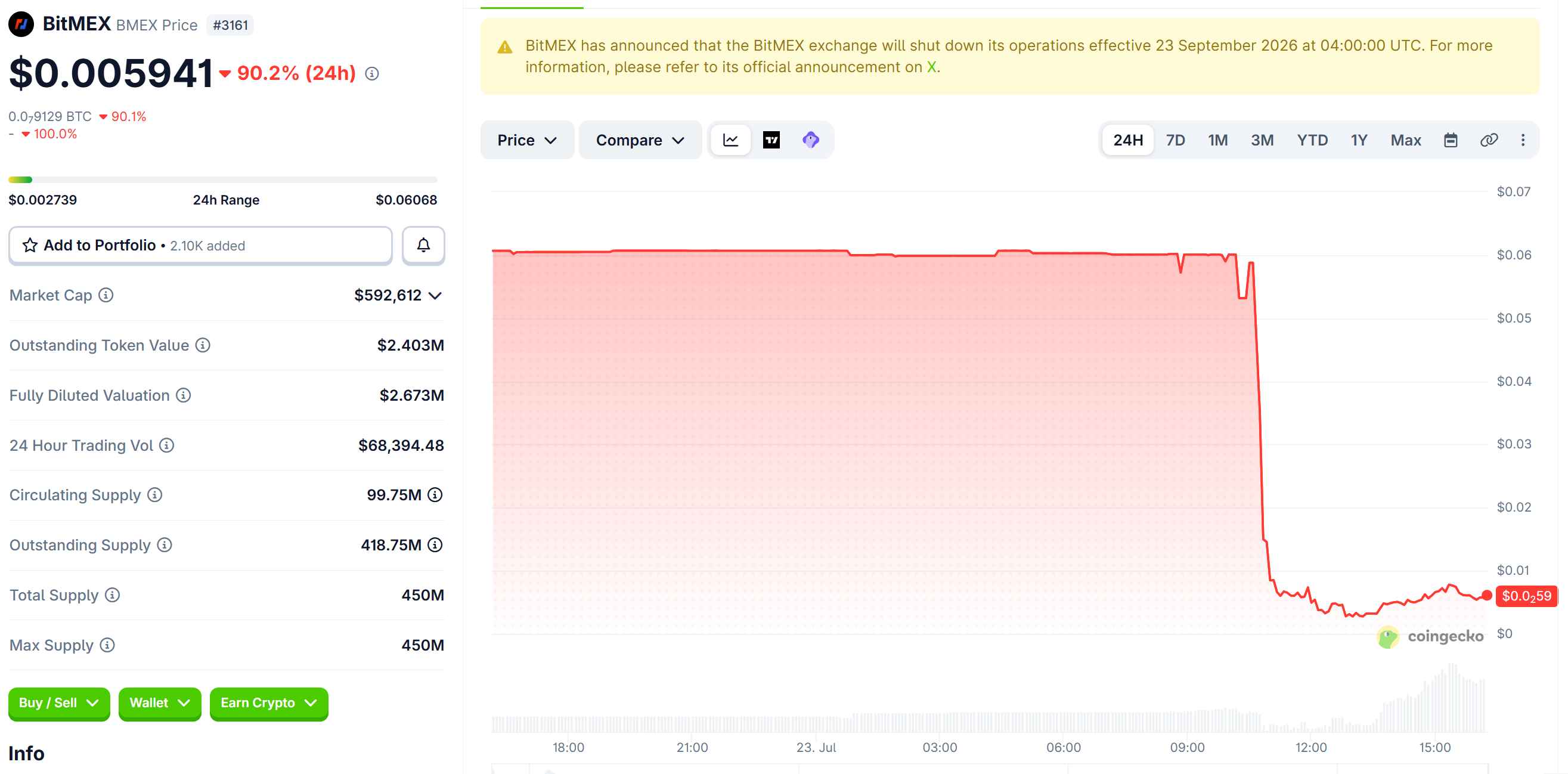
BitMEX is shutting down, and its native token has collapsed in tandem. The BMEX price fell nearly 90% in a single day after the exchange confirmed a September 23 closure date. The token currently trades near $0.0068, with its entire market capitalization at approximately $680,000.
Exchange Token Collapses as Platform Winds Down
Exchange tokens depend on their underlying platforms for utility and value. BMEX is a textbook case — and a stark reminder of the structural risk inherent in tokens whose value derives entirely from a single platform's operations.
Major exchange tokens like Binance's BNB and OKX's OKB command multibillion-dollar valuations because their platforms remain active and continue expanding utility. BMEX never approached that scale, and its collapse illustrates what happens when the underlying business disappears: the token's raison d'être vanishes with it.
BitMEX introduced the token in 2022, offering holders who staked it reduced trading fees along with other benefits. Those advantages are only relevant while the exchange remains operational. Once BitMEX confirmed its shutdown, the token's core utility effectively disappeared.
BMEX now trades roughly 98% below its price from one year ago. The token reached a record low near $0.0033 on Thursday before recovering slightly.
For BitMEX users, the September 23 closure means all open positions and balances must be settled or withdrawn before the deadline.
Rivals Positioned to Capture Market Share
BitMEX fundamentally transformed cryptocurrency trading. In 2016, the exchange launched the first perpetual swap — a derivatives contract with no expiration date.
The product proved immensely popular. Traders could hold positions indefinitely, with leverage of up to 100x, amplifying both gains and losses.
Competitors quickly replicated the design. Perpetual contracts now account for the majority of crypto trading volume. However, BitMEX was unable to maintain its first-mover advantage.
Regulatory pressure compounded the exchange's decline. US authorities charged BitMEX in 2020. The following year, the exchange paid $100 million to the CFTC and FinCEN over inadequate compliance controls. Founder Arthur Hayes pleaded guilty to violating US anti-money-laundering regulations.
While BitMEX navigated the regulatory fallout, competitors surged ahead.
"BitMEX pioneered the perpetual swap and became the world's #1 crypto exchange. Used by millions, it inspired the exchanges that followed — including Bybit. Regulators came for them, but the product outlived the backlash. Today perps are the beating heart of crypto, going legal in more countries every year (EU, Dubai VARA, HK, and more). End of an era. Respect to the legends who built it," said Ben Zhou, co-founder and CEO of Bybit.
The competitive landscape is now well defined. Binance leads perpetual futures trading by volume, with OKX and Bybit following closely. Deribit dominates the crypto options market.
On-chain trading venues are also growing rapidly. Hyperliquid leads perpetual DEX trading volume. dYdX continues to attract institutional traders to decentralized markets.
BitMEX had already diminished to a marginal presence. According to CryptoQuant CEO Ki Young Ju, the exchange processed approximately $84 million in Bitcoin (BTC) futures volume in a single day, representing about 0.08% of the total market.
BitMEX recorded $84M in BTC futures volume yesterday, representing 0.08% of the market. It was a great exchange that helped shape the industry, and now it is passing the torch to the next generation of exchanges it inspired. pic.twitter.com/sbL9SSWGmf — Ki Young Ju (@ki_young_ju) July 23, 2026
BitMEX's former traders will now need to migrate to other platforms. The distribution of that user base will ultimately reveal which exchanges have captured the market that BitMEX originally built.