BitMart to Wind Down Trading Platform as Exchange Closures Accelerate in 2026
Key Takeaways
- •BitMart suspended new registrations, deposits and new trading orders on July 26 and plans to stop all trading services on August 26.
- •The exchange said its decision followed a review of operating conditions, market environment and future strategic direction, without disclosing asset shortages or liquidity problems.
- •Users may still be able to withdraw after August 26, but requests could face extra procedures, documentation requirements and processing delays.
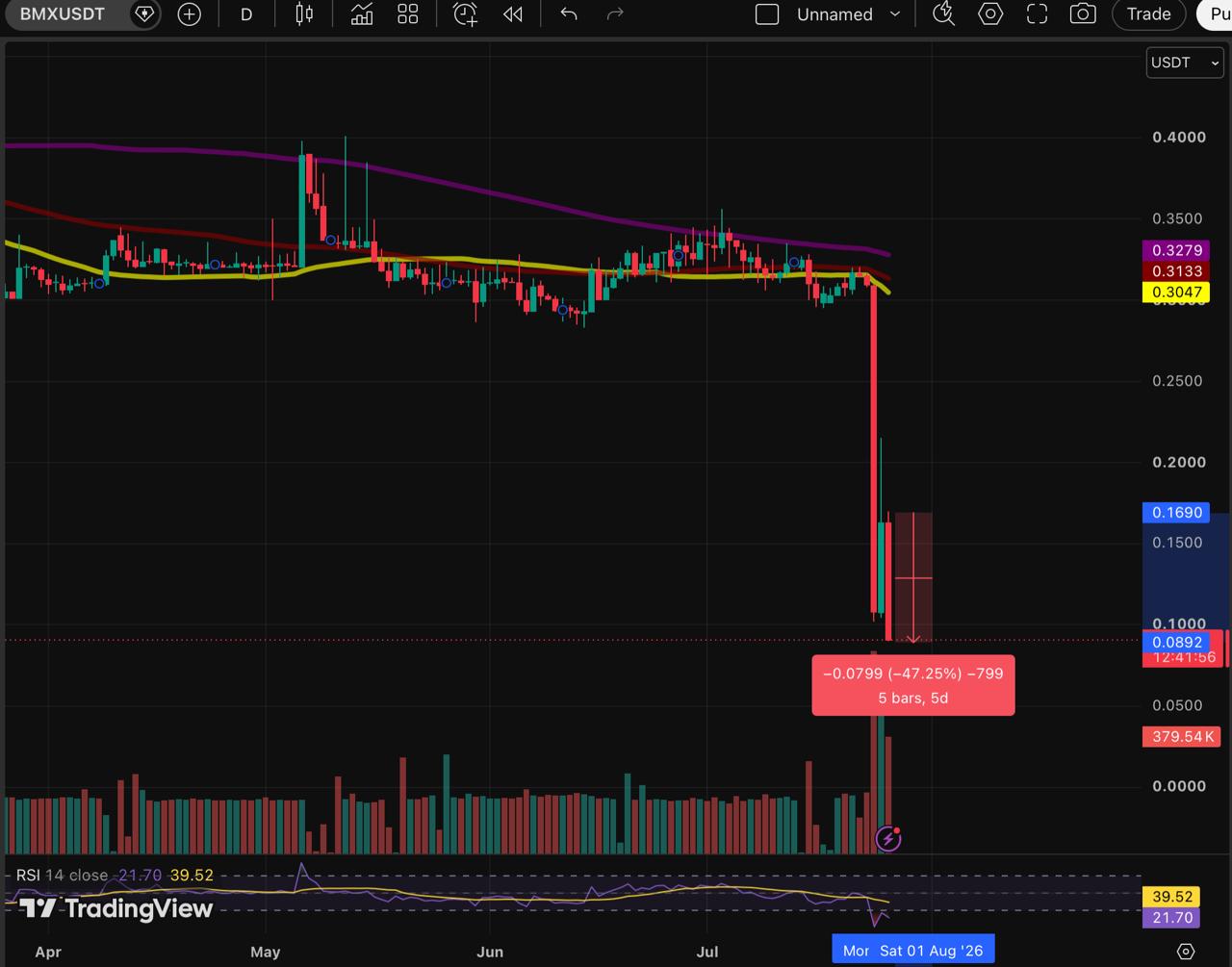
- •BMX dropped roughly 47% after the closure announcement as the token’s exchange-based benefits, including fee discounts, lose relevance when trading ends.
- •Former Global CEO Nenter Chow said he was terminated two days before the closure notice and was not consulted or informed before the announcement.
BitMart will wind down its trading platform after suspending new registrations, deposits and new trading orders on July 26 at 01:30 UTC, according to the exchange’s official closure announcement. All trading services are scheduled to end on August 26 at 01:00 UTC, and the platform plans to cease operations completely on January 31, 2027.
The exchange said the decision followed a review of its operating conditions, market environment and future strategic direction. BitMart did not disclose revenue figures, liquidity problems or any shortage of customer assets.
Even when a wind-down is orderly, an active marketplace becomes a deadline-driven withdrawal operation. Products and tokens built around the exchange can also lose their practical role while the platform remains online.
Important Notice
After a careful evaluation of the Company’s operating conditions, market environment, and future strategic direction, BitMart has made the difficult decision to commence an orderly wind-down of its trading platform operations. We deeply regret having to make… pic.twitter.com/KX3zczIrAh
— BitMart (@BitMartExchange) July 26, 2026
The operational deadline arrives before January 2027
BitMart’s formal closure date is months away, but the more immediate date for active users is August 26, when the exchange will stop spot, futures and other trading services.
Futures accounts are entering reduce-only mode, new spot orders are no longer being accepted, and automated products including copy trading, grid trading and API trading are being discontinued. Any derivatives positions that remain open when trading ends may be settled using the applicable mark price, index price or settlement rules.
That means traders lose control over the timing of their exit in August, five months before the platform is scheduled to shut down entirely.
BitMart has recommended that users close positions, complete any necessary identity verification and submit withdrawal requests before August 26. Withdrawals are expected to remain available after that date, but requests may be moved into a separate processing procedure and could require additional documentation.
Users who wait may face heavier withdrawal traffic, longer compliance checks or slower responses from a support team handling unusually high request volumes. Operational congestion alone can make access to funds slower and more complicated.
The same deadline matters for users and firms that relied on BitMart for automated execution, pricing or liquidity access, because API trading and order entry are being switched off before the final corporate shutdown date.
BMX loses the exchange utility behind it
BitMart’s native BMX token fell roughly 47% after the announcement, according to the supplied daily chart. The sell-off pushed BMX below all three displayed moving averages. The 50-day SMA was near $0.30, the 100-day around $0.31 and the 200-day near $0.327. In the chart snapshot, BMX was trading around $0.0892, far below the range it occupied before the closure became public.
The decline reflects a change in the token’s function. According to BitMart’s official description of BMX, the token was designed around exchange-specific benefits, including discounted trading fees. BitMart also planned to use part of its profits to repurchase and burn BMX.
Both mechanisms depend on an operating exchange. Trading discounts lose their function when trading ends, while a buyback programme tied to company profits becomes less relevant when the underlying business is being closed.
BMX will continue to exist as an ERC-20 token after BitMart closes. The wind-down notice, however, assigns no future purpose to the token and says nothing about future buybacks, remaining exchange benefits or other BMX-related programmes.
For any token whose main use is internal platform access, that distinction is central: the blockchain asset can remain transferable even after the service that gave it practical benefits disappears.
An exchange token is not a share
Exchange tokens may offer fee discounts, staking rewards, access to launches or other benefits funded by platform revenue. Those features tie their usefulness closely to the activity and growth of the issuing exchange.
Company ownership is separate. Based on BitMart’s published utility description, holding BMX gives its owner no direct claim on BitMart’s cash, customer base, technology or remaining assets during the wind-down.
Token holders may benefit when trading activity and exchange revenue expand, but they do not hold the legal protections or residual claims available to shareholders if the business closes.
BitMart’s decision came only days after BitMEX published a separate closure timetable, with trading scheduled to end in September 2026. A similar dynamic appeared there: BMEX fell 92% while Bitcoin open interest on BitMEX had declined 96% from its 2024 peak, showing that both the token’s utility and the exchange’s trading relevance had already weakened sharply.
BitMEX is also facing a proposed lawsuit involving allegations of theft and insider trading. The complaint arrived during the shutdown period, although the available evidence does not establish that it caused the exchange’s decision to close.
How crypto exchanges leave the market
Failed and discontinued crypto exchanges are often grouped into one broad category, but the reasons for their exits differ substantially.
Security failures occur when assets are stolen through an external breach or internal compromise. BitGrail closed in 2018 after a large Nano theft, while Cryptopia was hacked in January 2019 and entered liquidation four months later.
Insolvency occurs when an exchange cannot meet its obligations. Mt. Gox stopped operating in 2014 after a major theft contributed to its collapse.
Fraud involves deliberate misuse of customer assets or company records. FTX collapsed in 2022 after customer deposits were misappropriated, leading to the conviction of founder Sam Bankman-Fried. Thodex ended in 2021, and BitConnect ended in 2018.
Regulatory shutdowns occur when authorities prevent a platform from continuing operations. BTC-e was seized by law enforcement in 2017 over its role in processing criminal funds.
Commercial exits occur when declining revenue, volume or strategic relevance makes continued operation unattractive. LocalBitcoins stopped active trading in 2023 after years of falling volume, and DMM Bitcoin transferred customer accounts and assets to SBI VC Trade in 2025.
Based on the information BitMart has disclosed, the exchange currently fits the commercial-exit category. It has announced an organized wind-down and kept withdrawals available.
Former Global CEO Nenter Chow added a detail that complicates that reading. In a statement posted to X, he said his employment was terminated on July 24, two days before the closure notice, and that he was neither consulted about nor informed of the decision. He said he learned of it when it became public and urged users to rely on BitMart’s official channels and act on the notice without delay.
I want to clarify my position regarding BitMart’s notice on 26 July 2026 concerning the orderly wind-down of its trading platform operations.
On 24 July 2026 I was informed that my employment as Global CEO was being terminated and that my offboarding would begin immediately. I…
— Nenter (@50Nent) July 26, 2026
BitMart has not publicly responded to Chow’s statement, which remains his own account. It does not establish a cause for the closure, although it places the decision above the level of the company’s chief executive and suggests ownership rather than management drove the timing.
That classification could change if new evidence emerges. In the absence of a detailed financial explanation, the precise commercial reason remains unknown, and speculation is not a substitute for disclosed facts.
BitMart’s eight-year run exceeded the sector median
BitMart was founded in 2017 and began developing its trading business in 2018. By July 2025, the company said it had served more than 10 million users across more than 200 countries and regions. One year later, it is leaving the market.
Eight years of operation placed BitMart in the upper quarter of the industry’s survival record. Across 33 notable exchange closures since 2012, the median lifespan is four years.
Fourteen of the 33 exchanges, or 42%, closed within three years. Bitcoinica and Altsbit lasted less than twelve months. Six lasted exactly two years, including TradeHill, Bitfloor and FCoin. Only eight, or 24%, reached eight years or more. Four survived for a decade: LocalBitcoins, KUNA, Zondacrypto and BitMEX.
The year 2026 has already produced more closures in that set than any previous year. Zondacrypto, Bitcom, AscendEX, BitMEX and BitMart have all announced exits with the year barely half finished, compared with a previous high of four in 2019.
The 2026 group is also unusually old. Its five members averaged more than nine years of operation, compared with the four-year median. Two of them, Zondacrypto and BitMEX, are tied for the longest-running exchanges on the list at twelve years each. This year’s exits are clustered among established platforms.
The list combines different causes as well as different durations. It includes Mt. Gox’s insolvency, BitConnect’s fraud and LocalBitcoins’ voluntary wind-down, and lifespan alone cannot distinguish among them. Surviving ten years did not guarantee survival into an eleventh.
An exchange remains an operating company regardless of age. It requires recurring trading activity, sufficient fee revenue, banking access, secure custody, regulatory permission, competent management and enough customer trust to keep assets and orders on the platform. A company can continue processing trades while several of those foundations deteriorate, and users may see the formal closure notice only after management has spent months assessing whether the business remains viable.
User exit process before the deadline
BitMart’s timetable gives users more warning than an abrupt withdrawal freeze or bankruptcy filing. FTX showed the cost of the opposite outcome. It collapsed in November 2022, creditor repayments began only in February 2025, and the estate is still running distributions in 2026. Those creditors are repaid against claim values fixed at November 2022 prices, so receiving more than 100% of a claim still leaves a Bitcoin holder short of the coins deposited.
BitMart customers have been given time to close positions, redeem products, download records and transfer assets. Waiting until the final deadline remains the weakest available option.
The exchange warns that withdrawal requests may require identity checks, source-of-funds documentation, address verification, sanctions screening and Travel Rule reviews. Processing may also slow because of network conditions or a large number of simultaneous requests.
BitMart has separately warned users about scams offering paid priority withdrawals, account unfreezing or faster processing. The exchange says it will not request passwords, authentication codes, private keys or recovery phrases through private messages.
The practical process is administrative: review all spot balances and open derivatives positions; redeem eligible staking, lending and Earn products; complete required identity and security verification early; confirm the correct blockchain and destination address; download trading, deposit and withdrawal records; and use only BitMart’s official website and support channels.
Those steps do not require predicting whether BMX will recover or whether BitMart could reverse its decision. They reduce dependence on systems that are being progressively switched off.
The meaning of “not your keys”
The phrase “not your keys, not your coins” is sometimes used as a broad rejection of centralized services. Its more precise meaning is narrower: cryptocurrency held on an exchange depends on that exchange’s systems and willingness to process withdrawals.
A user holds an account balance and a claim against the platform. The exchange holds the private keys required to move the underlying blockchain assets.
Self-custody removes that continuing counterparty exposure, but it also requires personal responsibility for private keys, backups, addresses and transaction security.
BitMart’s closure shows why the distinction matters. Even during an orderly wind-down, users must follow the platform’s deadlines, pass its reviews and wait for it to approve and broadcast withdrawals. A user already holding assets in a self-controlled wallet does not depend on those processes.
BitMart may complete its wind-down cleanly and return every remaining balance. Even in that outcome, the BMX decline and the withdrawal timetable show how quickly the relationship changes once the company behind the market decides to leave it. The tokens survive on-chain. The route to them closes with the company.
Disclaimer: This article is for informational and analytical purposes only and does not constitute financial, investment or legal advice. Users should review BitMart’s official announcements and verify all withdrawal instructions through the exchange’s authorized channels.

