Bithumb Wins First-Instance Ruling in 194 Million Won Bitcoin Recovery Lawsuit
Key Takeaways
- •Bithumb, one of South Korea's largest cryptocurrency exchanges, prevailed in a first-instance court ruling in a 194 million won lawsuit seeking the recovery of Bitcoin.
- •The dispute concerned the recovery of a specific crypto asset held on an exchange, making it relevant to custody and ownership questions rather than Bitcoin's market price.
- •As a first-instance ruling, the decision reflects the trial court's view at this stage and does not provide the full reasoning behind any final judgment.
- •The losing side may pursue an appeal or further proceedings, so the dispute is not necessarily fully resolved.
- •Bithumb has previously faced legal and regulatory scrutiny, including attention over its CEO's reappointment amid a fine and an order book probe.
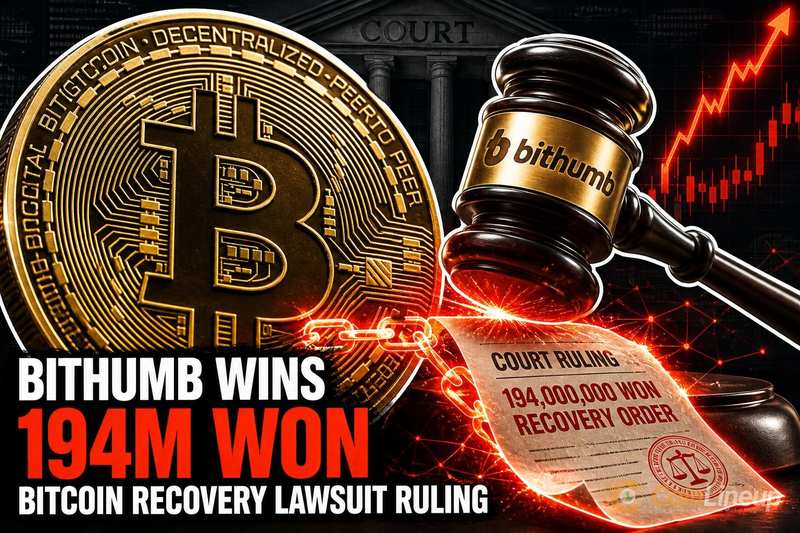
Bithumb, one of South Korea’s largest cryptocurrency exchanges, won a first-instance court ruling in a 194 million won Bitcoin recovery lawsuit. The court’s first-round decision went in the exchange’s favor in a dispute over the recovery of Bitcoin holdings.
A first-instance ruling is the initial judgment issued by a trial court before any appeal. In this case, that initial decision favored Bithumb. For related coverage, see Bitcoin Quantum-Resistant Mainnet Transaction Explained.
The dispute centered on the recovery of Bitcoin, not a general business disagreement. That distinction matters because the claim was tied directly to a specific crypto asset held on an exchange, which makes the case more relevant to custody and ownership questions than to Bitcoin’s market price. For related coverage, see Bitcoin and Gold ETFs Drew $7 Billion in 5 U.S. Trading Sessions.
What the ruling decided
The core outcome is straightforward: Bithumb was the winning party in a lawsuit valued at 194 million won that sought the recovery of Bitcoin.
Because this is a first-instance ruling, it reflects the trial court’s view of the case at this stage. It does not, by itself, provide the full reasoning behind any final judgment.
Bithumb has faced legal and regulatory scrutiny before. The exchange previously drew attention when its CEO sought reappointment amid a fine and an order book probe, so court outcomes involving the platform carry significance for its users. See Bithumb CEO Reappointment Controversy.
Why a Bitcoin recovery case matters
Recovery cases differ from ordinary price movements. They concern whether someone can legally reclaim a specific crypto asset, rather than whether that asset rises or falls in market value.
That legal angle is what makes this dispute notable. The 194 million won figure gives the case a concrete financial scale, separate from Bitcoin’s day-to-day market fluctuations. For market context, see Bitcoin and Bitcoin.
For anyone holding Bitcoin on an exchange, custody and recovery questions are practical issues, not abstract ones. Similar concerns appear in cases where weak wallet recovery phrases led to millions in crypto losses, showing how much the question of who controls the coins matters. See Weak Wallet Recovery Phrases Led to Crypto Losses.
What to watch next
A first-instance ruling is not always the end of a case. The losing side can often pursue an appeal or further proceedings, so the dispute may not be fully resolved.
Any next steps should be treated as possibilities, not confirmed outcomes. The available information covers only the first-round win, not what happens afterward.
For ordinary crypto holders, the takeaway is limited but relevant. A court has, for now, sided with the exchange in a recovery dispute, and how courts handle such cases may shape how similar claims are handled in future disputes involving exchange-held assets. As institutions continue moving self-custodied Bitcoin into regulated products, clarity on who can recover crypto assets remains important. See BlackRock Lowers Minimum for Moving Self-Custodied Bitcoin Into IBIT to $1 Million.
Disclaimer: This article is for informational purposes only and does not constitute financial or investment advice. Cryptocurrency and digital asset markets carry significant risk. Always do your own research before making decisions.
