Crypto X's Short-Squeeze Narrative Preceded 65% Drop in Bitfinex ETH Shorts
Key Takeaways
- •Several prominent Crypto X accounts highlighted on Sunday a roughly 13,000% two-week surge in Bitfinex ETH short positions, from around 771 ETH to more than 101,000 ETH, framing it as potential short-squeeze fuel.
- •The Bitfinex ETH/USD Shorts gauge subsequently dropped about 65%, from roughly 97,500 ETH to 34,000 ETH, within an incomplete daily candle.
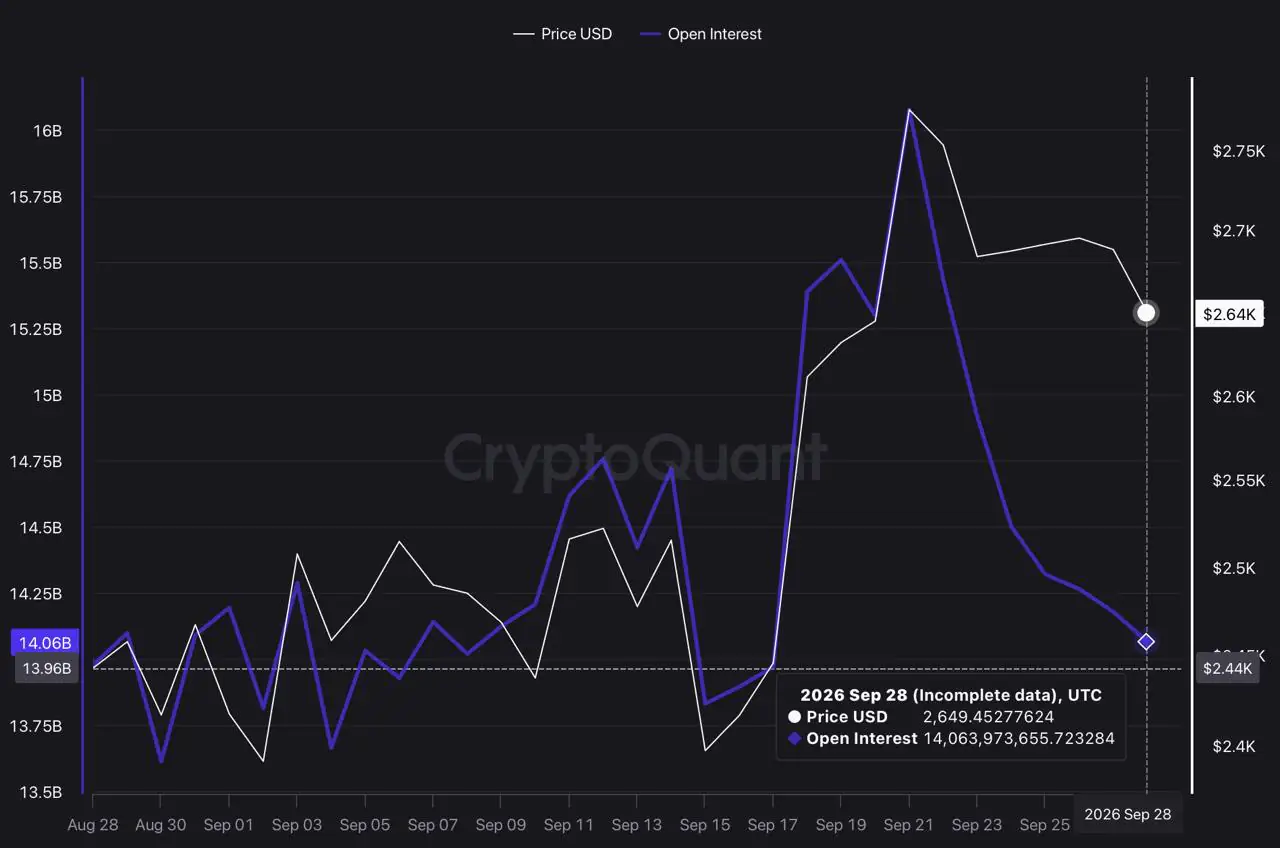
- •Aggregate ETH futures open interest had already fallen around 12.5%, from about $16.08 billion on September 21 to roughly $14.06 billion on September 28, before the social media posts circulated.
- •Ethereum traded near $2,650, down about 2.4% over 24 hours, amid renewed U.S.-Iran tensions, and the sharp Bitfinex shorts decline did not coincide with an ETH rally.
- •The peak Bitfinex short exposure of roughly 97,500 ETH equated to about $260 million, a small fraction of the roughly $14 billion in aggregate ETH futures open interest, and no evidence shows the posts caused the positioning changes.
Ethereum traders spent the weekend debating one question: did a wave of widely shared posts on Crypto X make some of them more willing to close ETH short positions? The charts confirm that positioning changed. What they cannot establish is why individual traders acted.
Crypto X turned positioning into a shared narrative
On Sunday, Crypto Goos, Crypto Rover and Coin Bureau each drew attention to elevated Ethereum shorts and the possibility of a squeeze.
🚨ALERT: ETH bears are going ALL IN on Bitfinex. ETH short positions have EXPLODED by roughly 13,000% in just TWO WEEKS, surging from around 771 ETH to over 101,000 ETH. That is an EXTREME buildup in bearish positioning, and it could become POWERFUL short-squeeze fuel if $ETH … pic.twitter.com/PXjX6R1jD1 — Coin Bureau (@coinbureau) September 27, 2026
The discussion centered on derivatives positioning. If ETH rose quickly, traders holding bearish positions could face mounting losses and might need to buy ETH to close their exposure — the basic mechanics of a short squeeze.
For a leveraged trader, seeing that argument repeated across several large accounts can alter risk management: a short may still appear reasonable, yet the potential cost of being caught in a rapid squeeze becomes harder to accept.
The broader open-interest decline started before Sunday
The timing limits any claim that Crypto X caused Ethereum's wider leverage reduction. Aggregate ETH futures open interest had already been falling from its September 21 peak before the Sunday posts circulated. CryptoQuant's chart shows open interest near $16.08 billion on September 21 and about $14.06 billion on September 28 — a reduction of roughly $2 billion, or around 12.5%, across the period.
Open measures the value of outstanding futures contracts. Each contract has both a long and a short side, so a falling total can reflect profit-taking, liquidations, position closures or capital moving elsewhere. It does not reveal which side initiated the change.
The two charts also describe different timelines. Aggregate ETH open interest began falling after its September 21 peak, while the Bitfinex ETH/USD Shorts gauge kept rising into September 27. That divergence helps explain why the short-squeeze narrative gained traction: bearish exposure was still building on one venue even as leverage across the broader ETH futures market was already being reduced. It does not show that all exchanges shared the same positioning. Bitfinex may have reflected a concentrated group of traders, while the aggregate open-interest figure combines long and short contracts across multiple venues.
Bitfinex shorts fell sharply after broader leverage had peaked
The sharper move appeared on the Bitfinex ETH/USD Shorts chart. The reading fell from roughly 97,500 ETH to 34,000 ETH — a decline of about 65% within an incomplete daily candle. That is a substantial change in short exposure on Bitfinex, but it does not measure total Ethereum short interest across the wider futures market.
For scale, roughly 97,500 ETH of short exposure equated to about $260 million at the prevailing price near $2,650 — a fraction of the roughly $14 billion in aggregate ETH futures open interest. A percentage move on a single venue can therefore look dramatic in a headline while remaining small next to the wider derivatives market.
The drop may reflect profit-taking after ETH's recent decline, lower leverage during a volatile session, or exchange-specific position changes. The gauge records the reduction in short exposure; it does not disclose the traders' reasoning.
ETH's pullback arrived during a wider risk-off session
ETH traded near $2,650 at the time of writing, down about 2.4% over 24 hours according to CoinMarketCap data. The daily chart shows ETH retreating from its recent high near $2,800.
The pullback came as renewed U.S.-Iran tensions lifted oil prices and unsettled risk-sensitive markets. Bitcoin also pulled back as traders reassessed the Hormuz situation.
The sharp Bitfinex reading did not coincide with an ETH rally. Ethereum fell alongside the wider market, leaving little evidence of a broad short squeeze in price action. The position change may instead reflect profit-taking, reduced leverage or exchange-specific activity during a volatile session.
What a viral positioning call can change
A well-known historical example comes from Elon Musk's posts about crypto. A 2023 study of his Twitter activity found links between crypto-related posts, abnormal short-term Bitcoin returns and trading volume. The signals it documents are short-horizon, however, leaving open whether viral posts shape slower shifts in derivatives positioning of the kind highlighted over the weekend. Musk's reach is exceptional, so the research provides context rather than a model for every influential crypto account.
The evidence supports a narrower conclusion
The Bitfinex ETH/USD Shorts gauge fell sharply after a short-squeeze narrative became widely shared across Crypto X. Aggregate ETH open interest, however, had already been declining from its September 21 peak, and Ethereum fell during Monday's broader risk-off session.
Crypto X may have changed how quickly some traders reconsidered bearish leverage. The evidence does not show that the posts moved ETH or caused the reduction in positions. Establishing that claim would require matching changes across several exchanges, including funding rates — the recurring payments between perpetual-futures traders that reveal whether longs or shorts are paying to hold their positions — short liquidations, broader short exposure and price behavior that clearly diverges from the rest of the market.
Until those signals line up, the charts remain a record of what changed in positioning, not proof of why traders acted.
This article is provided for informational purposes only and does not constitute financial or investment advice. Social-media posts, derivatives metrics and technical charts are interpretive tools, not guarantees of future market movement.

