Why a 5% US 30-Year Bond Yield Is a Red Alert for Crypto
Key Takeaways
- •The Japanese yen appreciated 2.9% against the US dollar during the final week of July 2026, its largest weekly gain since February, following two suspected interventions including a reported 8.45 trillion yen operation on Thursday.
- •The 30-year Treasury yield reached 5.275%, marking its highest monthly close since 2007, while the 2-year yield rose to 4.291% as traders priced approximately 65% odds on a September 16 Fed rate increase.
- •Three regional Fed presidents dissented on July 29 in favor of an immediate quarter-point rate hike, marking the first three-way split since September 2016.
- •Bitcoin declined 1.85% over the week, breaking below its $63,400 support level to trade at $62,980, with the sell-off coinciding with the yen's second surge and showing no crypto-specific catalyst.
- •US federal debt stands near $40 trillion with annual interest costs exceeding $1 trillion, and the Treasury signaled through the New York Fed that it may intervene in currency markets, asking banks to prepare for potential action.
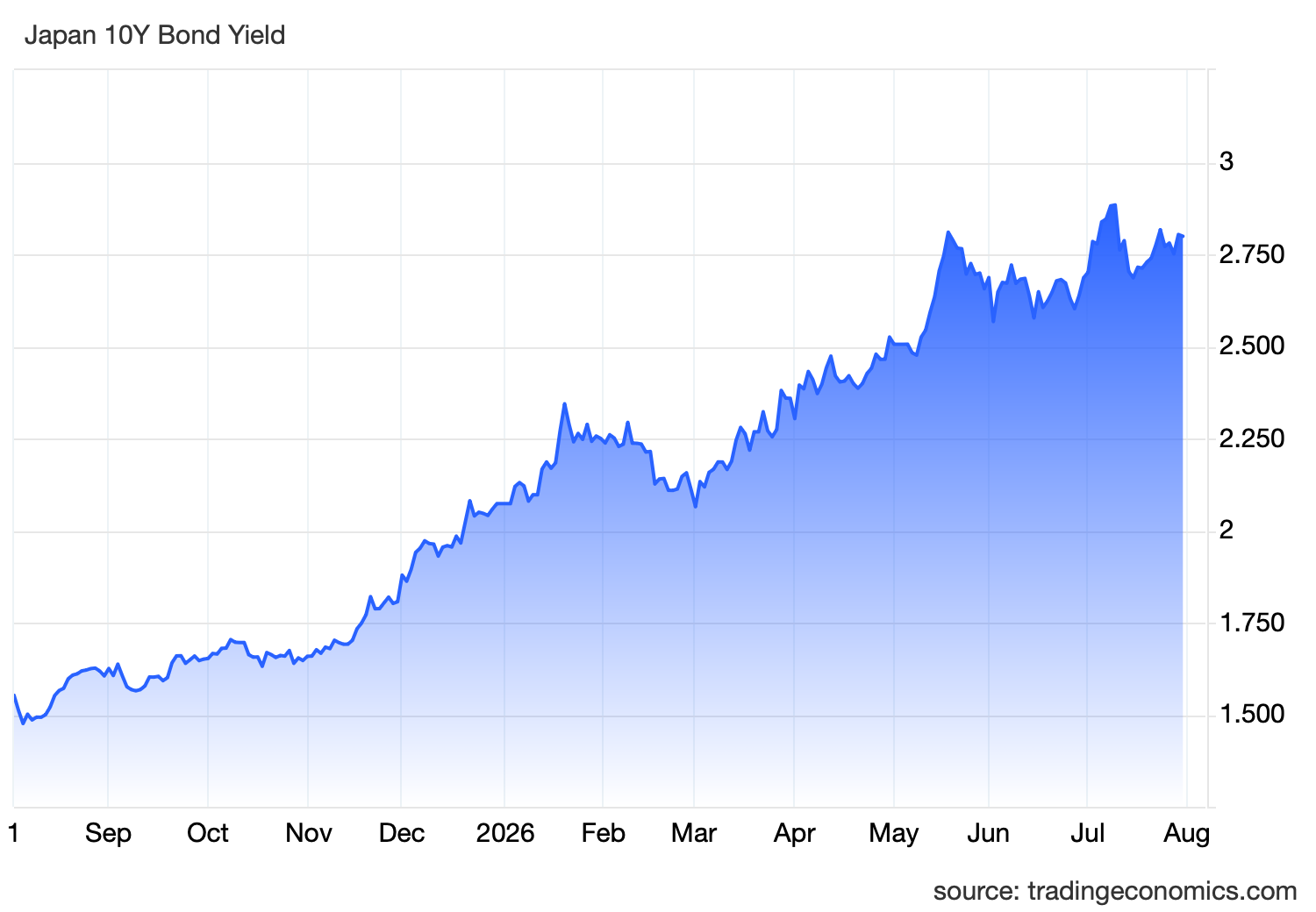
The final week of July 2026 was expected to be uneventful. The Federal Reserve held rates steady on July 29, and the Bank of Japan followed suit on July 31. The rate shock that might have squeezed leveraged positioning never materialized from either central bank. Instead, it arrived from the currency market—and from a bond market that spent the entire month of July repricing without waiting for official permission.
Bitcoin lost the $63,400 support level it had defended earlier in the session, trading at $62,980. The yen gained 2.91% over the week following two suspected interventions, squeezing yen-funded carry trades. The 30-year Treasury yield stood at 5.275%, heading toward its highest monthly close since 2007—a level last seen before the global financial crisis upended monetary policy for a decade and a half. And in an unprecedented break, three regional Fed presidents dissented on July 29 in favor of an immediate rate increase—the first such three-way split since September 2016.
The Yen Squeeze Was Live This Week
The carry trade did not remain theoretical. Across five trading sessions, the yen appreciated 2.9% against the US dollar—its largest weekly gain since February—delivered in two near-vertical moves.
On Thursday, Japanese authorities reportedly intervened to the tune of roughly 8.45 trillion yen, approximately $53 billion, ranking among the largest single-day currency actions on record. The operation pulled the yen off a four-decade low near 163.94. The Bank of Japan then held its policy rate at 1.0% on Friday morning, and the yen initially weakened back above 160. However, the US Treasury subsequently informed banks through the New York Fed that it may intervene and that institutions should "stand ready for future action." The yen then strengthened to 159.61.
Critically, both moves held. The yen closed the week at its strongest level rather than retracing, as single interventions typically do. When a funding currency appreciates 2.9% in one week, every yen-borrowed position becomes more expensive to repay. Traders closing those positions raise cash by selling their most liquid holdings. Bitcoin fell 1.85% over the same week, with a 2.68% decline in the final 24 hours coinciding with the yen's second surge.
While two markets moving in tandem across one window does not prove causation on its own, the pattern aligns precisely with what the carry-unwind mechanism predicts—and it appeared during the week that mechanism was most active.
Why Japan's Defense Reaches the Bond Market
Japan is the largest foreign holder of US government debt, which means a yen crisis can translate into a US borrowing-cost crisis through three distinct channels.
Forced selling: Defending the yen requires buying it, and Tokyo funds that partly by selling reserves that are weighted heavily toward US government bonds.
Carry unwind: Funds closing yen-borrowed positions sell assets to repay loans—the channel most likely to have reached crypto this week.
Repatriation: Japanese life insurers and pension funds have anchored demand for US long-duration debt for decades. With domestic yields at multi-year highs and another BOJ rate hike expected, holding low-yielding American paper increasingly makes little financial sense.
Thursday's reported operation likely ran through the first channel. Dollars on that scale come from reserves, and Japan's reserves are predominantly Treasuries.
What happens next depends on who acts. If Japan defends the yen alone, it sells more US debt to raise dollars, pushing yields higher. If Washington acts through its Exchange Stabilization Fund—the Treasury's emergency currency-intervention account established in the 1930s, which held roughly $217 billion at the end of June—Tokyo faces less pressure to liquidate, narrowing that supply channel. The last US intervention to support the yen came in 2011, a G7 coordinated action following the earthquake and tsunami.
American participation could produce a better outcome for crypto, but it carries an immediate cost. Coordinated intervention forces yen shorts to close rapidly, and a fast unwind generates turbulence across bonds and equities that reaches crypto first.
Yields Repricing All Month
The currency move landed on a market already absorbing the steepest long-end repricing in years.
The 30-year Treasury yield trades at 5.275%, and the monthly close will be the highest since 2007. It opened July at 4.955% and has added 32.4 basis points—a 6.5% move in four weeks, with the steepest portion arriving after the Fed's decision.
That rise stems from two separate mechanisms, and conflating them obscures what each signifies.
The 2-year yield trades at 4.291%, up 0.96% on the day and roughly 89 basis points above its early March level near 3.40%. The short end of the curve tracks Fed expectations, and it is rising because traders anticipate a hike. CME FedWatch places approximately 65% odds on a September 16 increase against 35% for another hold.
The long end responds to fiscal supply. Bloomberg's framing of the July 9 auction stated it directly: swelling bond supply is driving investors to demand higher returns. Those bonds cleared at 5.058%, the highest auction yield since 2007, though below pre-auction trading levels. Demand exceeded expectations at that price, describing a market finding a new equilibrium rather than one breaking down.
US federal debt runs near $40 trillion, annual interest costs have surpassed $1 trillion, and the deficit sits around $2 trillion per year. That is why the equilibrium keeps moving higher. Every basis point raises the cost of rolling existing debt and funding the next round.
The 10-year yield, which effectively sets mortgage rates rather than tracking the Fed's overnight rate, trades near 4.73% after sitting below 4% before the Iran energy shock. That is the figure reaching households, and it has moved further in proportional terms than the long bond.
The front end prices policy; the long end prices debt—both are rising together. A policy-driven move can reverse when inflation cools. A supply-driven move persists as long as governments keep borrowing.
What Rising Yields Do to a Non-Yield-Producing Asset
Bitcoin produces no yield. In an era of cheap money, that is a technical detail. At 5.275%, it becomes an allocation problem.
In cash terms, $100,000 invested in the 30-year bond now pays roughly $5,275 per year, guaranteed, for three decades. The same amount in Bitcoin pays nothing and is currently worth about half of its peak value. That comparison confronts every institution holding crypto through a mandate—and institutions are the holders who may be required to act on it rather than simply choosing to wait.
Every percentage point available on government debt increases what an investor forgoes by holding something that pays nothing. When the long bond sat near 0.7% in 2020, the comparison was academic. A guaranteed return above 5% over three decades competes directly with the argument crypto relies on during a drawdown: hold and wait.
The faster transmission channel is portfolio flow. Allocators rebalancing toward fixed income trim their riskiest positions, and crypto trades around the clock at the far end of the risk spectrum. This mechanism requires no Fed decision and no crypto-specific news—which is why a support level can break on a day when nothing happened in crypto itself.
The Support Broke as the Month Closed
Earlier on Friday, Bitcoin was holding a support confluence near $63,400, where the 0.236 Fibonacci retracement and the 50-day moving average sat within $200 of each other. The session low reached $63,546 before buyers pushed the price back up.
That defense has since failed. Price sits roughly $420 below the 50-day average, and the level that halted every pullback for a week is now overhead resistance rather than underlying support.
Nothing within crypto explains the move. The CoinMarketCap 20 index is down 2.4% over the same 24-hour window, and Bitcoin's weekly loss sits alongside a 1.20% decline across the broader basket. The catalysts were in Tokyo and the US debt market.
The Bond Vigilantes Are Back
Three regional Fed presidents dissented on July 29 in favor of an immediate quarter-point increase: Beth Hammack of Cleveland, Neel Kashkari of Minneapolis, and Lorie Logan of Dallas. Dissents are typically one voice, occasionally two. Three members breaking from the majority and all demanding the same action has not occurred since September 2016.
Chair Kevin Warsh, in the role since May 22, reiterated that the Fed would not hesitate to return inflation to 2% while declining to specify how or when. Inflation has run above target for more than five years and worsened following the Iran energy shock. Warsh acknowledged that parts of the business community now expect the target itself to be loosened.
Investors who sell bonds to impose discipline on a central bank earned a name in the 1980s. Ed Yardeni, who coined the term "bond vigilantes," described the current move as the market enforcing order because the Fed will not.
His conclusion runs against intuition. To bring long-term yields down, the Fed may need to raise short-term rates first, because long yields depend less on the policy rate than on confidence that inflation will be controlled. That reading explains why sessions without a clear tightening signal have pushed yields higher.
For crypto, this complicates the usual playbook. A hawkish September decision would tighten the front of the curve, which is negative. It might also ease pressure at the long end, which is positive. The two effects pull against each other, and which dominates remains genuinely unclear.
The Debasement Case, and Why It Arrives Late
A serious counter-argument runs in the opposite direction. If long yields are rising because investors doubt governments can fund themselves without debasing the currency, that is precisely the scenario Bitcoin was designed for. Fiscal dominance—where government borrowing needs effectively override central-bank independence and force monetization of debt—is a monetary-integrity narrative, and monetary-integrity narratives favor fixed-supply assets. Crypto-native analysts have made this case repeatedly, and it is not wrong in principle.
The difficulty is sequencing. When long-end bond markets sell off in disorderly fashion, liquidity drains before narratives can assert themselves. Margin calls trigger, allocators raise cash, correlations converge toward one, and the most liquid volatile assets are sold first. Bitcoin has repeatedly been among them, and Friday's break fits that pattern rather than the hedge narrative.
Both readings can hold across different time horizons. Weeks of tightening favor the opportunity-cost story. Years of fiscal deterioration favor the debasement story. A trader positioned for the second while the first plays out gets the thesis right and the timing wrong—which, in a leveraged market, produces the same outcome as being wrong entirely.
What Crypto Traders Should Watch
Three signals matter going forward, each affecting a different segment of the market.
The first is whether Washington actually intervenes. Another yen spike would force more investors to close positions funded with cheap Japanese loans, and crypto typically absorbs the impact early. It trades every hour of every day, so selling can begin immediately, whereas an investor wanting to sell stocks or bonds must wait for those markets to open. Smaller coins suffer most, as fewer buyers are waiting and the same volume of selling pushes prices down further.
The second is September 16. FedWatch prices a Fed hike at approximately 65%, and on Yardeni's logic, the effect is not the straightforward one crypto usually assumes. Higher short-term rates make borrowing to trade more expensive—something traders feel within days through funding costs on leveraged positions. Any relief at the long end operates far more slowly and reaches large investors rather than active traders.
The third is 5.396%, the monthly high from June 2007. Breaching that level would put the long bond at yields unseen in nearly two decades—a zone that, the last time it was visited, preceded the worst financial crisis since the Great Depression and the era of quantitative easing that repressed yields for a generation. The damage in that scenario comes from investors quietly reallocating rather than being forced out. Pension funds and asset managers reviewing where to deploy capital against a continuously rising safe return are what ultimately translate into ETF outflows over subsequent months.
Two of those three signals depend on decisions made in Tokyo and Washington. The levels that will matter for Bitcoin in August are being set by policymakers who are not thinking about Bitcoin at all.
Disclaimer: This article reflects market conditions as of Friday, July 31, 2026, and is for informational purposes only. It does not constitute financial or investment advice. Currency intervention decisions can change conditions rapidly, and historical correlations do not guarantee future outcomes.
Methodology: Bitcoin and CMC20 prices are from CoinMarketCap. Yield figures come from the monthly US30Y and daily US02Y charts on TradingView. Yen movement is from JPY/USD daily and five-day charts. Rate-hike probabilities are from CME FedWatch, the July 9 auction result from Bloomberg, debt figures from the US Debt Clock, and the Treasury notice from Reuters via Yahoo Finance. Cycle-model references are from CryptoQuant contributor Rei Researcher and Glassnode, both published July 31. Ed Yardeni's bond vigilante framing is his own analytical view.

