Largest Bitcoin Whales Lead Accumulation in Summer 2026 While Retail Distributes
Key Takeaways
- •Bitcoin wallets holding more than 10,000 BTC accumulated a net 46,420 coins over the past two months, surpassing their previous March record of 23,238 BTC.
- •Retail investors holding between 0.1 and 1 BTC distributed a net 9,700 coins, reducing their market exposure while the largest wallets intensified buying.
- •The Coinbase premium index remains negative, indicating weak demand from US-based buyers and a geographic shift of BTC purchasing activity toward Asian and other global trading venues.
- •Binance experienced stablecoin inflows with over $700 million in TRON-based USDT outflows being replaced by Ethereum-based stablecoins, potentially positioning liquidity for future BTC allocation.
- •Market sentiment has persisted in the fear range for three consecutive months as prolonged sideways trading delays confirmation of a definitive Bitcoin price bottom.
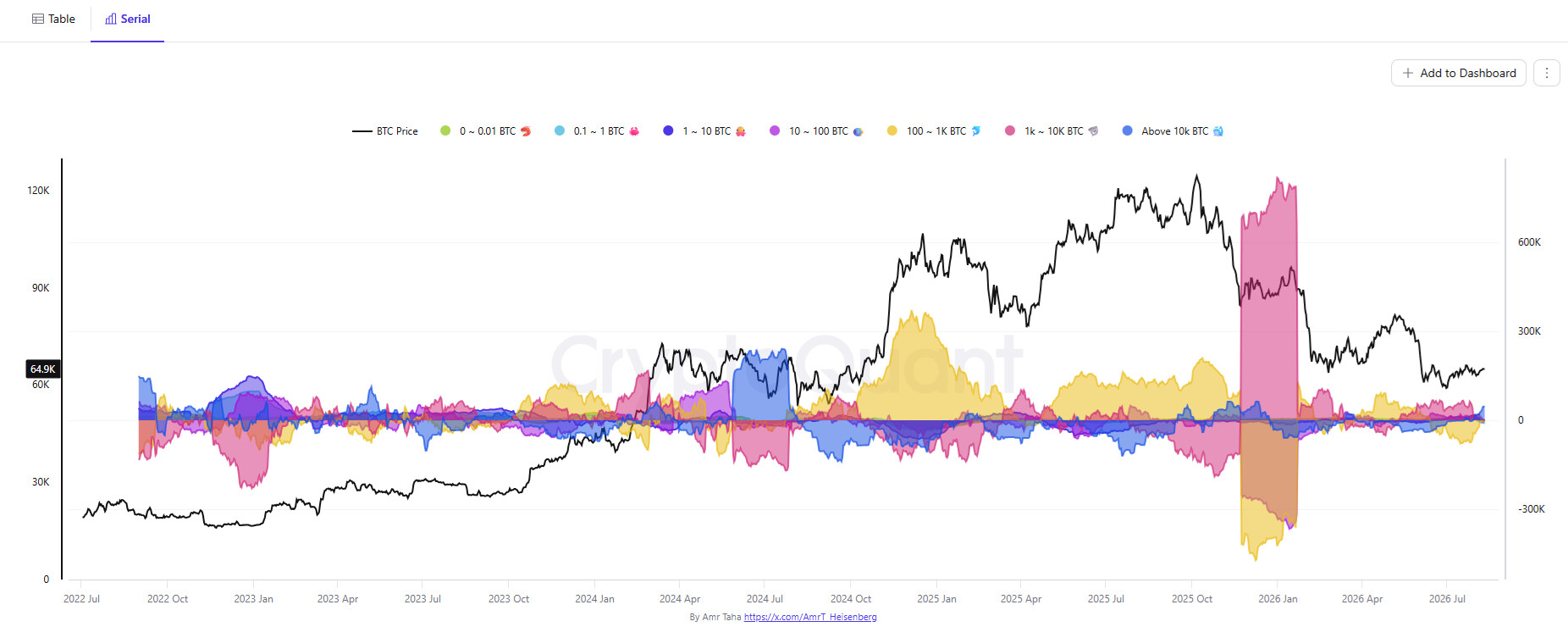
The Bitcoin cohort holding more than 10,000 BTC in their wallets has emerged as the most active buyer during the summer of 2026. Nearly all other wallet cohorts remain idle following an initial accumulation rush in January.
The largest BTC wallets, each containing over 10,000 BTC, likely belong to institutional entities, ETFs, or individual whales. Market participants closely monitor this cohort for signals that could indicate an end to the ongoing BTC bear market. These largest whales have accelerated their accumulation over the past several weeks, coinciding with BTC's recovery toward approximately $65,000. The divergence between large-wallet accumulation and retail distribution echoes patterns observed in prior cycle troughs, where concentrated whale buying preceded broader market recoveries — though such divergences have not always been followed by immediate price reversals.
Over the past two months, addresses holding more than 10,000 BTC accumulated a net 46,420 BTC — their highest accumulation level since March 15. This figure surpassed their previous March record, when large wallets had added 23,238 BTC.
Conversely, retail wallets have entered a distribution phase. Holders of 0.1 to 1 BTC distributed a net 9,700 coins. This cohort has historically been volatile, frequently shifting between accumulation and distribution. As of August, small-scale holders are reducing their exposure, while the largest whales are generating spot demand for BTC. Order size data indicates growing activity among large whales rather than smaller traders or retail participants.
Is BTC Entering an Accumulation Phase?
At present, only one cohort is showing net accumulation, and BTC as a whole is exhibiting weakening spot demand. Throughout the year to date, multiple cohorts have alternated between accumulation and distribution.
Current BTC price movements and prolonged sideways trading remain insufficient to stimulate broader buying activity. Even whales appear cautious about potential downside. Based on historical halving timeframes, BTC would typically already be in an accumulation period following the April 2024 halving, which reduced block rewards and historically preceded supply-driven price appreciation cycles. However, skeptics of the four-year cycle theory suggest that the accumulation window may be delayed by several months.
Where Is BTC Demand Coming From?
Recent on-chain and exchange data indicate that BTC demand is shifting geographically. The Coinbase premium index remains negative, suggesting weak demand from US-based buyers. The index, which measures the price spread between Coinbase Pro and other exchanges, is commonly used as a proxy for US institutional appetite. BTC purchasing activity appears to be migrating toward Asian and other global trading venues.
BTC may also benefit from stablecoin reserves that could be deployed in another accumulation round. Binance reflects this shifting trend, experiencing daily inflows of stablecoin liquidity. The exchange saw outflows exceeding $700 million in TRON-based USDT, which is now being replaced by Ethereum-based stablecoins.
A portion of the stablecoins flowing into Binance may be allocated toward BTC. While this liquidity realignment does not guarantee a BTC rally, it could influence premiums, alter available liquidity depth, and trigger localized surges in trading activity.
As of August 10, Strategy (formerly MicroStrategy) is being closely monitored for a potential break in its selling streak and a resumption of BTC purchases. The treasury-focused company, which holds over 200,000 BTC as the largest public corporate holder, has historically been a bellwether for institutional sentiment. The company's actions may signal a broader shift in sentiment. Additionally, on Monday the H100 group announced the purchase of 2,455.37 BTC, indicating that the corporate treasury narrative remains active as a source of demand and long-term holding.
Overall, BTC market sentiment remains subdued, lingering predominantly in the "fear" range for the past three months. Sideways trading continues to delay confirmation of a definitive price bottom. Despite isolated signs of buying activity, widespread accumulation and conviction purchasing are not currently the primary drivers of BTC market sentiment.

