Bitcoin On-Chain Signals Point to Large-Holder Accumulation, but Custody Shifts Cloud the Picture
Key Takeaways
- •The number of Bitcoin wallets holding at least 10,000 BTC reached 90, the highest level in six months, representing a 7.1% increase over eight weeks.
- •U.S. spot Bitcoin ETFs attracted approximately $853.5 million in net inflows last week, with BlackRock's IBIT accounting for $693.7 million alone.
- •A recent Coldcard security vulnerability has prompted investors to relocate funds between wallets, potentially distorting on-chain distribution signals.
- •BlackRock's Head of Digital Assets Robert Mitchnick observed that Bitcoin demonstrated reduced correlation with equities during a July pullback in AI-related stocks.
- •Price action remains the missing confirmation for the accumulation thesis, as Bitcoin has yet to break out of its extended trading range.
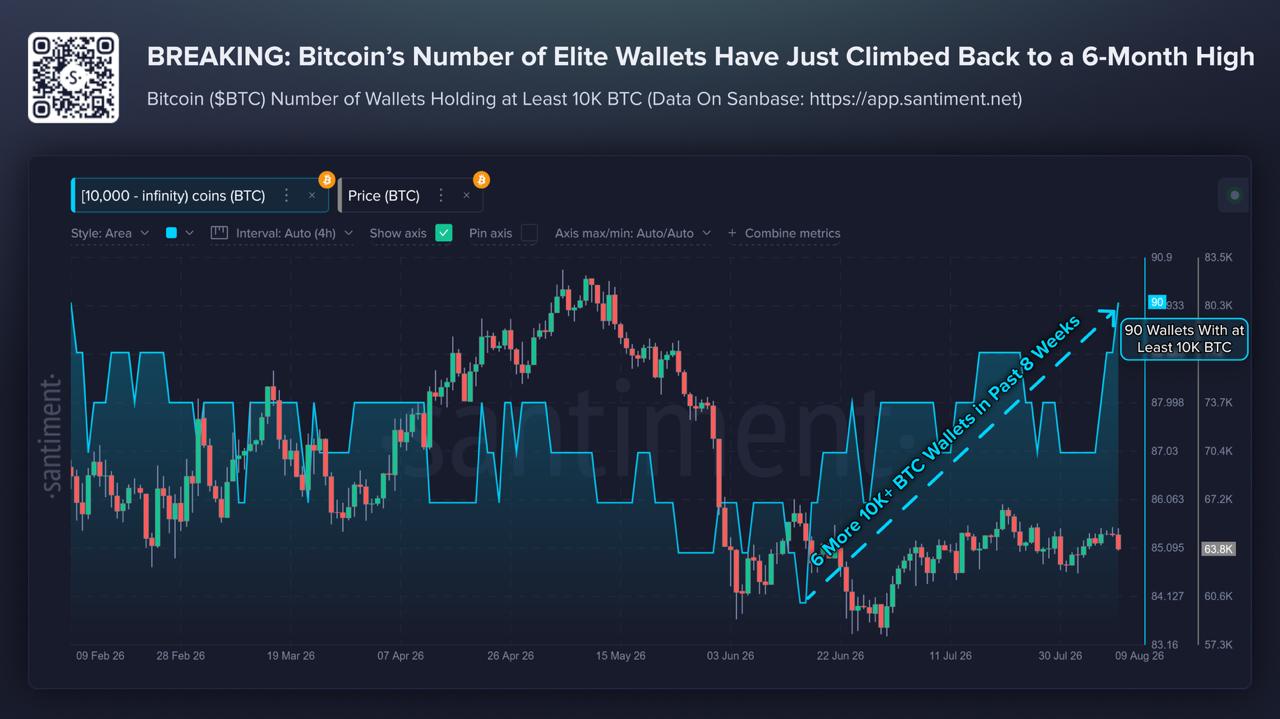
Santiment reported on August 10 that the number of Bitcoin wallets holding at least 10,000 BTC has risen to 90 — its highest level in six months. That figure represents six additional wallets compared to eight weeks ago, a 7.1% increase, while holdings among smaller wallets have declined throughout August.
The analytics firm views this combination as potentially bullish. Supply is becoming more concentrated among the largest holders at a time when U.S. spot Bitcoin ETF demand has also strengthened. The funds attracted approximately $853.5 million in net inflows last week, including $693.7 million for BlackRock's IBIT alone. (Santiment)
Since their launch in January 2024, U.S. spot Bitcoin ETFs have become one of the most closely watched demand metrics in the crypto market, offering a proxy for institutional appetite that on-chain wallet data alone cannot capture.
The central question is whether these two trends reflect genuine accumulation beneath Bitcoin's price consolidation, or whether recent changes in how investors store their Bitcoin are making the on-chain picture appear stronger than it actually is.
Santiment's Bullish Case
Santiment's argument rests on the direction of supply movement between wallet cohorts. When smaller traders increase their share while large holders distribute, the market typically becomes more vulnerable to selling pressure. The current pattern is moving in the opposite direction: micro-wallet holdings are falling while the largest address tier is gaining ground.
This concentration leaves more supply in what Santiment describes as stronger hands. Historically, the firm has viewed such distribution patterns as favorable ahead of major market moves, particularly when whales continue accumulating while retail participation weakens.
The interpretation carries weight, but wallet counts alone cannot identify the entities behind each address. A wallet holding more than 10,000 BTC could belong to an individual investor, but it could equally represent an exchange, a custodian, or infrastructure serving institutional products. This is a long-recognized limitation in on-chain analysis: clustering algorithms can group related addresses, but they cannot definitively classify the owner behind them.
That distinction has gained importance following the recent Coldcard security scare, which has complicated the on-chain picture.
Coldcard's Distorting Effect on Wallet Data
The Coldcard vulnerability has revived the debate between self-custody wallets and ETFs while prompting users to move funds and reconsider their storage strategies. This type of activity can distort wallet-based signals over the short term.
When Bitcoin moves from one self-custody address to another, or becomes consolidated under a larger custodian, the blockchain records a meaningful shift in wallet distribution — even though no new investor has necessarily entered the market.
This does not invalidate Santiment's observation that smaller holders are losing share while larger addresses gain it. It does, however, make the underlying cause more difficult to isolate. Some of the movement may represent fresh accumulation; some may simply reflect investors reorganizing their custody arrangements after the security incident. On-chain wallet counts alone cannot cleanly distinguish between the two.
BlackRock Sees a Shift in Investor Behavior
BlackRock has identified another change that may help explain why institutional demand has remained resilient despite Bitcoin's stagnant price.
Robert Mitchnick, the asset manager's Head of Digital Assets, said sentiment has shifted in a noticeable but subtle way as Bitcoin has begun behaving more independently from equities. (The Block)
He pointed to July, when AI-related stocks experienced a sharp pullback while Bitcoin held up considerably better. Bitcoin's correlation with equities has fluctuated significantly over the past several years, rising during risk-off episodes and fading during periods when crypto-specific narratives dominate. For portfolio managers, this matters because Bitcoin becomes more valuable as a diversifier when it does not simply mirror the movements of equities they already hold. A period of lower correlation strengthens the case for treating BTC as a distinct allocation rather than another version of the same risk trade.
Mitchnick has also described Bitcoin ETF investors as predominantly long-term, buy-and-hold holders. The latest flow data fits that profile: demand returned even without a strong upside move in BTC, and BlackRock's IBIT captured the majority of the week's net inflows. That behavior looks less like momentum-chasing and more like investors maintaining exposure through a weak market.
What Remains Unconfirmed
The on-chain and ETF data lend support to the accumulation thesis, but they have not conclusively settled it. A continued decline in smaller-holder balances alongside persistent ETF inflows would make Santiment's stronger-hands argument more compelling. The signal would become harder to dismiss if large-wallet growth continues after the disruption triggered by Coldcard subsides.
Price action remains the missing confirmation. A breakout from Bitcoin's extended range would suggest that the supply absorbed during consolidation is finally generating enough demand to move the market. If wallet distribution keeps shifting while BTC remains range-bound, custody redistribution becomes a more significant part of the explanation.
Related reporting: Strategy sells additional BTC as capital strategy shifts
For now, the data indicates that Bitcoin is changing hands. The next meaningful price move should reveal whether those hands are genuinely stronger.

