Bitcoin's 30-Day Volatility Drops Below KOSPI as South Korea's Index Hits 81% Implied Vol
Key Takeaways
- •Bitcoin's 30-day realized volatility has fallen below the KOSPI's, with daily return swings of 48% versus 63% for the Korean benchmark.
- •Bitcoin was trading near $62,250 at publication, down approximately 29% year-to-date and roughly 50% below its October 2025 all-time high of $126,000.
- •The KOSPI's elevated volatility is driven by its heavy concentration in Samsung Electronics and SK Hynix, which together account for over half the index's total weight.
- •The Korea Exchange triggered nine trading halts in 2026 due to volatility, compared with only one in all of 2024.
- •Regulatory developments tied to U.S. crypto legislation remain the most likely catalyst for a reversal of Bitcoin's current low-volatility regime.
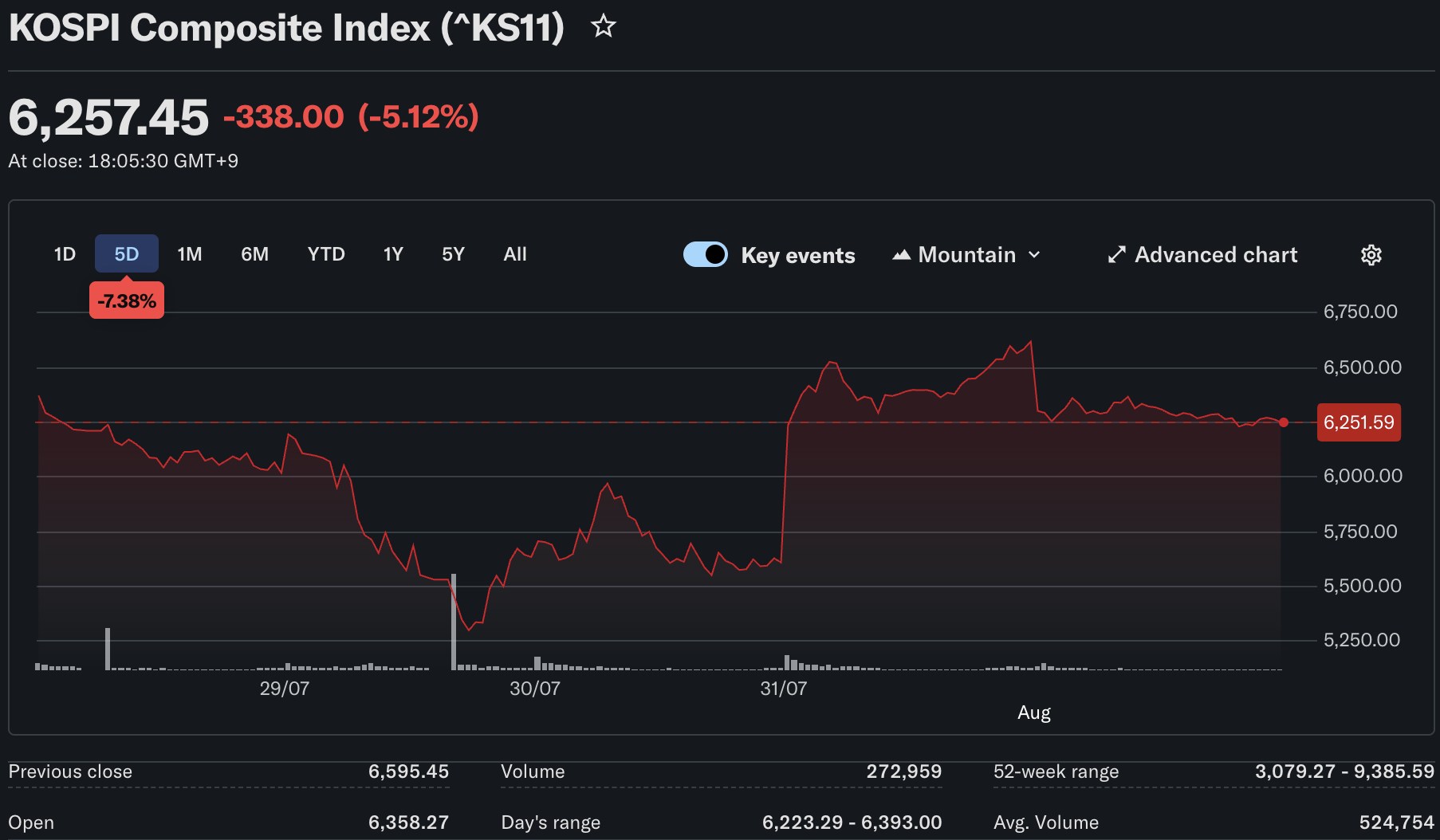
Bitcoin's 30-day realized volatility has dipped below that of South Korea's KOSPI equity benchmark, according to comparative market data — a notable reversal that places the world's largest cryptocurrency beneath an equity index that Bloomberg now characterizes as the most volatile benchmark stock index globally. Bitcoin has historically exhibited annualized volatility ranging from 60% to 80%, making this compression particularly unusual for an asset long regarded as the epitome of price instability.
Options-market data referenced in supplementary reporting places the KOSPI's 30-day implied volatility index at an annualized 81%, approximately double Bitcoin's comparable metric of roughly 38%. (Yahoo Finance)
At the time of publication, Bitcoin was trading near $62,250, down approximately 29% year-to-date from its opening level near $88,000 and roughly 50% below its October 2025 all-time high of $126,000, according to CoinGecko data.
This sustained, one-directional decline is a key reason Bitcoin's volatility reading appears muted relative to the KOSPI's. Realized volatility, which measures actual price movements over a trailing period, tends to compress during extended directional moves — whether up or down — because daily returns become more uniform. Implied volatility, by contrast, reflects the market's expectation of future price swings derived from options pricing. The divergence between the two measures for both assets is itself instructive: the KOSPI's elevated implied reading signals that traders anticipate further turbulence ahead, while Bitcoin's lower figure suggests the options market is pricing continued relative calm. The central question facing the market is whether this comparative calm reflects a durable structural shift in Bitcoin's risk profile or merely a temporary pause within its historically volatile cycle.
Bitcoin Volatility Data: What the 30-Day Compression Reveals
$BTC is back into the $62,000-$62,500 level.
Hold this level, and Bitcoin could rally towards $65,000.
Lose this level, and BTC could drop to $60,000. pic.twitter.com/O877SmIdMU
— Ted (@TedPillows) August 3, 2026
Bitcoin's 30-day realized volatility has recently fallen below that of the KOSPI, an equity index recognized for pronounced swings, with Bitcoin's daily return swings at 48% compared to the KOSPI's 63%.
Previous periods of compressed volatility — such as those seen in 2019 and mid-2023 — have often preceded major price movements. However, the current situation is distinct because the comparison is being drawn against a dominant equity index rather than established crypto-market norms.
The volatility decline is largely attributed to the unwinding of AI-related trades, as speculative interest in Bitcoin has diminished in tandem with high-beta growth assets. As a result, Bitcoin has been trading within a narrow range, remaining below its 50-day moving average and producing a slow directional drift rather than its customary high-volatility dynamics.
South Korea Stock Market KOSPI: AI Concentration and Samsung–SK Hynix Dominance
South Korea's equity market has effectively become a leveraged AI trade, driven primarily by Samsung Electronics and SK Hynix, which together account for over half of the KOSPI's total index weight. Samsung is the world's largest manufacturer of memory chips, while SK Hynix is the dominant supplier of HBM (high-bandwidth memory) used in advanced AI accelerators — making both companies critical nodes in the global AI infrastructure supply chain. This concentration means that forecasts regarding data center spending and AI earnings have an outsized impact on the entire index.
Recent volatility has been severe. SK Hynix fell 27% in just three trading sessions on concerns over data center investments before rebounding to the Korea Exchange's 30% circuit breaker limit. The Korea Exchange triggered nine trading halts in 2026 due to this volatility, compared with only one in 2024.
Finance Minister Koo Yun Cheol stated that regulators expedited approval of single-stock leveraged ETFs, which at their peak accounted for over 70% of daily trading volume. Retail investors, heavily positioned in these leveraged ETFs tied to Samsung and SK Hynix, amplified market movements. Liquidation volume for AI-related leveraged trades surpassed $2 trillion within a three-month period.
The KOSPI's volatility index ranged from the high teens to nearly 98 over the past year, underscoring a shift toward meme-stock-like behavior rather than traditional market patterns.
What the Volatility Inversion Means for Bitcoin's Investment Case
bitcoin:native just flashed a signal that only shows up once or twice a year: Bitcoin realized volatility now lower than tech stocks for past 30 days.
Everything else is trading like crypto, except for crypto.
Historically has been a very good time to buy. pic.twitter.com/byS4ySPjE7
— Luke Martin (@VentureCoinist) August 3, 2026
The observation that Bitcoin's comparative volatility has fallen below a volatile national equity index challenges the common argument against including the cryptocurrency in institutional portfolios on the basis of extreme price risk. If Bitcoin's 30-day realized volatility is lower than that of the KOSPI, it weakens a traditional objection to allocation.
Evidence of this shift can be seen in increased institutional staking and integration, strengthening the diversification argument as Bitcoin's risk profile aligns more closely with high-beta equities.
The Korea Premium Index, which tracks the premium that Bitcoin commands on Korean exchanges relative to global spot prices — sometimes referred to as the "Kimchi Premium" — has historically served as a barometer of Korean retail sentiment toward crypto. Its current trajectory may suggest that investors seeking stability following AI-related equity losses could redirect capital toward Bitcoin. However, while Bitcoin's correlation with tech stocks has softened, it has not disappeared entirely.
Regulatory shocks — particularly those related to U.S. crypto legislation — could rapidly reintroduce volatility, meaning the current calm may represent a temporary market condition rather than an enduring trend. The approval of spot Bitcoin ETFs in the United States in early 2024 fundamentally altered institutional access to the asset, and subsequent regulatory developments remain the most likely catalyst for a volatility regime change.

