Top Bitcoin Blockchain Visualizers for Your Home and Office
Key Takeaways
- •Mempool.space has become one of the most visited Bitcoin-only sites, estimating fee markets and showing which transaction types are expected in the next block.
- •Dr. Jochen Hoenicke's mempool data site has been online for at least a decade, and its historical records are used by researchers and Bitcoin historians.
- •The April 2024 halving cut the block subsidy to 3.125 BTC, a figure featured on GetNotZero's dashboard alongside hash-rate, difficulty, price and mempool metrics.
- •Pat Riley's OmPool turns the Bitcoin mempool into a generative musical instrument for the Omarchy operating system, with tempo following transaction activity and pitch following fee rates.
- •Most of the featured projects are open source or built on public data, allowing users to self-host them and verify Bitcoin's live state against a personal full node.
Bitcoin is often described in abstract terms such as “cryptocurrency” or “digital gold”—metaphors intended to make a digital monetary system feel more physical and tangible. Regardless of how well those descriptions work, they are not the only efforts to make Bitcoin feel like more than a technology asset in a portfolio.
A growing niche of Bitcoin visualizers, explorers and art-focused interfaces has emerged to make the network feel alive. These projects can be displayed on a wall, observed casually or listened to like background sounds. In some cases, Bitcoiners connect them to physical that visitors can interact with, turning the network into a conversation piece.
The following selection covers price feeds, node data, mempools and transaction activity. All of it draws on the same public raw material: every Bitcoin transaction is broadcast across a peer-to-peer network and recorded on a shared ledger that anyone can inspect, which is why the differences among these tools lie mainly in presentation.
Block explorers
Block explorers are among the most recognizable windows into Bitcoin. They have existed since the industry's early days and serve as a public-notary-like interface for on-chain transactions. A user can send a bitcoin payment, enter its transaction ID or destination address on an explorer, and obtain a cryptographically authenticated, timestamped record that can be shared with the recipient. Most wallets now integrate at least one block explorer into their transaction data, allowing users to verify payments through a separate application or website.
Blockchain.info was probably the first major block explorer. It also operated as a web wallet and has since expanded into other ventures across the broader crypto industry. In the Bitcoin-only market, Mempool.space is among the most visited sites, offering a clear view of Bitcoin's activity.
In addition to showing whether a payment has been confirmed on-chain, Mempool.space estimates the fee market so users can avoid overpaying for on-chain transactions. That market exists because block space is limited: new blocks are found roughly every ten minutes on average, so transactions compete for the room available in each one. It also displays the transaction types expected to be mined in the next block. The project's open-source back end can be run locally, including as a layer over a user's own full node. This allows the interface to reflect an individual perspective of the network, including that user's mempool.
ExploreTimeChain.com presents the time chain—Satoshi Nakamoto's original term for the blockchain in early versions of the code—as a space-exploration interface. Users can enter transaction IDs and public addresses to view related details, or manually fly a ship through block space, where each meteor represents a transaction. The site also presents blocks as a three-dimensional chain.
Tesseractb offers another three-dimensional view of the chain, using geometric figures inspired by tesseracts. A search icon in the lower-right corner accepts transaction IDs and other data for identifying specific addresses or blocks, effectively making the project a block explorer.
Symphony, an IOHK.io project, gamifies block exploration in three dimensions. Users can enter transaction IDs and block numbers to navigate the time chain. Its design is both visual and acoustic, using a synthetic symphony to create the impression of exploring the Milky Way. The environment supports gaming-style controllers and keyboard controls and is compatible with virtual reality.
The Anatomy of Bitcoin website also functions as a block explorer. Built by Pedro, its technology stack is live and synchronized with the network. The explorer accepts transaction IDs and returns two- and three-dimensional transaction data, although the relevant interface is somewhat buried in the menus.
The project's back end is its central feature: MIT-licensed, open-source three-dimensional modeling of the Bitcoin system across multiple layers. It covers everything from the bit-level cryptography of a private key to node-network topology, blockchain data and the dynamic state of the UTXO set. The resulting data-science stack could provide a foundation for other projects.
The site was launched with the goal of producing a film that would teach people about Bitcoin visually. Several trailers and speeches were included in the roadmap, but fundraising was lackluster, and the film was not completed. The project remains a source of content and inspiration, and its creator's work could potentially be revived or forked.
Mempool visualizers
Some mempool visualizers are not block explorers and do not focus on individual transactions. Instead, they show trends in transaction flows from either a data-science or an artistic perspective. The mempool itself is the holding area for transactions that have been broadcast to the network but not yet confirmed in a block, which makes it a live gauge of demand for block space.
Mempool.JHoenicke.de
One of the best-known examples is Dr. Jochen Hoenicke's mempool data site, which has been online for at least a decade and displays data reaching as far back as 2026. Its historical record of Bitcoin mempool activity is used by researchers and Bitcoin historians.
Hoenicke is a German computer scientist who became known in Bitcoin as a white-hat security researcher and later as a Trezor cryptographer. He now works for Certora, a smart-contract technology firm. The scripts for his site are open source under AGPL3. The site is particularly useful for assessing how congested or empty the next block may be and estimating on-chain fees.
GetNotZero combines a real-time data dashboard with a hobbyist-mining concept. Its orange, cypherpunk-style interface displays next-block hash-rate estimates, mempool data expected in the next block, mining difficulty, price, the estimated time until the next halving and other metrics. The halving is the protocol rule that cuts the block subsidy in half every 210,000 blocks—roughly every four years—with the most recent event, in April 2024, reducing the reward to the current 3.125 BTC.
The dashboard also invites users to try mining at home with a personal computer. While laptop mining once made some participants wealthy, the odds are now much lower, though they are not zero. If a solo miner finds a full block, the reward is 3.125 BTC deposited into a personal, self-hosted wallet without questions or KYC. The project presents this possibility in a visually designed interface.
The site txcity.io takes a more playful approach, comparing the Bitcoin and Ethereum mempools through an eternal bus stop modeled on South Park's imagery. It accounts for SegWit transactions as an addition to Nakamoto-era block space and depicts transactions accumulating on both sides as South Park-like characters wait for the next bus—or block. (SegWit is the 2017 protocol upgrade that changed how transaction data is weighed against the block limit, allowing more transactions to fit in each block than the original size limit permitted.) The site also covers a range of legacy cryptocurrencies beyond Bitcoin and Ethereum.
Musical mempools
Other projects interpret on-chain activity through sound. Their interfaces assign tones and notes to the self-organizing activity of the Bitcoin market, producing musical patterns shaped by transaction and mempool events.
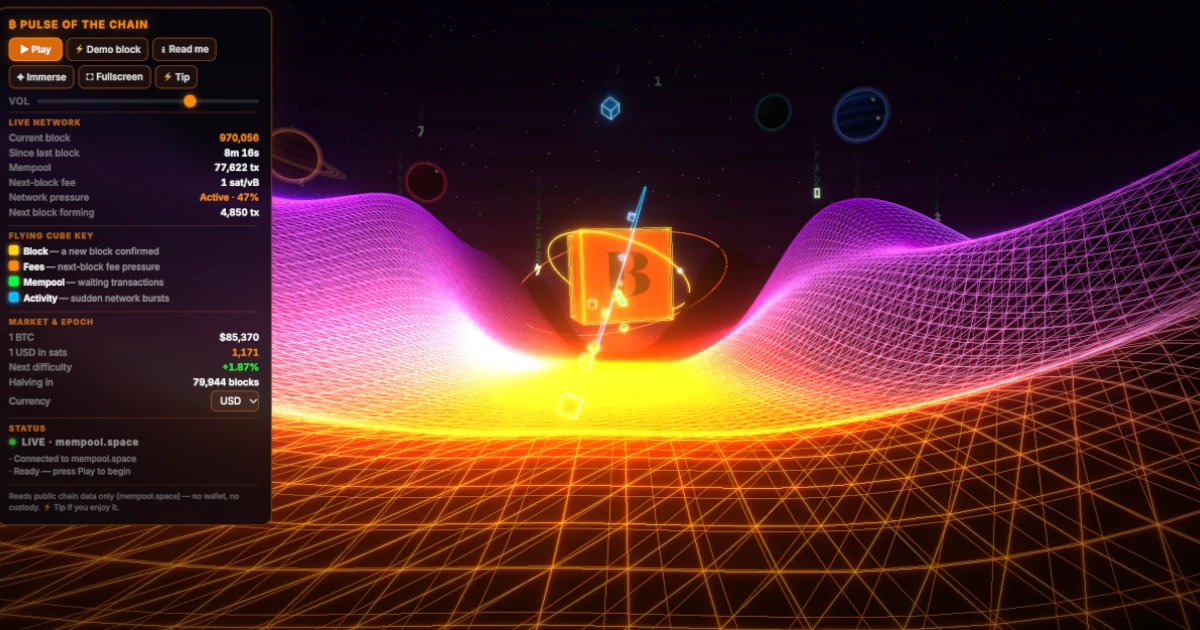
Proof of Sound assigns notes to different transaction types and mempool events. Newly found blocks receive their own dedicated note. The synchronized synthwave animation is designed to remain on a screen as decoration, with sound controls and customization options for the background experience.
Bitlisten takes a more minimalist approach, assigning each mempool transaction a bell sound based on its size. The result is simple background audio. Its default instrument is a celesta, but users can choose from several others, changing the character of the resulting music. The project is open source and can be modified.
An anonymous Netlify application offers a similar combination of musical and visual activity, but with a more controlled musical experience. Its on-chain activity is primarily visual, with synth waves reacting to network events. The application's readme says that each moment is unique, while the music is produced rather than generated directly from the mempool's activity.
The final project is OmPool, an interface for the Omarchy operating system created by Pat Riley. Designed to run as an operating-system panel, it can remain available in the background. The software is open source, and its interface follows Omarchy's design while adding sound patterns generated from mempool activity.
In an announcement post on X, Riley wrote:
Turned the Bitcoin mempool into a live generative musical instrument – Tempo follows transaction activity – Pitch follows fee rate – Value sets the reverb – Blocks change the scale Built on @OmarchyLinux @mempool + SuperCollider pic.twitter.com/doUwKyBTz5 — Pat Riley (@_rileyio) September 5, 2026
The source also includes the following repeated version of the post:
Turned the Bitcoin mempool into a live generative musical instrument – Tempo follows transaction activity – Pitch follows fee rate – Value sets the reverb – Blocks change the scale Built on @OmarchyLinux @mempool + SuperCollider pic.twitter.com/doUwKyBTz5
Whether on a wall display or an operating-system panel, most of the projects above are open source or built on the network's public data, meaning the same live view of Bitcoin can be self-hosted, modified and—when run against a personal full node—verified on one's own terms.
This article first appeared on Bitcoin Magazine and was written by Juan Galt.

