Bitcoin Unrealized Loss Falls Below 40% Stress Zone as Analysts Caution Risk Remains
Key Takeaways
- •Bitcoin's Percent Unrealized Loss has declined to 35.2%, retreating below the 40% deep-stress threshold after peaking at 42.2% in late June.
- •Historically, readings above 40% have signaled deeper bear-market conditions, while the 60% threshold has marked periods of widespread investor capitulation.
- •Previous market cycles in 2014-2015, 2018-2019, and 2022 demonstrated that the first move above 40% did not immediately mark a market bottom, often followed by volatile consolidation.
- •Despite the recent improvement, unrealized losses remain elevated compared to healthier phases of prior cycles, indicating that many holders still face negative returns.
- •Analysts caution that unrealized loss metrics should be evaluated alongside exchange flows, long-term holder behavior, realized losses, and derivatives positioning rather than in isolation.
Bitcoin investors are showing signs of recovering from one of the market's recent periods of elevated stress, with on-chain data indicating that the percentage of coins sitting at an unrealized loss has fallen below a key historical threshold.
According to the latest CryptoQuant data, Bitcoin's Percent Unrealized Loss currently stands at 35.2%, meaning roughly one-third of the tracked Bitcoin supply is being held below its acquisition price. CryptoQuant is a widely used blockchain analytics platform that tracks on-chain activity across major crypto exchanges and wallet cohorts.
The reading marks an improvement from late June, when the metric rose to 42.2% and briefly moved above the historically important 40% deep-stress zone. The indicator later eased to 30.4% around July 21 before rebounding to its current level.
Although the latest figure points to improving market conditions, analysts note that unrealized losses remain elevated compared with healthier phases of previous market cycles. The distinction matters because unrealized losses reflect paper losses only—holders have not yet sold—meaning the metric captures latent selling pressure rather than realized damage.
On-Chain Stress Indicator Moves Out of the Danger Zone
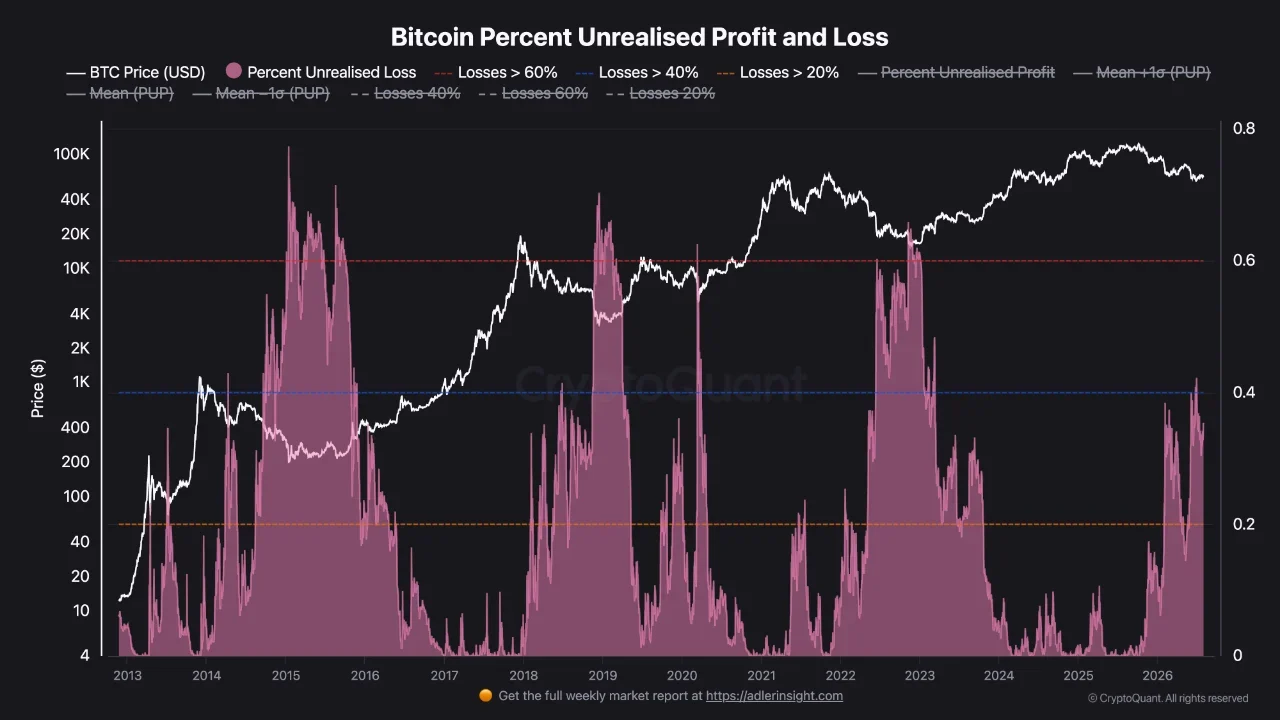
The attached chart tracks Bitcoin's Percent Unrealized Loss against the asset's long-term price performance.
In the chart, the purple area represents the share of circulating Bitcoin supply currently held at an unrealized loss, while the white line tracks Bitcoin's market price across multiple market cycles.
Historically, readings above 20% have signaled growing market stress, while moves beyond 40% have coincided with deeper bear-market conditions. The 60% threshold has generally marked periods of capitulation, when widespread selling pressure and investor panic have dominated the market.
The latest decline to 35.2% places Bitcoin back below the deep-stress zone, suggesting that some of the pressure seen during recent price weakness has eased.
Historical Cycles Show Why the 40% Level Matters
The chart highlights several previous market cycles in which unrealized losses climbed above the 40% threshold before extending toward 60% during prolonged bear markets.
During the 2014–2015, 2018–2019 and 2022 downturns, the first move into the 40% region did not immediately mark the market bottom. Instead, Bitcoin typically entered a period of volatile consolidation before either recovering or experiencing a final wave of capitulation.
Unlike those earlier cycles, the current reading has retreated below 40% relatively quickly, indicating that selling pressure has moderated rather than intensified.
From a technical perspective, the chart shows the unrealized loss metric falling back below the historical deep-stress threshold. Current levels remain well below the 60% zone that has historically accompanied widespread panic selling. Many holders, however, continue to face negative returns.
On-Chain Data Suggests Caution on Bitcoin Rather Than Panic
Unrealized loss metrics are widely used by on-chain analysts to assess investor sentiment because they measure the proportion of Bitcoin holders currently sitting on paper losses.
High readings generally reflect deteriorating market confidence, while declining values often indicate that prices have recovered enough to reduce the share of underwater investors.
However, on-chain metrics are rarely used in isolation. Analysts typically combine unrealized loss data with exchange flows, long-term holder behavior, realized losses, and derivatives positioning to build a broader picture of market conditions. Exchange inflows, for instance, can signal intent to sell, while long-term holder supply trends indicate whether experienced investors are accumulating or distributing.
For now, Bitcoin appears to have stepped back from the deeper stress zone that emerged in late June. While that suggests improving sentiment, the indicator remains above the longer-term comfort zone, meaning investors will likely continue watching whether the metric stabilizes below 40% or begins climbing again if market weakness returns.
The post Bitcoin's Unrealized Loss Drops Below 40% Stress Zone, Analysts Say Risk Hasn't Fully Passed appeared first on Blockonomi.