Bitcoin May Hit Turning Point This Week as Durable Bottom Takes Shape, Grayscale Says
Key Takeaways
- •Bitcoin climbed about $10,000 in one week to $79,500 on Aug. 21, reaching its highest price since May.
- •Grayscale said the rally may indicate that Bitcoin’s latest bear market is reaching a turning point.
- •The current decline has been milder than earlier cycles, with Bitcoin down about 50% from its peak versus historical drops of roughly 80% or more.
- •VanEck said eight of 12 capitulation signals were active as of Aug. 12 and described the drawdown as potentially late-stage.
- •U.S. spot Bitcoin ETFs recorded about $1.92 billion in net inflows over five sessions ending Aug. 21.
Bitcoin May Hit Turning Point This Week as Durable Bottom Takes Shape, Grayscale Says
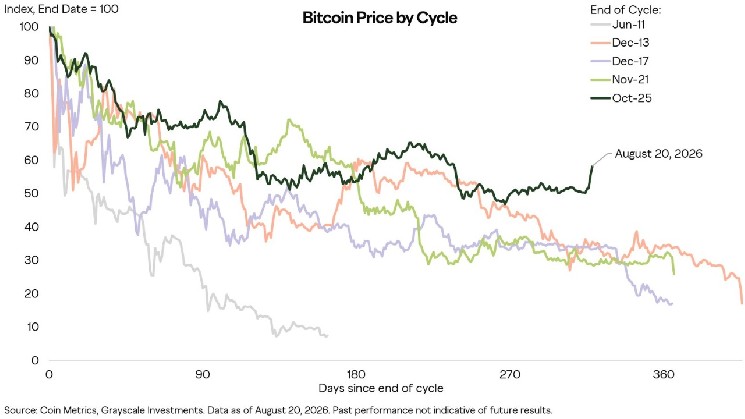
Bitcoin’s rapid recovery may signal that its latest bear market has reached a turning point, crypto asset manager Grayscale said in an Aug. 22 post on X. The post was accompanied by a chart comparing bitcoin’s current decline with the four previous market cycles.
The assessment followed a roughly $10,000 weekly bitcoin rally that lifted the cryptocurrency to $79,500 on Aug. 21, its highest price since May. The rebound broke a prolonged trading range and forced traders holding bearish derivatives positions to close their bets. Although short liquidations helped accelerate the advance, the move also coincided with renewed spot demand and inflows into exchange-traded funds (ETFs). Liquidations occur when exchanges force-close leveraged positions that have moved too far against their holders, so the buying they generate reflects positioning rather than fresh conviction — a distinction that matters when judging whether a rally can hold.
“This week may be a turning point for bitcoin.”
— Grayscale, Aug. 22 post on X
The asset manager expanded on the market outlook after publishing an assessment of whether current prices offer a good time to buy bitcoin. That analysis identified continued structural adoption, the maturity of the bear market, and a potentially supportive macroeconomic environment as three considerations for long-term investors.
Chart Shows a Shallower Bitcoin Decline
The accompanying “Bitcoin Price by Cycle” chart indexes bitcoin at 100 at each cycle peak and tracks its subsequent performance by the number of days since that peak. The current cycle begins with the October 2025 high and extends through Aug. 20. The visualization uses historical bitcoin price data from Coin Metrics to compare the current drawdown with four previous cycles whose peaks occurred in June 2011, December 2013, December 2017, and November 2021. Bitcoin’s current drawdown is shallower than the four earlier cycle declines shown.
“Historically, bitcoin has bottomed ~80% below its cycle peak price. In the latest bear market bitcoin fell ~50% from its peak, less than all prior cycles to this point.”
— Grayscale
The comparison does not prove that the latest low will hold, but it indicates that the market has absorbed the downturn without repeating the losses of approximately 80% seen in earlier cycles.
Bitcoin’s recurring expansions and corrections have often followed a loose four-year pattern connected with halvings, liquidity, and investor behavior. Halvings are protocol events that cut the rate at which new bitcoin is issued in half roughly every four years, tightening supply growth on a schedule written into the asset’s code rather than set by any central issuer. Correction phases in earlier bitcoin market cycles erased approximately 78% to 94% from previous peaks, although changing market structure could reduce the depth of future declines.
Other Market Signals Point Toward Accumulation
Separate research has also identified conditions associated with the later stages of a bitcoin correction. Vaneck’s Aug. 18 analysis found that eight of 12 capitulation signals — indicators built to flag stretches of distressed, exhausted selling — were active as of Aug. 12, while all 12 had entered their capitulation zones at some point during the preceding three months.
Vaneck’s Bitcoin Chaincheck analysis described the drawdown as potentially late-stage and said bitcoin may be nearing or entering an accumulation phase. Vaneck also expects a shallower trough than in previous cycles, citing spot exchange-traded products, a larger institutional holder base, and the absence of major leveraged-lender failures.
Those indicators do not provide reliable short-term confirmation of a bottom. Vaneck found that comparable signal clusters historically produced below-baseline average returns over both 90- and 180-day horizons. One-year performance exceeded bitcoin’s typical return, but the finding relied on a small group of heavily overlapping observations.
ETF Demand Strengthens the Recovery
Renewed investment through U.S. spot bitcoin exchange-traded funds (ETFs) provides another measure of the demand behind the recovery. Spot ETFs hold the cryptocurrency directly and trade on conventional stock exchanges, giving brokerage investors a way to gain bitcoin exposure without holding the asset themselves, which is why their weekly flows are widely tracked as a gauge of institutional demand. The products recorded approximately $1.92 billion in net inflows over the five sessions ending Aug. 21, a streak of five consecutive positive trading days, and finished the period with total net assets of $96.07 billion.
The inflows suggest that the rally extended beyond forced buying by short sellers, but they do not establish that another decline has been avoided. Higher interest rates, weaker liquidity, renewed fund redemptions, or profit-taking could still test the market’s latest gains. The evidence that would inform that debate is the same data the analysts cite: whether ETF inflows persist in the coming weeks, whether the capitulation signals Vaneck tracks move out of their zones, and how the current drawdown continues to compare with prior cycles on the indexed chart.
“Markets were debating whether bitcoin would see another leg down in Q4 2026. While there are still risks, the rally this week may indicate we’ve reached a more durable bottom.”
— Grayscale
Source: news.bitcoin.com

