Bitcoin Posts Best Week Since March 2023 as Treasury Buyback Plans Lift Risk Assets
Key Takeaways
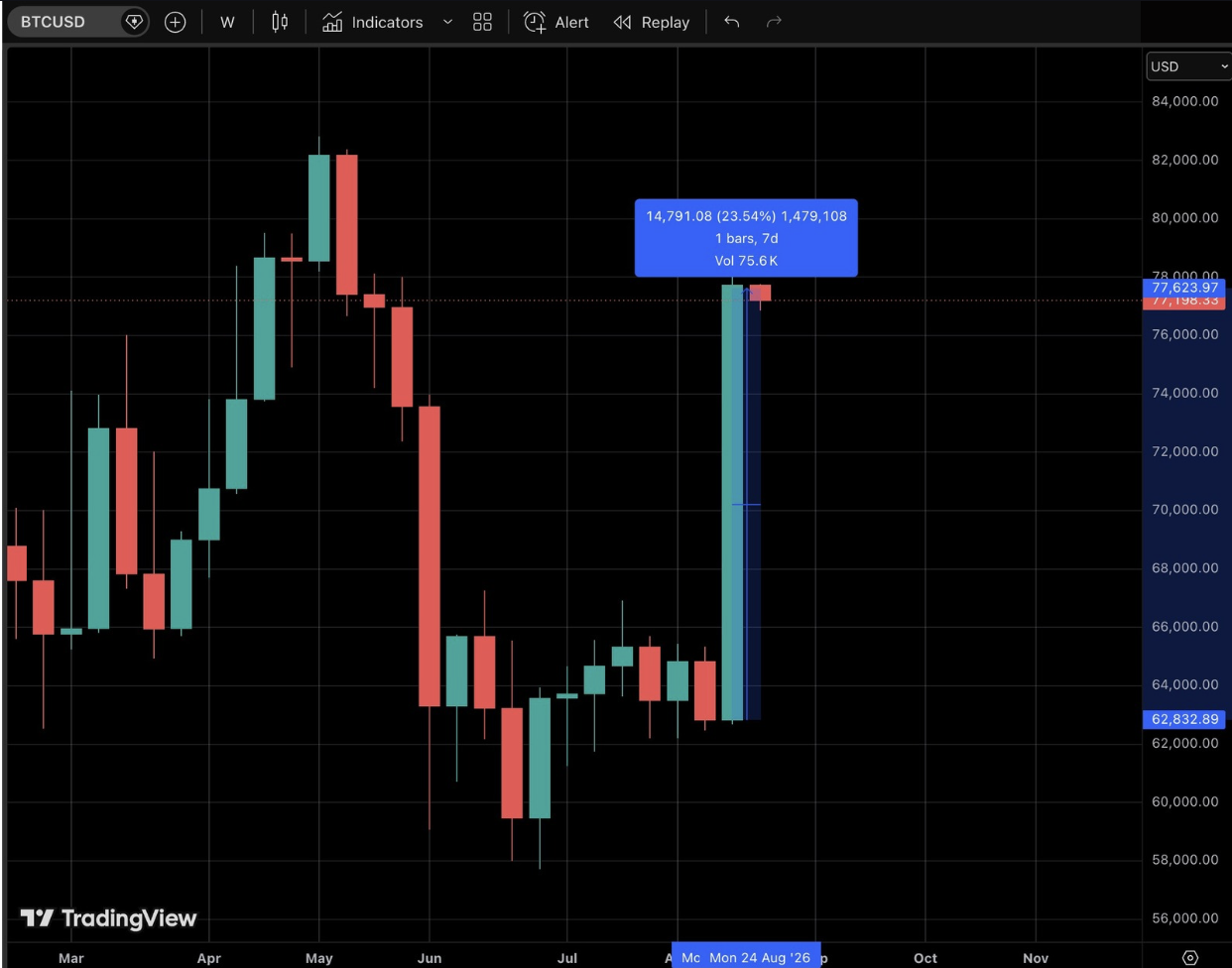
- •Bitcoin climbed more than 23% for the week to around $77,700, its best weekly return since March 2023, adding over $280 billion to its market capitalization.
- •Treasury Secretary Scott Bessent announced that long-dated bond buybacks will rise from $2 billion to at least $4 billion per operation between September 9 and November 4, after the 30-year yield reached 5.337%, its highest level since 2007.
- •August 19 saw roughly $2.739 billion in short positions force-closed, the largest single day of short-side liquidations since CoinGlass began tracking the metric in June 2021.
- •Altcoins outpaced Bitcoin, with XRP gaining more than 48%, Zcash advancing 71% on a Grayscale ETF conversion filing, and Hyperliquid's HYPE rising over 43% to an all-time high of $83.
- •A reader poll split nearly three ways, with the plurality of 36.36% withholding judgment until the Senate's September 15 cloture vote on the CLARITY Act, which would divide digital asset oversight between the CFTC and SEC.
The total crypto market saw more than $474 billion return after a single line in a U.S. Treasury Department announcement. Cryptopolitan asked newsletter readers whether they believed the move was genuine and whether it had further room to run. Most respondents said they were waiting for Congress before drawing a conclusion.
The Move Itself
Bitcoin opened on Monday, August 17, at about $62,800 and closed on Friday at around $77,700, after briefly touching roughly $79,500. That was a gain of more than 23% in seven days, marking its strongest weekly return since March 2023, when prices climbed sharply during the regional-banking stress that followed Silicon Valley Bank’s collapse. In dollar terms, BTC rose by nearly $14,000 in five days and added more than $280 billion to its market capitalization over the same period.
The move in altcoins was even stronger. The TOTAL2ES chart on TradingView, which measures the combined market capitalization of all cryptocurrencies excluding Bitcoin and stablecoins, posted a weekly gain of 28.93%. That was its largest weekly move since November 2024.
XRP rose more than 48% over the week, while Ethereum gained roughly 29% and traded above $2,400. Zcash advanced 71% after a Grayscale ETF conversion filing, the same pathway the firm used to turn its flagship Bitcoin trust into a spot ETF in January 2024. Other legacy altcoins, including BNB, Chainlink, Cardano, and Dogecoin, also recorded double-digit gains.
Hyperliquid was another standout. The project has drawn positive attention for much of this year, and HYPE has been the best-performing top-10 cryptocurrency by market capitalization year to date. Last week, however, it posted one of the strongest candles in its history, gaining more than 43% and reaching a new all-time high of $83. The move followed remarks from President Trump, who said the CFTC was working hard to bring the platform onshore in what he described as a fully compliant and legal manner.
A major mechanical factor also helped drive the rally. According to CoinGlass, Wednesday, August 19, was the largest single day of short-side liquidations since the company began tracking the metric in June 2021. About $2.739 billion in short positions were force-closed, surpassing the previous record set on October 10. Liquidations occur when exchanges close leveraged positions whose collateral no longer covers the required margin; closing a short requires buying, and that forced buying adds upward pressure that can trigger still more liquidations.
What Actually Set It Off
The catalyst did not come from crypto itself. On Wednesday, August 19, Treasury Secretary Scott Bessent announced that the government would at least double the size of its long-dated bond buyback operations, increasing them from $2 billion to a minimum of $4 billion per operation. The change will run from September 9 through November 4.
The U.S. government finances itself by selling bonds. Investors purchase those bonds and receive interest. The interest rate the government must offer, known as the yield, moves with demand. When demand is strong, the government can borrow more cheaply. When demand is weak, it must pay more.
By mid-August, demand for long-dated U.S. debt was weak enough that the 30-year yield reached 5.337%, its highest level since 2007.
A buyback is when the Treasury enters the open market and repurchases bonds it previously issued. It has operated this as a standing program since May 2024, mainly as maintenance for the bond market’s plumbing. Doubling the size of those operations puts a much larger buyer on the other side of the trade, and increased buying pressure tends to push yields lower.
That matters to crypto because long-term government debt yields are effectively the baseline return available with no credit risk. Other assets are priced relative to that benchmark. When a 30-year bond yields more than 5%, holding a volatile asset with no yield can look unattractive by comparison. When yields fall, the calculation changes, and capital may move farther out the risk curve in search of return.
The dollar sold off. Gold rallied. Equities ended a three-day losing streak. Bitcoin surged. All four moves reflected the same broader trade.
There is one important caveat. The Treasury is not creating new money here. It is buying long-dated debt and funding that by issuing short-dated debt, so the total amount of government borrowing does not change. This is a change in the maturity profile of the debt rather than an expansion of liquidity. The market reaction was driven by the signal, not the mechanism: Washington will step in when the long end becomes uncomfortable.
Reader Pulse: The Poll
What the Split Says
The poll produced three answers, each drawing roughly one-third of respondents, with only a six-point spread from top to bottom. There was no consensus, which is unusual for readers following this market after a 23% weekly move.
Maybe, but Congress still has to act (36.36%): This was the plurality view and the one that appears most cautious rather than dismissive. Respondents in this group did not dispute the importance of the Treasury move. Instead, they argued that a macro tailwind alone is not enough to push Bitcoin to six figures without a regulatory catalyst.
That view is tied to September 15, when the CLARITY Act is scheduled for its first procedural vote in the Senate. The bill would create a federal market-structure framework for digital assets, dividing oversight between the CFTC, which would regulate tokens on sufficiently decentralized networks as commodities, and the SEC, which would retain authority over digital asset securities. Trump used the same White House meeting on Wednesday to press Congress on market-structure legislation. If that vote fails, the bill is effectively finished for 2026. This group appears to have recognized that the political catalyst and the macro catalyst are moving on separate tracks, and only one of them has already arrived.
No, we’ve seen fake breakouts before (33.3%): A third of readers treated the rally as pattern recognition rather than pessimism. Bitcoin’s 2026 high was $94,820 in January. Its all-time high of $126,198 was set last October. A price around $77,000 is a strong weekly move, but it remains below both levels.
This group also appears to have focused on the market structure behind the move. More than $4 billion in liquidations means a large share of the buying was forced rather than voluntary. Squeezes eventually run out of fuel. Once shorts are cleared, what remains is a market with thinner positioning in both directions.
Yes, this is the real catalyst (30.3%): The smallest group, but not by much, and its argument was not weak. Something real changed on Wednesday. The Treasury signaled that it will intervene to compress long-end yields, and that intervention becomes operational on September 9.
Ray Dalio, the founder of hedge fund Bridgewater Associates, also told investors on Friday to reduce bond exposure and hold gold and some Bitcoin against U.S. debt risk. For investors focused on currency debasement and fiscal deterioration, this week looked like confirmation rather than noise.
All three views are internally consistent. None is obviously wrong. They are simply weighting the same facts differently, and the difference comes down to whether the September dates matter.
Two Dates, One Answer
The path ahead is unusually clear, which is not common in this market.
September 9 is when the expanded buybacks begin. Up to now, the market has been reacting to an announcement. On that date, the support becomes operational, and if long-end yields continue to compress, the bid for risk assets could persist.
September 15 is the CLARITY Act cloture vote — the procedural step that limits debate and requires 60 votes to advance most legislation, which is why the bill’s Republican supporters would need Democratic votes to get there. Trump hosting executives at the White House is not the same as seven Democratic senators agreeing to back a bill. If the vote passes, the 36% who said Congress still has to act will have their answer, and the macro and regulatory catalysts will finally align. If it fails, the political tailwind disappears into a market that has just cleared out short positions and may have less support on any reversal.
What makes this week different from earlier false starts is where the catalyst came from. Bitcoin did not rally because of an ETF approval, a corporate treasury purchase, or some other event originating inside crypto. It rallied because the U.S. Treasury signaled that it would intervene to hold down long-end yields, and capital repriced across gold, equities, and digital assets at the same time.
That is Bitcoin behaving more like a macro asset than a self-referential one, which is the role institutional investors have long said it could eventually play.
Whether that thesis holds remains unresolved. Readers split three ways because the honest answer requires information that does not yet exist. Three weeks from now, it will.
Don’t just read crypto news. Understand it. Subscribe to our newsletter. It's free.

