Bitcoin Hits $84,000 as May High Gives Way; $212.78 Million in Shorts Liquidated in One Hour
Key Takeaways
- •Bitcoin broke above the May 2026 swing high near $82,800 on September 21, reaching $84,257 on the Bitstamp BTC/USD four-hour chart before pulling back toward $83,800 and later trading near $84,450.
- •CoinGlass recorded $218.58 million in Bitcoin liquidations within one hour, of which $212.78 million — about 97.3% — were short positions closed as the price moved through $82,800.
- •Bitcoin accounted for approximately 80.5% of the $271.50 million in market-wide liquidations during that hour and about 46% of the $598.72 million closed over the full 24-hour period.
- •Updated data showed 24-hour BTC liquidations climbing to $311.25 million, with $238.42 million in shorts representing nearly 98% of the latest hourly total, and the largest single liquidation was an approximately $11.29 million BTCUSDT position on Binance.
- •The setup now hinges on three levels: a close above $84,257 confirms the advance, holding $82,800 would turn the former ceiling into support, and losing it shifts focus back to $80,000 and the $77,900–$78,500 moving-average cluster.
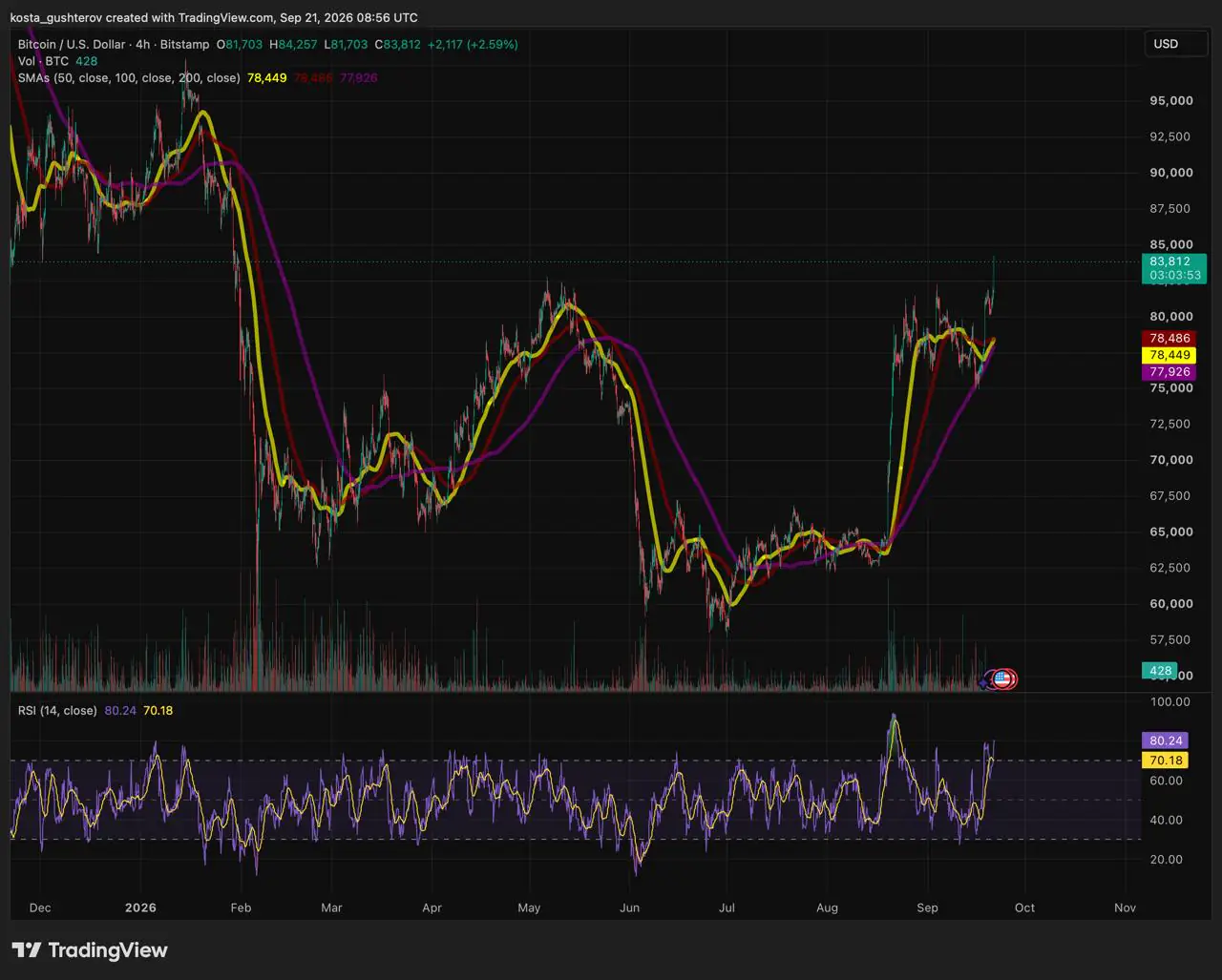
Bitcoin broke above its May high on September 21, reaching $84,257 on the Bitstamp BTC/USD four-hour chart before returning to approximately $83,800 at 08:56 UTC. The move carried the price above the May 2026 swing high near $82,800, with liquidation data from CoinGlass — a platform that aggregates liquidation figures from cryptocurrency exchanges — pointing to a burst of short-position closures concentrated within a single hour.
The advance was not a new high for 2026. Bitcoin traded around and above the same area in late January before the February sell-off. The move also cleared the wider $80,000–$82,300 resistance area identified when Bitcoin previously rebounded from $76,500–$77,000, leaving $82,800 — the former May ceiling — as the first level to watch if the price pulls back.
Most of Bitcoin's liquidations arrived within one hour
When the CoinGlass figures were checked, the platform had recorded $218.58 million in Bitcoin liquidations during the previous hour:
- Total: $218.58 million
- Short positions: $212.78 million
- Long positions: $5.80 million
- Short share: approximately 97.3%
That single hour represented approximately 79% of Bitcoin's $275.33 million liquidation total for the full 24-hour period.
The wider crypto market recorded $271.50 million in liquidations during the same hour, including $261. million in shorts. Bitcoin therefore accounted for approximately 80.5% of all market liquidations and 81.2% of the short positions closed during that window.
The concentration occurred during the same period in which the price moved through $82,800. That timing supports the conclusion that forced short covering accelerated the advance.
The imbalance also appears in the 24-hour figures
The same pattern is visible across the full 24-hour window. CoinGlass recorded $598.72 million in market-wide liquidations, with Bitcoin contributing $275.33 million, or approximately 46% of the total.
- BTC shorts: $256.65 million
- BTC longs: $18.69 million
- Short share of BTC liquidations: 93.2%
- BTC share of market short liquidations: 50.9%
CoinGlass reported 126,991 liquidated traders across the market during the 24-hour period. Its Bitcoin dashboard displayed 12,862 affected traders, and the largest single liquidation was an approximately $11.29 million BTCUSDT position on Binance.
The figures confirm forced closures, not private stop orders
A short position benefits when Bitcoin falls. If the price rises too far, an exchange can forcibly close a leveraged short before its collateral becomes insufficient. Closing the position requires buying Bitcoin, so several liquidations occurring together can push the price higher and trigger the next group of vulnerable positions. In leveraged markets, this chain-reaction dynamic is commonly known as a liquidation cascade.
The one-hour figures show that this process accelerated the move. They do not establish that liquidations started the rally — buying pressure first had to lift Bitcoin into the prices where leveraged shorts became vulnerable.
Traders may also have placed conventional stop-loss or breakout orders above $82,800. Previous swing highs commonly attract both order types, but those private instructions are not visible until they execute.
What is confirmed: $212.78 million in BTC shorts were liquidated within one hour. What is not confirmed: how many ordinary stop-loss or breakout orders were waiting above $82,800.
Three prices now define the setup
Above $84,257: the advance continues. A four-hour close above the intraday high would confirm that Bitcoin finished a trading period beyond $84,000. It would not amount to a new 2026 high, as the late-January trading area means BTC is returning to prices with recent trading history rather than entering an untested range.
Holding $82,800: the May ceiling becomes support. A pullback that attracts buyers near $82,800 would provide stronger confirmation than the initial surge. It would show that demand remained after forced short covering slowed.
Below $82,800: $80,000 returns to focus. A quick return below the previous high would turn attention back to $80,000. Beneath that, the 50-, 100- and 200-period moving averages form a tighter support cluster between approximately $77,900 and $78,500.
Bitcoin approaches those tests with the four-hour Relative Strength Index (RSI), a momentum indicator, near 80. The reading shows unusually fast momentum but does not require an immediate decline; strong advances can remain overbought while demand continues absorbing available supply.
The test begins after forced buying fades
The short liquidations help explain the speed of the move, but that source of buying disappears once vulnerable positions are closed. A successful retest of $82,800 would show that ordinary demand, not only forced purchases, is prepared to support the higher range. A rapid fall back below it would suggest that Bitcoin only moved above resistance long enough to trigger existing orders, without establishing support.
Update: At 09:32 UTC, Bitcoin was trading near $84,450. Updated liquidation data showed $311.25 million in BTC positions closed over 24 hours, including $292.21 million in shorts and $19.04 million in longs. The latest one-hour total had risen to $244.19 million, with shorts accounting for $238.42 million, or nearly 98%. The figures indicate that forced short closures remained concentrated as Bitcoin moved further above its May high.
This article is provided for informational purposes only and does not constitute financial or investment advice. Cryptocurrency prices, leverage and liquidation totals can change rapidly.

