Weak Nonfarm Payrolls Fuel Bitcoin (BTC) Rally Toward $90,000 Target
Key Takeaways
- •September nonfarm payrolls added just 29,000 jobs, well below expectations, and the unemployment rate rose to 4.2%, pushing the market-implied probability of an October Fed rate hike down to 18% from 64%.
- •Bitcoin reached $87,229 on Bitstamp, its highest price since January, before pulling back to around $86,700, aided by declining Treasury yields and the withdrawal of a sell wall near $85,000.
- •Glassnode identified a fresh concentration of sell orders around $87,000, and analysts view the $87,300–$87,400 zone as decisive, with a daily close above $87,500 potentially triggering a move toward $90,000 and a rejection risking a retest of $84,500.
- •Spot Bitcoin ETFs attracted approximately $2.6 billion in net inflows during September, a factor QCP Capital cited behind Bitcoin's 12% monthly gain as gold fell 8.5% over the same period.
- •Strategists diverge on the outlook: Wincent's Paul Howard maintained a $100,000 year-end target citing Citi's $113,000 forecast, while Sygnum's Fabian Dori cautioned that liquidity conditions, not weak employment data alone, remain the key driver of Bitcoin's price.
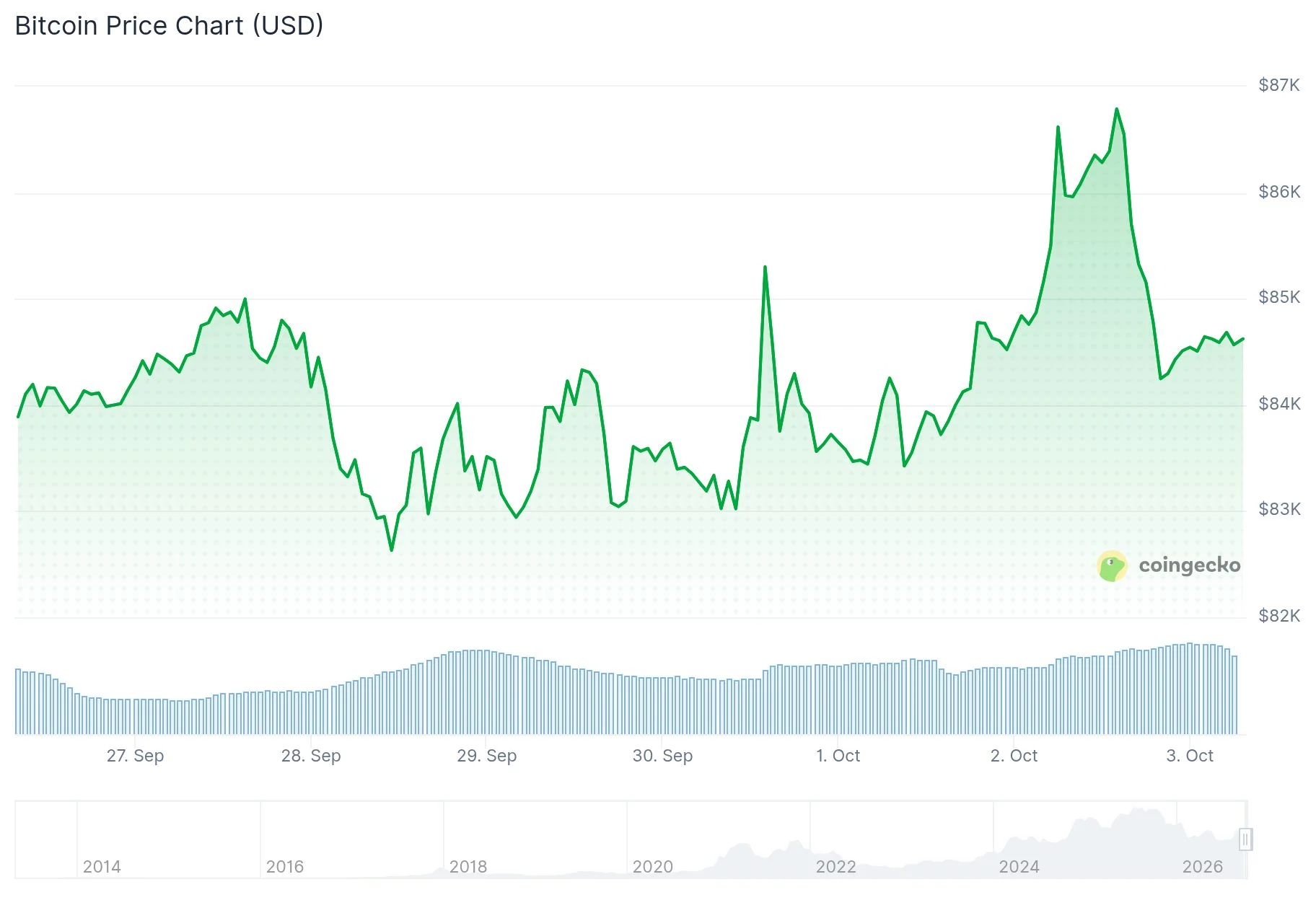
Bitcoin pushed above the $87,000 threshold on Friday, October 2, 2026, as disappointing United States employment figures triggered a decline in Treasury bond yields and reenergized demand for risk assets. According to TradingView market data, the leading cryptocurrency touched $87,229 on the Bitstamp exchange, marking its strongest performance since January, although the peak fell marginally short of establishing a fresh eight-month record. Bitcoin retraced to levels beneath $86,000, and as of publication time the digital asset was changing hands around $86,700.
The rally was underpinned by a combination of macroeconomic and market-structure factors: a September nonfarm payrolls report that fell far short of forecasts, a second straight session of declining Treasury yields, and the removal of a major sell wall near the $85,000 level.
Weak Jobs Report Reshapes Rate Expectations
The September nonfarm payrolls report registered a meager 29,000 new positions, significantly missing the 84,000 additions that market forecasters had anticipated. The shortfall was substantial, with payrolls coming in at barely a third of the projected figure. August employment data underwent a downward revision as well, from 162,000 to 133,000 jobs, while the unemployment rate ticked upward to 4.2% from the previous 4.1% reading. According to trading intelligence platform The Kobeissi Letter, the release marked the third-weakest employment report of 2026.
BREAKING: The US economy adds +29,000 jobs in September, well below expectations of +89,000. The unemployment rate rose to 4.2%, above expectations of 4.1%. August's job number was also revised down by -29,000 jobs. This marks the third weakest jobs report of 2026.
— The Kobeissi Letter (@KobeissiLetter) October 2, 2026
Equity markets responded positively to the labor market weakness. The S&P 500 index advanced 1%, while the technology-heavy Nasdaq Composite jumped 1.8%.
Market participants also dramatically reduced their expectations for Federal Reserve tightening. CME Group's FedWatch Tool indicated merely an 18% probability of a .25% rate increase in October, plummeting from the 64% probability registered one week prior. The swing illustrates why the monthly payrolls release ranks among the most closely watched macro data points in digital-asset trading: the anticipated path of interest rates shapes the opportunity cost of holding a non-yielding asset such as Bitcoin.
Treasury Yields Continue Retreat
US Treasury yields extended their decline for a second consecutive session. The 30-year maturity yield registered at 5.573%, while the benchmark 10-year yield settled at 5.2%.
Cryptocurrency trading institution QCP Capital suggested that a Treasury market relief rally would provide Bitcoin with its most favorable upward trajectory. The firm observed that Bitcoin has demonstrated resilience throughout a real-rate environment that has negatively impacted gold valuations. Real yields — nominal borrowing costs adjusted for inflation — are widely watched as a pressure point for assets that generate no income, a category spanning both gold and Bitcoin.
Order book data reinforced the picture of improving momentum. Blockchain analytics platform Glassnode reported that sellers had partially executed limit orders near the $85,000 level before withdrawing their remaining positions, eliminating a significant resistance barrier that had previously constrained upward price movement. Glassnode subsequently identified a fresh concentration of sell orders positioned around $87,000. Sell-wall dynamics of this kind are a staple of order-book analysis, offering a structural read on where overhead supply sits.
QCP Capital established resistance at $87,400 and support at $82,500, highlighting that Bitcoin successfully defended the support threshold on three separate occasions this week. Market observers view the $87,300–$87,400 zone as critical for a potential rally toward $90,000.
Analysts Point to Bullish Breakout
Market analyst Ted, operating under the handle @TedPillows on X, indicated that Bitcoin had broken out of its bullish pennant formation accompanied by increasing spot market demand. He emphasized that the cryptocurrency is nearing its yearly opening price level — the reference price from the start of the calendar year and one of the most widely cited markers in technical analysis — suggesting that a daily settlement above $87,500 could catalyze a rapid advancement toward $90,000. He cautioned, however, that another failure at this resistance zone would likely force price action back toward a retest of the breakout point at $84,500.
$BTC has broken out of its bullish pennant with rising spot demand. Now, Bitcoin is approaching its yearly open level. If BTC manages a daily close above $87,500, a rally towards $90,000 could happen quickly. Another rejection from this zone means BTC will retest the breakout… pic.twitter.com/ibfNPD5cmy
— Ted (@TedPillows) October 2, 2026
Market Strategists Evaluate Future Trajectory
Bitcoin registered a 12% appreciation throughout September, while gold experienced an 8.5% decline during the identical timeframe. QCP Capital characterized the rally as resembling a concentrated capital flow movement rather than a widespread rotation away from fixed-income securities. The firm also highlighted the role of exchange-traded funds focused on spot Bitcoin, which accumulated approximately $2.6 billion in net inflows throughout September, identifying the flows as a contributing factor driving the appreciation. Spot ETF flows are closely watched as a barometer of institutional participation in the asset.
Market analysts project that Bitcoin could achieve valuations between $90,000 and $100,000 before year-end if it successfully breaks through its current resistance zones.
Not all strategists read the labor market data as straightforwardly bullish. Fabian Dori, Chief Investment Officer at Sygnum Bank, cautioned that disappointing employment data does not automatically translate into bullish conditions for Bitcoin. He emphasized that liquidity conditions remain the primary catalyst for Bitcoin price action regardless of direction.
Paul Howard from Wincent reaffirmed that his $100,000 year-end projection remains intact, referencing Citi's updated price forecast of $113,000 as supporting evidence. Matt Mena, Senior Crypto Research Strategist at 21Shares, noted that the fourth quarter historically represents Bitcoin's strongest performance period, delivering average returns of 62.7%. In the weeks ahead, traders are likely to watch Bitcoin's behavior around the $87,300–$87,400 resistance zone, the $84,500 breakout level, and the next monthly installment of US labor data.

