Bitcoin (BTC) Blasts Through $80K, Liquidating $250 Million in Short Positions
Key Takeaways
- •Bitcoin rose roughly 6% on Friday to an intraday high of $81,034 on Bitstamp, breaking above the $80,000 level during US equity trading hours.
- •The rally eliminated approximately $250 million worth of cryptocurrency short positions across a four-hour window, according to CoinGlass data.
- •The 30-year US Treasury yield climbed 90 basis points to 5.34% as energy-market instability persisted, with IEA data showing Strait of Hormuz crude flows fell to 7.6 million barrels daily in August, a 13.1 million barrel shortfall versus pre-conflict levels.
- •Bitcoin recovered its True Market Mean of $76,660, a level Glassnode said places the asset back in a bullish regime, while analysts broadly view the $80,000–$82,000 band as critical resistance, with corporate treasuries' average cost basis at $80,500.
- •A US House committee passed the Strategic Bitcoin Reserve bill, which would secure government-seized Bitcoin in a federal reserve for at least 20 years with mandatory periodic audits, though the measure still requires approval from the full House and the Senate.
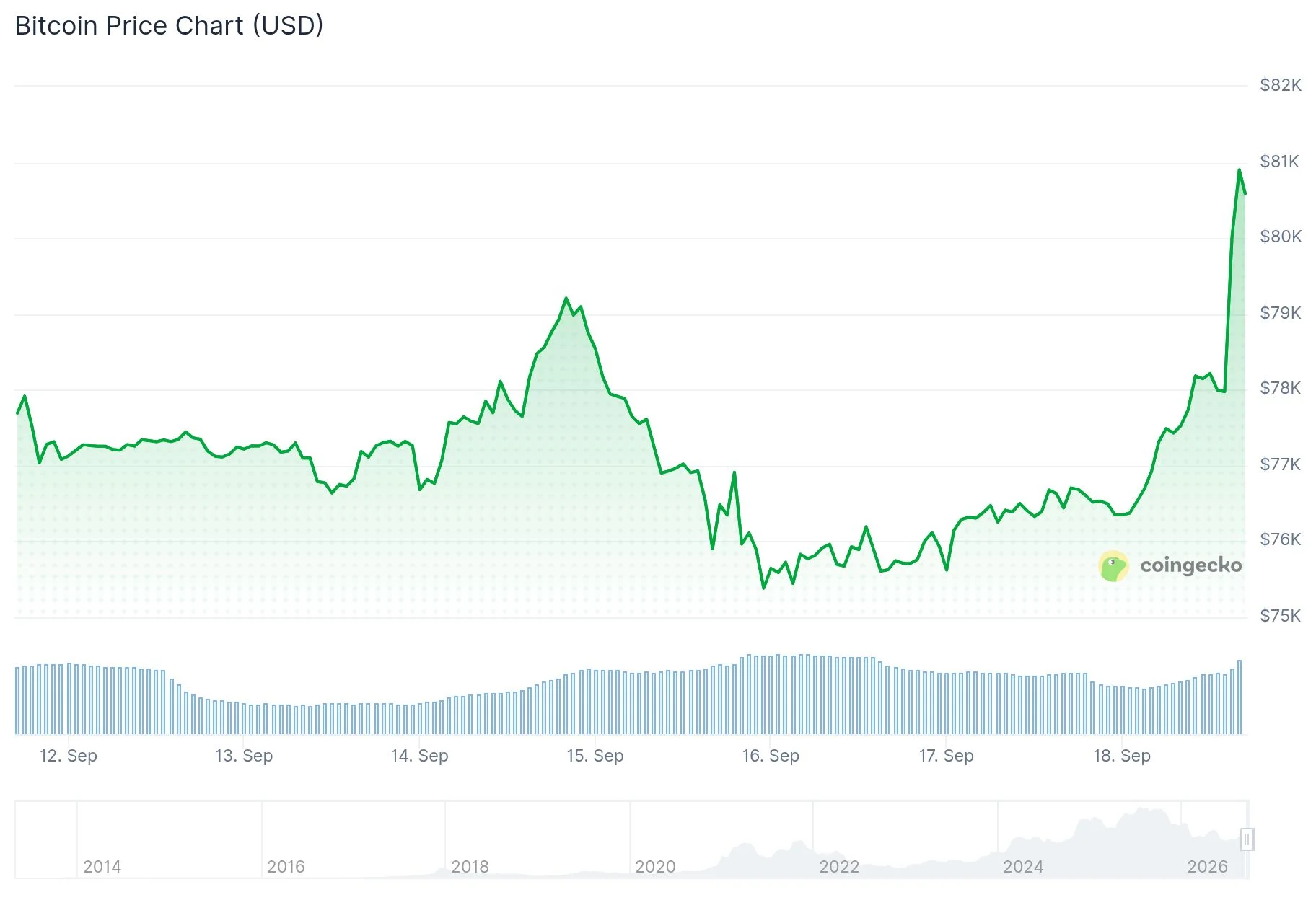
Bitcoin, the world's largest cryptocurrency by market value, surged roughly 6% on Friday, blasting through the $80,000 threshold as turmoil in global energy markets pushed Treasury yields to elevated levels. The momentum shift materialized at the opening of US equity market hours.
The BTC/USD trading pair touched an intraday peak of $81,034 on the Bitstamp exchange, according to TradingView market data. The explosive move reflected a broader rotation into riskier assets as market participants responded to escalating volatility in the energy sector.
West Texas Intermediate crude dropped to $94.8 per barrel before staging a rebound, with oil hovering near the $98 mark at the time of writing as supply-disruption fears maintained pressure across commodity markets. The Strait of Hormuz ranks among the world's most important transit routes for seaborne crude, which is why its flow data draws close scrutiny whenever supply security comes into question. The International Energy Agency issued a Friday warning indicating that nations might need to implement oil consumption reductions. According to the IEA's assessment, petroleum flows passing through the Strait of Hormuz declined to 7.6 million barrels daily in August — a 13.1 million barrel shortfall compared to pre-conflict levels with Iran.
BREAKING: The SEC and CFTC are pushing ahead with crypto rules despite the CLARITY setback. And $BTC is back above $81K. Imagine if Washington finally got its act together. pic.twitter.com/HJ9MbzpVZw
— Merlijn The Trader (@MerlijnTrader) September 18, 2026
Against the backdrop of petroleum market instability, the 30-year US Treasury bond yield jumped to 5.34%, marking a 90 basis point increase for the trading session. Escalating yields have compelled monetary authorities in both the United States and Japan to implement interest rate hikes during the current week. Rising yields raise the opportunity cost of holding non-yielding assets such as Bitcoin, a dynamic that typically weighs on risk appetite — making the cryptocurrency's climb through this backdrop all the more notable.
Bitcoin's rapid ascent catalyzed a cascade of forced liquidations among bearish traders. Data from CoinGlass revealed that approximately $250 million worth of cryptocurrency short positions were eliminated across a four-hour window. Liquidations of this kind occur when leveraged bets move too far against traders and positions are closed automatically, and the resulting buy-to-cover activity can amplify the very rally that triggered it.
Market technician Rekt Capital shared analysis on X characterizing the present situation as a "moment of truth" for optimistic traders. His assessment highlighted $82,000 as a critical threshold — an inability to breach this level could establish a double-top rejection formation echoing the unsuccessful May recovery attempt. A sustained move through that ceiling, or another rejection there, now stands as the clearest near-term marker for the rally's durability.
BTC Recaptures Critical Blockchain Metric
The flagship cryptocurrency also recovered its True Market Mean position, currently established at $76,660. Cost-basis models of this kind track the aggregate on-chain purchase price of coins and are widely used as dividing lines between bullish and bearish market conditions. Blockchain analytics firm Glassnode announced via X that this development places the asset "back above a crucial level and back into a bullish regime."
Corporate Bitcoin treasury holdings carry an average acquisition cost of $80,500, reinforcing the significance of this price zone as a contested battleground between bulls and bears. Market analysts broadly identify the $80,000–$82,000 band as critical resistance territory.
Nic Puckrin, founder of Coin Bureau, told Yahoo Finance: "Once bitcoin broke past the resistance level around $78,000, shorts got liquidated, pushing it toward $80,000." He continued: "The real test is now in the $80,000–$82,000 range, where resistance is much stronger."
Congressional Progress on Strategic Bitcoin Reserve Legislation
From a policy perspective, House committee members moved the Strategic Bitcoin Reserve legislation forward on Thursday. The proposed law would secure government-seized Bitcoin holdings within a federal reserve structure for a minimum two-decade period, accompanied by mandatory periodic auditing. If enacted, the framework would formalize a long-term federal commitment to holding the asset, with the audit provisions establishing a standing record of US holdings.
BREAKING: US House committee PASSES the Strategic Bitcoin Reserve bill. The bill would lock government held Bitcoin in a federal reserve for at least 20 years and require regular audits of US Bitcoin holdings. pic.twitter.com/YbiOzeBVfe
— Bull Theory (@BullTheoryio) September 16, 2026
Committee passage occurred along partisan lines, with the measure still requiring endorsement from both the full House chamber and the Senate — hurdles that will determine whether proposal advances beyond the committee stage.
The digital asset maintained its strength despite the Clarity Act encountering defeat during a Senate procedural vote earlier this week, a split outcome that underscores the uneven path of crypto legislation in Congress. Cryptocurrency futures market participants sustained optimistic positioning, with substantial concentration in bullish call options entering the weekend session.
Source: Blockonomi

