Bitcoin Surges Past $80,000 for First Time in Three Months Amid Record Spot ETF Inflows
Key Takeaways
- •Bitcoin moved back above $80,000 for the first time since May 15, 2026, after gaining about 38% from its late-June and early-July low point below $58,000.
- •U.S.-listed spot Bitcoin ETFs took in about $1.9 billion last week, marking their largest seven-day inflow since October 2025.
- •More than $220 million in cryptocurrency short positions were liquidated over the 24 hours around Bitcoin’s move above $80,000.
- •Treasury repurchase activity and lower government bond yields have helped support risk assets, including cryptocurrencies.
- •Market attention is now on this week’s PCE inflation report, which is closely watched for clues on the Federal Reserve’s next interest-rate moves.
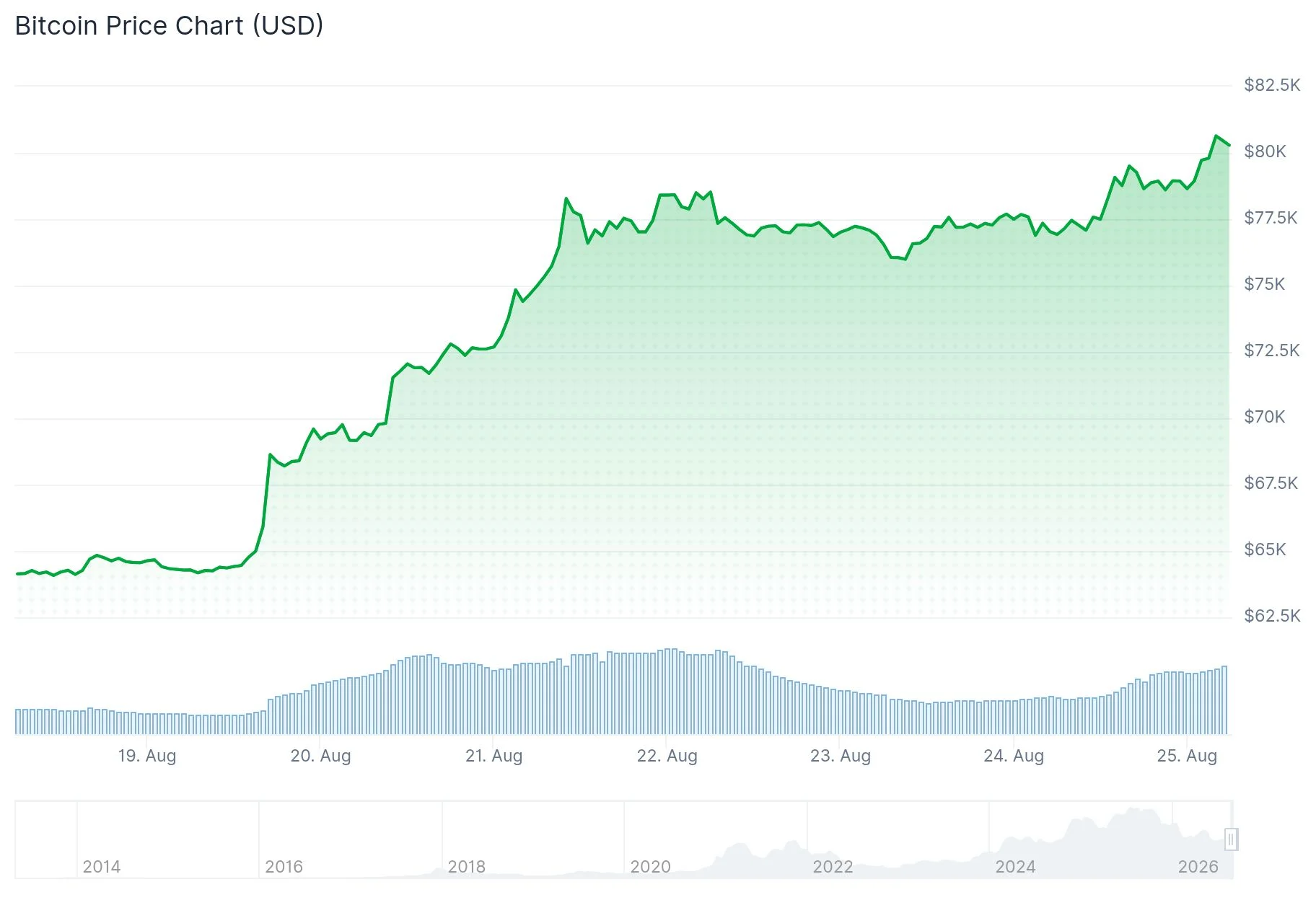
Bitcoin pushed through the $80,000 price point on Monday, marking its first visit to this level since May 15, 2026, and continuing a powerful uptrend that has accelerated throughout the past week. The breakthrough occurred as Wall Street trading commenced, with the BTC/USD pair advancing approximately 3% during the session before experiencing a modest retreat following the close of European markets.
Since touching its nadir in late June and early July — when the flagship cryptocurrency momentarily traded beneath $58,000 — Bitcoin has appreciated by approximately 38%. On a month-to-date basis, the digital asset has gained 25% in August, representing its strongest August performance since 2017.
Treasury Strategies Support Risk Assets
The upward momentum has received significant support from evolving U.S. Treasury strategies. Treasury officials have doubled their scheduled repurchases of longer-maturity government securities extending through early November, financing these acquisitions through short-term debt instruments. Additionally, on Monday the Treasury indicated potential utilization of its approximately $1 trillion General Account to facilitate the buyback operations. The Treasury has run a regular buyback program for older securities since mid-2024, its first routine repurchase operations in more than two decades, and the General Account — held at the Federal Reserve — functions as the U.S. government’s primary operating account.
The corresponding decline in Treasury yields has provided support for risk-oriented assets, including cryptocurrency markets, following an extended period of restrictive financial conditions. Lower yields reduce the return available on safe assets such as government bonds, a dynamic that has historically coincided with stronger demand for higher-risk holdings.
Institutional Appetite Strengthens
U.S.-listed spot Bitcoin exchange-traded funds attracted approximately $1.9 billion during the previous week. The figure represents the most substantial seven-day capital influx since October 2025, signaling reinvigorated appetite among institutional and traditional market participants. Spot Bitcoin ETFs, which U.S. regulators first approved in January 2024, hold the cryptocurrency directly and trade on conventional stock exchanges, allowing traditional investors to gain exposure without purchasing and safeguarding the coins themselves.
Source: — Wu Blockchain (@WuBlockchain) August 25, 2026
The breach of the $80,000 threshold simultaneously catalyzed a cascade of forced short closures. Data from CoinGlass revealed that more than $220 million in cryptocurrency short positions were liquidated during the 24-hour window surrounding the milestone; liquidations occur when exchanges forcibly close leveraged positions once price moves exhaust a trader’s posted collateral, a mechanism that can amplify short-term price swings. Technical analysts have identified a concentration of buy-side liquidity positioned near $76,700, which market observers consider a probable support zone should prices experience a retracement.
Market Observers Evaluate Durability of Rally
Market analyst Ali Charts shared on X that Bitcoin has successfully recaptured its 1,130-day simple moving average — a long-run trend gauge that averages closing prices across roughly three years to filter out short-term noise — a technical level that has historically signified the conclusion of bear market phases across four distinct market cycles. Bitcoin relinquished this moving average on June 1, 2026, remaining beneath it for 80 consecutive days before recovering it on August 20 following a move above $74,000. Ali Charts suggested that if historical patterns hold, the cyclical bottom may have already been established.
BITCOIN: ANOTHER BULLISH SIGNAL $BTC has just reclaimed its 1,130-day simple moving average as support, a level that has consistently marked the end of previous bear markets. Over the past four market cycles, Bitcoin began a new bull market shortly after reclaiming this moving… pic.twitter.com/Re8TYnDe5o — Ali Charts (@alicharts) August 24, 2026
Trading analyst Rekt Capital observed that Bitcoin secured its first weekly settlement above the 50-week exponential moving average — presently positioned at $77,251 — since November 2025.
“Should this represent a Bear Market Relief Rally, then Bitcoin might experience a retracement as soon as this week, or potentially within the coming weeks,” Rekt Capital stated. “The critical factor now involves Bitcoin demonstrating persistent strength.”
Throughout Bitcoin’s 2022 bear cycle, BTC registered two weekly closes above its 50-week EMA prior to descending to cyclical lows — a downturn that took the cryptocurrency from its November 2021 record near $69,000 to under $16,000 after the collapse of the FTX exchange.
Market attention now shifts to the Federal Reserve’s primary inflation metric, the PCE index, scheduled for release this week. The Personal Consumption Expenditures index, published by the Commerce Department, is the inflation gauge the Federal Reserve uses for its 2% target, and its readings inform expectations about the future path of interest rates.
Source: Blockonomi

