Bitcoin Breaks Above $78,000 in Largest Weekly Gain Since February 2024
Key Takeaways
- •Bitcoin climbed above $78,000 on August 21, 2026, its first time above that level since May, after gaining roughly $16,000 in under five days for its largest weekly advance since February 2024.
- •The U.S. Treasury announced on August 19 that it would at least double liquidity-support buybacks of longer-dated bonds to a minimum of $4 billion per operation, effective September 9, pressuring long-end yields lower.
- •A cascading short squeeze liquidated more than $3 billion in leveraged positions within a single 24-hour window, while U.S. spot Bitcoin ETFs drew over $1 billion in net inflows, the strongest weekly tally since January.
- •President Trump urged passage of the CLARITY Act at an August 19 White House meeting with crypto executives, with the Senate set to vote on the market-structure bill, which would divide digital-asset oversight between the SEC and CFTC, on September 15.
- •Coinbase CEO Brian Armstrong said Bitcoin is very likely to reach $300,000 to $400,000 by 2030, even as the asset still trades more than 40% below its October 2025 all-time high above $126,000.
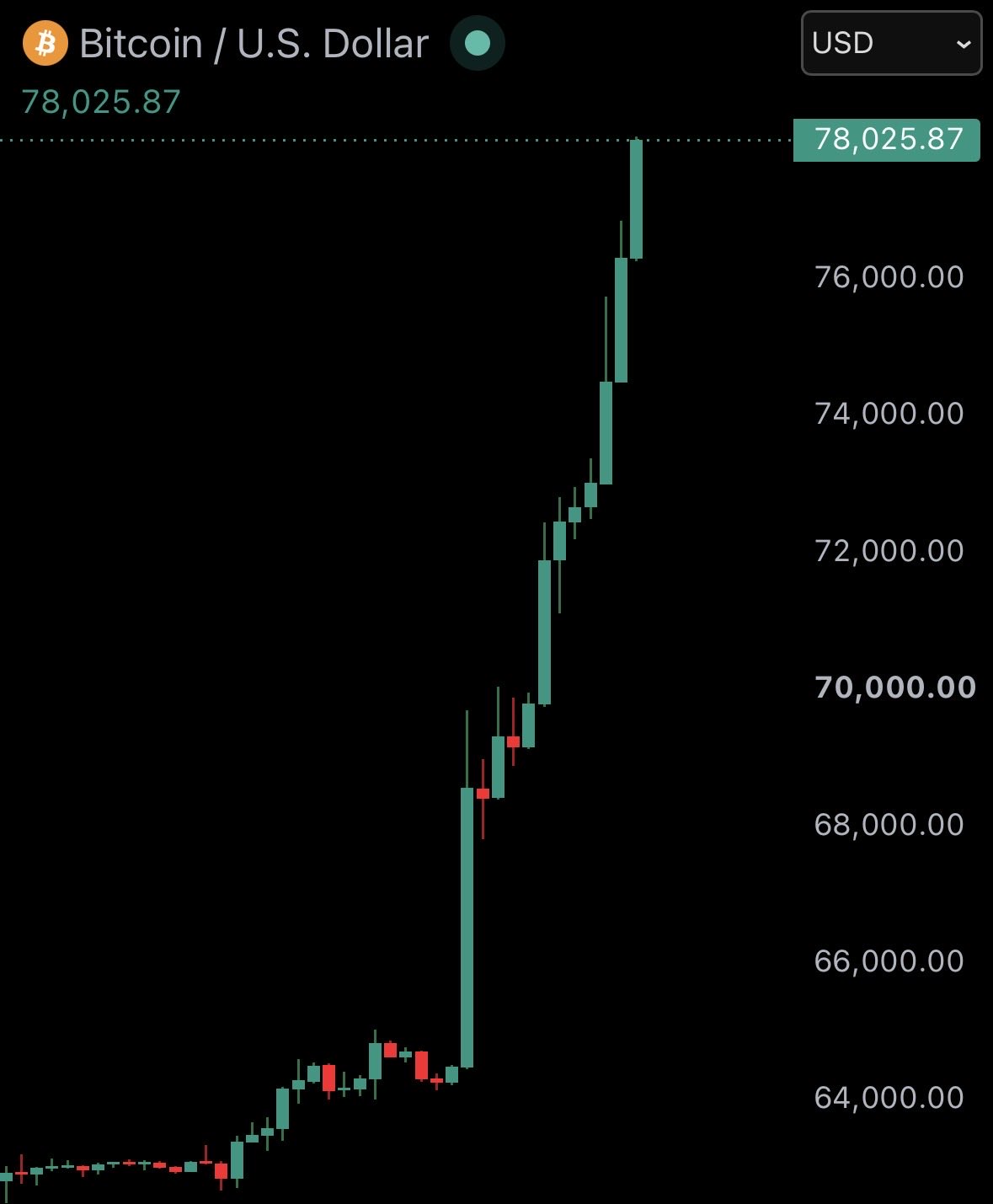
Bitcoin has climbed above $78,000 for the first time since May, surging roughly $16,000 in under five days and posting its largest weekly gain since February 2024 with an advance of more than 20%. The rally has added roughly $280 billion to Bitcoin’s market capitalisation, lifting it to around $1.5 trillion and powering a broader cryptocurrency recovery that has injected hundreds of billions of dollars into the total market in a matter of days.
As of the morning of August 21, 2026, Bitcoin was trading at about $78,000, up from around $63,000 at the start of the week. Even by crypto standards, the speed of the move is notable: the asset has gained more ground in five sessions than it managed across many prior months of consolidation.
Ethereum and other major altcoins have followed, with earlier double-digit percentage advances helping push the overall crypto market capitalisation back toward the $2.6 trillion range after it had hovered near $2.17 trillion just days earlier. Trading volumes have surged, and the Fear & Greed Index — a widely followed crypto sentiment gauge that aggregates price momentum, trading volume, volatility, and social-media signals — has shifted decisively into greed territory.
Treasury liquidity move provides the spark
The primary catalyst came on August 19, when the U.S. Treasury announced it would at least double the size of liquidity-support buybacks for longer-dated government bonds — from a maximum of $2 billion to at least $4 billion per operation — for the 10-to-20-year and 20-to-30-year sectors. Buybacks of this kind see the Treasury repurchase outstanding longer-dated bonds, paying cash into the market while removing duration from circulation — a lever aimed directly at the far end of the yield curve.
Effective from September 9 through early November, the move immediately pressured long-end yields lower. The 30-year yield retreated from multi-year highs, easing financial conditions and encouraging capital to flow back into risk assets. Bitcoin, long sensitive to shifts in liquidity and real yields — in part, analysts say, because it pays no yield of its own — responded sharply.
That macro catalyst collided with crowded short positioning. Billions of dollars in leveraged short positions were liquidated in rapid succession — more than $3 billion across the market in a single 24-hour window earlier in the week, with the majority concentrated in Bitcoin. The forced buying generated by the short squeeze created a self-reinforcing upward spiral that carried the price through successive resistance levels.
Institutional flows and whale accumulation return
Institutional demand also reappeared. U.S. spot Bitcoin ETFs recorded more than $1 billion in net inflows over several days, the strongest weekly tally since January. The funds, approved by U.S. regulators in January 2024, hold Bitcoin directly and trade on exchanges like ordinary stocks, making the asset accessible through standard brokerage accounts. Large holders, or “whales,” have been accumulating as well, adding billions of dollars’ worth of Bitcoin in recent weeks, according to on-chain data.
Policy optimism provided additional fuel. President Donald Trump’s White House meeting with crypto executives on August 19, during which he urged passage of the CLARITY Act, reinforced the sense that regulatory clarity is approaching. The Senate is scheduled to vote on the market-structure bill on September 15. The legislation is designed to divide oversight of digital-asset trading between the Securities and Exchange Commission and the Commodity Futures Trading Commission, addressing a jurisdictional gray area that U.S. crypto firms have navigated for years.
Bullish calls from industry voices
Coinbase CEO Brian Armstrong, speaking on CNBC’s Squawk Box and Fox Business the following day, framed the moment in explicitly bullish terms. He said the crypto market is “on the cusp” of the next bull market for spot trading, pointing to the roughly year-long duration of the prior downturn — consistent with historical bear-market lengths of 370–380 days — the impending CLARITY vote, and Bitcoin’s traditional seasonal strength in the final months of the year. On long-term price, Armstrong stated it is “very likely” Bitcoin will reach $300,000 to $400,000 by 2030. When asked about $100,000 by the end of 2026, he replied that there is “a good chance.”
Other prominent voices echoed the constructive outlook. Geoffrey Kendrick, Standard Chartered’s head of crypto research, called the Treasury buybacks “exactly the type of thing bitcoin loves” and reiterated a year-end 2026 target of $100,000. VanEck’s Matthew Sigel has projected $100,000 next year, with potential upside toward $500,000 by 2029 if historical cycle patterns hold.
These forecasts have amplified retail and institutional attention at a moment when technical momentum is already strong: Bitcoin has reclaimed its 200-day exponential moving average — a long-run trend indicator many traders treat as the dividing line between bull and bear regimes — for the first time in months and broken above multiple volume-profile resistance zones.
Context and risks
The broader context remains important. Even after this powerful rebound, Bitcoin still trades more than 40% below its October 2025 all-time high above $126,000, and the total crypto market remains roughly 45% under its peak near $4.8 trillion. The current advance therefore represents a recovery within a larger corrective phase rather than a confirmed new cycle high. Nevertheless, the combination of improved liquidity, regulatory progress, and exhausted short interest has shifted market psychology rapidly.
Risks are real. Some analysts have described the near-term move as “premature,” arguing it has been driven more by short covering and temporary yield relief than by sustained organic demand. Overbought readings on shorter timeframes, elevated funding rates — the recurring payments that keep leveraged perpetual-futures prices anchored to spot — and the possibility of profit-taking ahead of the September Senate vote could produce volatility. Any renewed rise in long-term yields or unexpected political setbacks on the CLARITY Act would likely test the durability of the rally.
For now, the data are unambiguous. In less than a week, Bitcoin has added $16,000, delivered its strongest weekly performance in more than two years, and expanded its market value by roughly $280 billion. Supported by Treasury liquidity measures, a cascading short squeeze, robust ETF inflows, and high-profile endorsements from Coinbase CEO Brian Armstrong and other institutional voices, the cryptocurrency market has staged one of the most impressive short-term recoveries of 2026.
Whether this surge marks the true beginning of the next sustained bull phase will depend on follow-through capital, further policy clarity — with the enlarged Treasury buyback operations beginning September 9 and the Senate’s CLARITY vote following on September 15 — and the market’s ability to hold gains above key technical levels such as $80,000 and, ultimately, $90,000.

