Bitcoin's Failed $82K Breakout Puts Spot Demand to the Test
Key Takeaways
- •Bitcoin traded near $79,600 after retreating from $82,250, failing to hold acceptance above the roughly $82,000 resistance zone.
- •Binance Bitcoin open interest rose nearly 8% in 24 hours to over $10 billion, its highest dollar level in six months, equivalent to 125,830 BTC.
- •The 90-day moving average of spent outputs from coins held more than five years reached about 1,500 BTC, roughly double its May level.
- •Large whale deposits to exchanges increased as Bitcoin climbed from the mid-$60,000s, with seven-day altcoin deposit transactions rising to about 45,000.
- •Open interest, spent outputs, and exchange inflows cannot reveal whether coins were sold, deposits funded futures positions, or which side initiated new derivatives exposure.
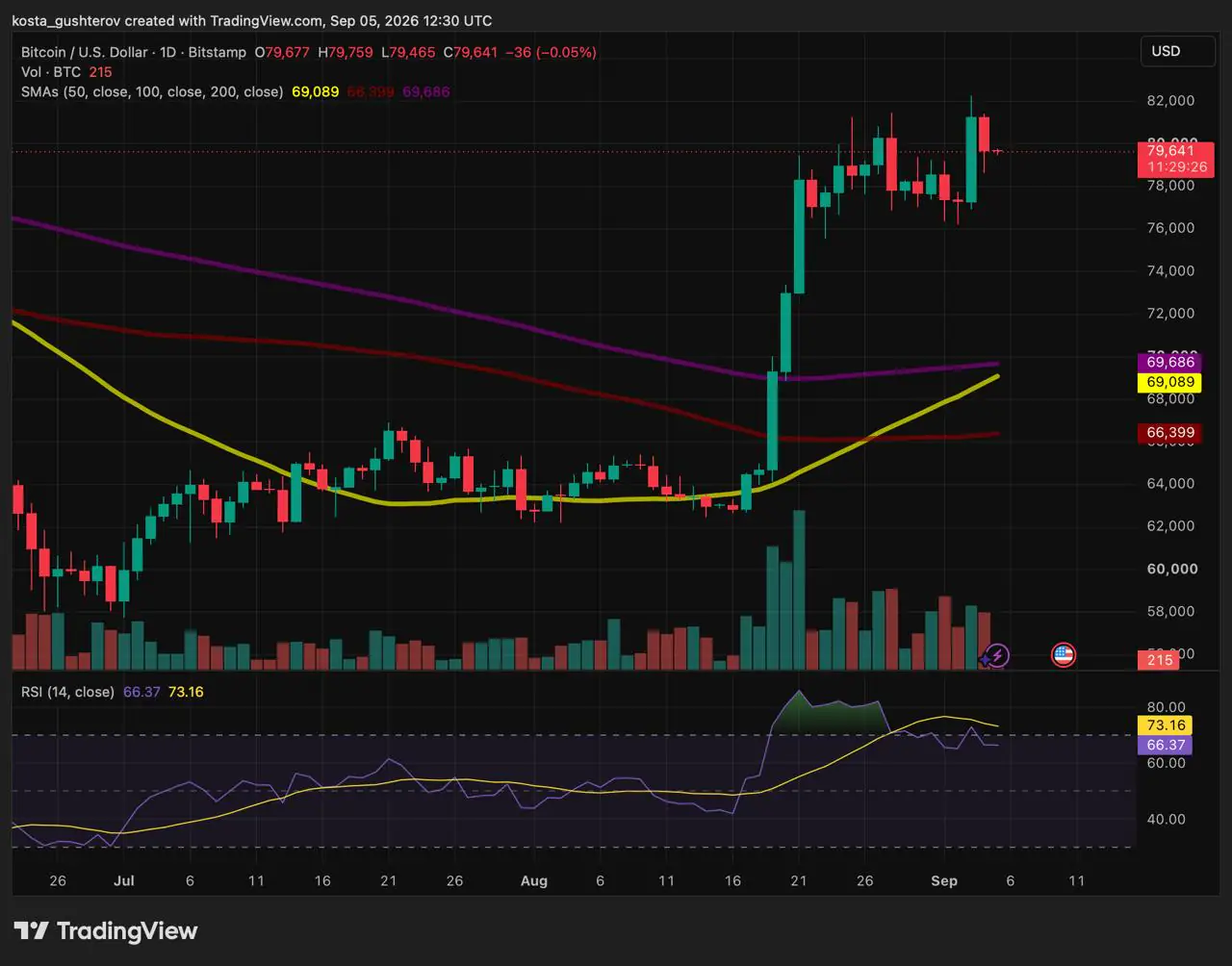
Bitcoin retreated after reaching $82,250, and the next challenge for the market is now clear: whether spot demand can back a fresh breakout attempt.
Bitcoin's September high becomes the next resistance
Bitcoin was trading near $79,600 at the time of writing, two days after touching $82,250.
On the daily BTC/USD chart, price remained above the 50-, 100- and 200-day simple moving averages. Those trend references sat between approximately $66,400 and $69,700, underscoring how far Bitcoin has recovered since August.
Their distance below the current market also means they provide little guidance on immediate support near $79,600. The shorter-term question is whether Bitcoin can hold inside its recent range before challenging the September high again.
An earlier analysis of Bitcoin's recovery levels identified $81,480 as the first major ceiling. Bitcoin did trade above that level, but its subsequent retreat below $80,000 shows buyers did not establish lasting acceptance above the wider $82,000 area.
Binance open interest rose beyond the price effect
A CryptoQuant analysis by Darkfost reported that Binance Bitcoin open interest increased nearly 8% in 24 hours and exceeded $10 billion, its highest dollar value in six months. Open interest counts the total value of futures contracts that have been opened but not yet closed or settled, so it is a standard gauge of how much leveraged positioning is sitting in the market at any moment.
The key figures on Binance:
- $10B+ — dollar-denominated Bitcoin open interest.
- 125,830 BTC — outstanding exposure expressed in BTC.
- 37%+ — Binance's reported share of Bitcoin open interest.
Part of the dollar increase came from Bitcoin itself becoming more valuable, which lifted the notional value of contracts that were already open. However, CryptoQuant's BTC-denominated measure also climbed, indicating that outstanding exposure expanded even after much of that price effect was removed.
The 125,830 BTC reading is a unit of measurement, not proof that the same amount of physical Bitcoin was deposited or locked as collateral. It expresses the notional size of the contracts in BTC terms.
Open interest also cannot reveal whether aggressive buyers, hedging activity or new short exposure drove the increase. Every futures contract has both a long and a short side. Funding rates, futures basis and order-flow data are needed to judge which side is paying more aggressively for exposure.
What the increase does mean is that more notional futures exposure remains open and vulnerable to a sudden price movement. That can amplify volatility if traders begin closing positions together.
Activity is also rising among five-year holders
A separate CryptoQuant analysis found that the 90-day moving average of spent outputs from Bitcoin held for more than five years had reached approximately 1,500 BTC. That reading was around twice its level in May.
Bitcoin records balances as unspent transaction outputs, commonly called UTXOs. Once an output is included in a new transaction, it becomes a spent output. Its age indicates how long the coins had remained untouched, but not why they moved or where they ultimately went.
Some of these transfers may precede sales, but wallet consolidation, custody changes and security upgrades can produce the same on-chain signal. Darkfost cited wallet reorganization after the Coldcard episode as one possible explanation, although the metric cannot identify individual motives.
An earlier report on the Coldcard wallet flaw explains how defensive wallet migrations can wake dormant coins without creating immediate sell-side supply.
The 1,500 BTC figure therefore measures greater activity among older outputs. It is not the amount sold by long-term holders during a single session.
Whale deposits bring Bitcoin closer to liquidity
Some of the renewed activity also reached exchanges. A third CryptoQuant analysis reported that large Bitcoin deposits increased as BTC advanced from the mid-$60,000s into the upper-$70,000s, with Binance receiving many of the largest inflows.
The activity was not confined to Bitcoin: seven-day altcoin deposit transactions reportedly climbed from approximately 15,000-20,000 around the August lows to roughly 45,000.
Moving BTC onto an exchange makes it easier to trade, but a deposit is not a completed sale. The coins may instead be used for market making, arbitrage, custody or collateral.
Rising Binance inflows and higher futures open interest could partly reflect related activity. Some deposited BTC may support coin-margined positions or other trading strategies, although the available data do not connect specific deposits to individual futures contracts.
Much of Binance's derivatives activity can also use stablecoin collateral, so the two datasets should not be treated as direct equivalents.
What is visible:
- Futures exposure increased in both dollar and BTC terms.
- Older outputs began moving more frequently.
- Large exchange deposits also increased.
What the metrics cannot show:
- Whether older coins were transferred for sale.
- Whether exchange deposits funded futures positions.
- Which side initiated the new derivatives exposure.
What would separate demand from speculation
Spot activity should accompany the next breakout
Another advance through the September resistance would be more convincing if spot-market activity strengthened alongside it. Spot buying provides direct demand for the underlying asset without requiring a futures contract that can later be liquidated. Since January 2024, spot Bitcoin exchange-traded funds in the United States have become one of the most visible channels for that kind of unleveraged exposure, making spot-flow data from such vehicles a widely watched complement to exchange volumes when traders assess demand at resistance levels.
The available open-interest data confirm that futures participation increased, but they do not measure how much unleveraged demand is waiting above $80,000. Spot volume and order flow will provide a more direct test when Bitcoin revisits the resistance zone.
More leverage below resistance increases fragility
Open interest confirms that positions are being added; it does not establish that the underlying trend is healthy. If exposure keeps expanding while BTC repeatedly fails to advance, more positions become vulnerable to a sudden move outside the range.
Funding and futures basis can add context. Rapidly rising positive funding would show that leveraged long positions are becoming more expensive to maintain, increasing the risk of an unwind if price falls.
Netflows show whether exchanges retain deposits
Gross inflows measure BTC entering identified exchange wallets without subtracting withdrawals. Netflow provides a clearer view of whether exchange-controlled balances increased over the same period.
Even positive netflow cannot prove that retained coins will be sold. It can, however, show whether more BTC remains readily available inside exchange infrastructure while the market tests resistance.
The breakout now needs buyers, not only activity
Bitcoin attracted new futures exposure just as older coins and whale deposits became more active. Whether that activity supports or disrupts the recovery now depends on the strength of spot demand.
A move above the resistance zone would be more credible if spot activity expanded without an equally sharp build-up in leveraged exposure. Until that happens, the increase in participation shows that Bitcoin is attracting attention again, not that buyers have secured its next leg higher.
The article is provided for informational purposes only and does not constitute investment advice.
Source: Coindoo
