Bitcoin Slides 3.7% to Test $81,500, the Average Cost Basis for US Spot Bitcoin ETF Holders
Key Takeaways
- •Bitcoin fell 3.7% and moved to test the $81,500 level, which corresponds to the average cost basis of U.S. spot Bitcoin ETF holders.
- •U.S. spot Bitcoin ETFs began trading in January 2024 after Securities and Exchange Commission approval, creating a new cohort of buyers whose collective breakeven price is now being tested.
- •A cost basis functions as a breakeven reference for investors, but it is neither a guaranteed support level where buyers automatically enter nor a barrier the price cannot cross.
- •Three scenarios are now in focus for traders: Bitcoin holding at or above $81,500, breaking clearly below it into unrealized losses for ETF holders, or dipping briefly before recovering.
- •No conclusion about the test's outcome can yet be drawn, and how Bitcoin closes relative to $81,500 in upcoming sessions is expected to show whether the decline is a brief pause or the start of a larger move.
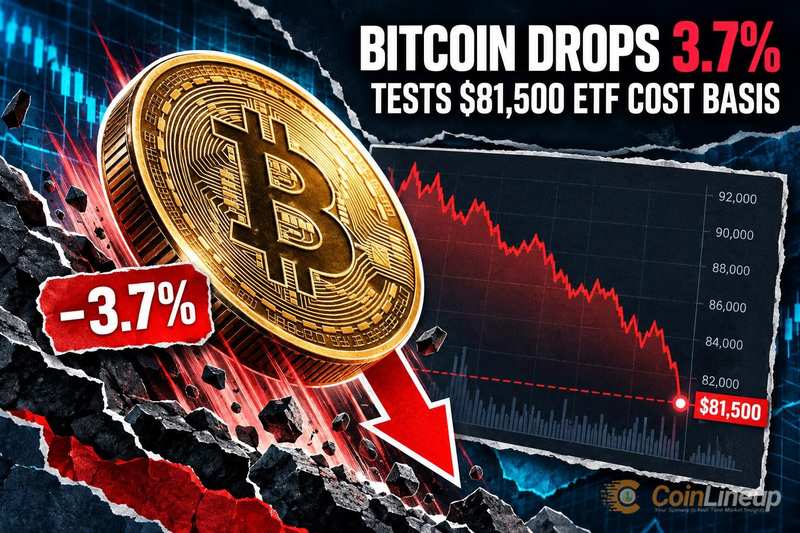
Bitcoin fell 3.7% and moved to test the $81,500 price level, a zone analysts describe as the average cost basis for holders of U.S. spot Bitcoin exchange-traded funds (ETFs). When a major asset approaches the average purchase price of a large group of investors, the moment often becomes one of the most closely watched points in the market, because it marks the threshold at which that group collectively moves between unrealized profit and unrealized loss.
Bitcoin Approaches the $81,500 ETF Cost Basis
According to reporting from The Defiant, Bitcoin's price declined 3.7% to approach the $81,500 area. The move brought the asset to a level representing the approximate average price at which investors entered the market through spot Bitcoin ETFs in the United States.
The $81,500 zone is not an arbitrary figure chosen by analysts. It reflects the average entry price, or cost basis, of ETF holders as a group. That cohort is a relatively recent fixture of the market: U.S. spot Bitcoin ETFs began trading in January 2024 after approval from the Securities and Exchange Commission, giving investors a way to gain exposure to Bitcoin through conventional brokerage accounts rather than purchasing and storing the asset themselves. Because the products brought a new population of buyers into the market, the group's average entry price is watched as a gauge of how that entire cohort is positioned. The decline is also not the first time macroeconomic pressure has pushed Bitcoin sharply lower; a similar episode saw Bitcoin fall $3,000 when bets on Federal Reserve rate hikes surged.
Why the ETF Cost Basis Matters
A cost basis is simply the average price someone paid for an asset, and it serves as the breakeven reference for that purchase. An investor who bought Bitcoin at $81,500 is exactly at breakeven when the price trades at $81,500: no money has been made, and none has been lost yet.
Spot Bitcoin ETFs are funds that hold actual Bitcoin on behalf of investors. For these products, the cost basis represents the collective average purchase price of everyone who bought into the funds. When Bitcoin's price tests that level, ETF investors as a whole are sitting precisely at their breakeven point. Bitcoin's live price movement can be tracked on CoinGecko.
Price levels near a large group's breakeven tend to draw attention because investors who entered around that level may react differently depending on whether the asset holds above it or slips below. A comparable dynamic appeared earlier when Bitcoin tested $69,000 support alongside ETF outflows, and market behavior shifted noticeably at that time.
It is worth being clear about what the cost basis level is not. It is not a guaranteed floor where buyers will automatically step in, and it is not a wall that Bitcoin cannot pass through. It is a reference point that gives context to where a specific group of investors stands financially.
What Bitcoin Traders Will Watch Around $81,500
The available reporting establishes that Bitcoin is testing this level, but it does not confirm what happened next. Three scenarios are now in focus for market participants.
The first is that Bitcoin holds at or above $81,500, keeping ETF holders at or above their breakeven point as a group. The second is that Bitcoin breaks clearly below $81,500 and stays there, which would push the average ETF holder into an unrealized loss. The third is that Bitcoin briefly dips below the level but quickly recovers — an outcome some traders would read as a successful test. Each scenario carries different implications for the largest cohort of ETF-era buyers.
Similar tests of important price levels have played out before. Bitcoin fell to $78,400 on macroeconomic commentary and slipped below $64,000 ahead of a Federal Reserve decision. In both cases, the price level Bitcoin was testing shaped how market participants responded.
None of those scenarios is guaranteed by the current data. The 3.7% decline brings Bitcoin to the level in question; what the price does from here is not established by the information available at the time of writing, and no conclusion about the outcome of the test can yet be drawn.
For anyone who holds Bitcoin directly or through an ETF, the practical point is this: a test of the ETF cost basis is a moment of uncertainty, not a verdict. Whether Bitcoin closes above or below $81,500 over the next trading sessions will give a clearer picture of whether the move was a brief pause or the start of something larger.
Disclaimer: This article is for informational purposes only and does not constitute financial or investment advice. Cryptocurrency and digital asset markets carry significant risk. Always consult a qualified financial professional before making investment decisions.

