Bitcoin Price Holds Quiet Below $80K as Short-Term Losses Pile Up
Key Takeaways
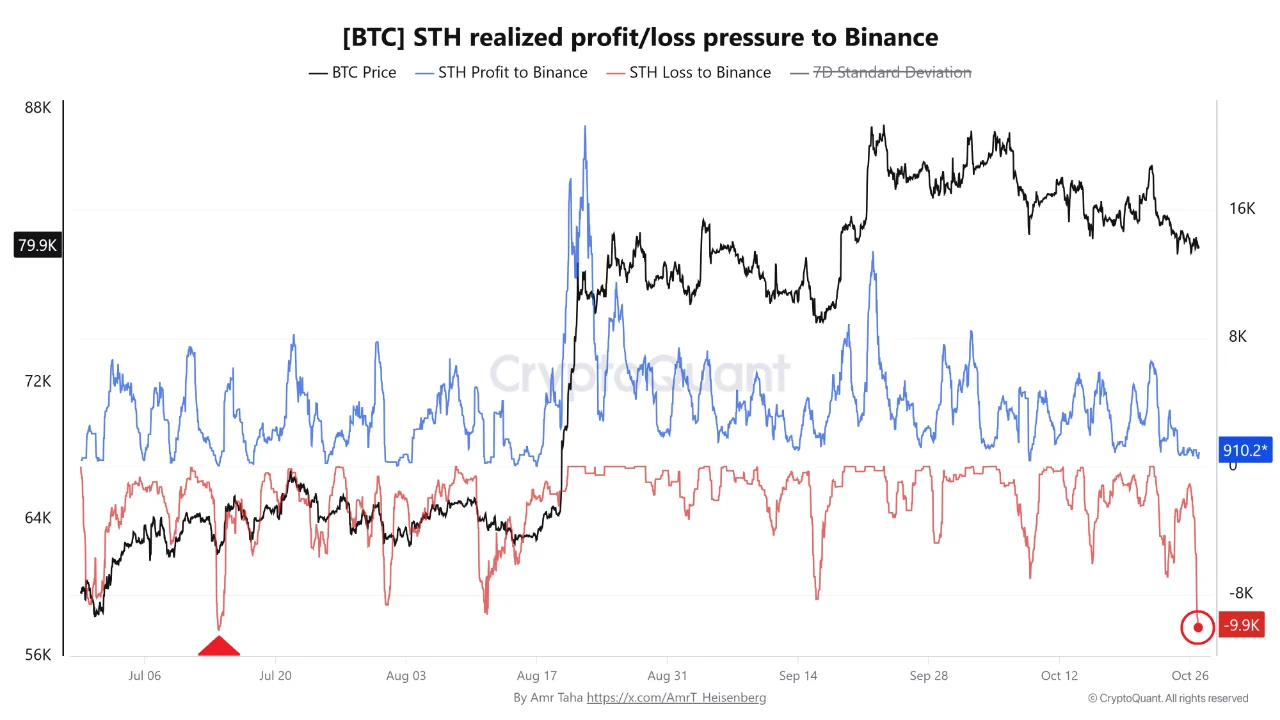
- •Short-term holders’ loss-making transfers to Binance reached 9,990 BTC on October 26, the second-heaviest reading since June 30 in the cited data.
- •Bitcoin’s 30-day realized volatility was 24.23%, lower than on 97% of days since March 2021, while estimated leverage remained near 0.246.
- •CME FedWatch indicated about a 90% probability of a Federal Reserve rate hold on October 28, making Chair Kevin Warsh’s comments on December policy a key focus.
- •About $11 billion in Bitcoin options are scheduled to expire on October 30, followed by US midterm elections on November 3.
- •Bitcoin remained below resistance at the 23.6% Fibonacci retracement near $80,370 and the 50-day moving average at $81,866, with initial support between $75,798 and $76,038.
Bitcoin traded at $79,910 at 11:59 UTC on October 27, down 0.30% on the day, according to the Binance BTC/USDT daily chart. The session ranged from $79,506 to $80,388, extending Bitcoin's test of the $80,000 mark ahead of the Federal Reserve's decision this week.
Short-Term Holders Sell at July-Level Losses
Short-term holders — wallets that bought within roughly the past five months — have been transferring coins to Binance while underwater. In a report on CryptoQuant, analyst Amr Taha said his measure of those loss-making transfers reached −9,990 BTC on October 26. The minus sign denotes coins moved at a loss; it does not mean coins left the exchange. Because these coins belong to the market's most recent buyers, the inflows offer a direct read on how that cohort is handling the pullback.
The figure nearly matches the −10,232 BTC recorded on July 13, when Bitcoin traded near $62,000. The cohort is now moving almost the same amount at a loss with the price $17,900 higher — the second-heaviest reading since June 30 in Taha's data. Coins that reach an exchange are available to sell, though not all of them will be.
The swing from profit to loss came quickly. On October 22, short-term holders booked $3.13 billion in net realized profit, Taha said, the most in more than 15 months. Four days later, the flow had turned to losses. Coins sold at a loss were bought above today's price, and Bitcoin spent most of October trading between $80,000 and $87,000.
A Quiet Tape, With a Fed Move Priced In
Little of that stress shows up in daily price swings. A separate CryptoQuant report by The Daily Digits put 30-day realized volatility — a measure of how much the price actually moved — at 24.23%, lower than on 97% of days since March 2021, as Bitcoin slid in small steps.
Options are charging more, however. Implied volatility, the move traders pay to insure against, stood at 36.69% for Deribit's November27 expiry. For the October 28–29 Fed window, the report priced a 2.27% move, about $1,819, with forward implied volatility of 43.4% for those two days against 34.8% afterward. That is a range in either direction, not a target. The gap between the two measures captures traders paying a premium for event protection even while actual price movement sits near the bottom of its multi-year range.
Calm does not have to end in a surge. Between April 2022 and September 2026, implied volatility exceeded what the following 30 days actually delivered in 73.8% of 1,613 observations. Leverage shows no build-up either: the all-exchange estimated leverage ratio — a gauge of futures open interest relative to coins held on exchanges — has held between roughly 0.22 and 0.26 for a month, last printing 0.246.
What Could Break the Calm This Week
The Fed announces its decision at 18:00 UTC on October 28, with the press conference at 18:30, according to the Fed's calendar. As of Monday, CME FedWatch — which derives its odds from fed funds futures — priced a hold at around 90%, so the reaction is likely to hinge on what Chair Kevin Warsh says about December, where markets still lean toward another hike.
Two more events follow. About $11 billion in Bitcoin options expire on Friday, October 30, which can add volatility as traders close or roll positions near key strikes. The US midterm elections on November 3 then put crypto policy back in focus. Taken together, the rate decision, the options expiry, and the vote hand this unusually quiet tape three scheduled tests inside a single week.
Below the 50-Day, With $76,000 Next
On the chart, Bitcoin sits about 8.5% below its swing high near $87,400 and beneath two hurdles: the 23.6% Fibonacci retracement at $80,370 and the 50-day SMA at $81,866. Tuesday's session high of $80,388 briefly cleared the first before the price slipped back.
The first solid support below is a tight band between the rising 100-day SMA at $75,798 and the 38.2% retracement at $76,038. Beneath it, levels spread out: the 200-day SMA at $73,064, the 50% retracement near $72,540, and the 61.8% retracement close to $69,050.
Potential Moves (Not a Forecast)
Bitcoin sits just under $80,000, between the 23.6% Fib overhead and the 100-day SMA below.
- Upside: Daily closes back above $80,000, followed by the $80,500 pivot and the 50-day SMA at $81,866, could reopen the $84,000 range top, with the $87,367 swing high beyond it.
- Rejection: If rallies stall between $80,368 and $81,8 and daily closes stay below $80,000, the $75,800–$76,000 band becomes the next test.
- Bigger picture: Holding that band keeps this a pullback within the summer advance. Losing it, and then the 200-day SMA near $73,064, would put the trend itself in question.
This article is provided for informational purposes only and does not constitute financial or investment advice. Technical levels and market indicators do not guarantee future price movement.
Originally published on Coindoo.

