Bitcoin Falls to $63,000 as ETF Outflows Extend for Third Straight Day
Key Takeaways
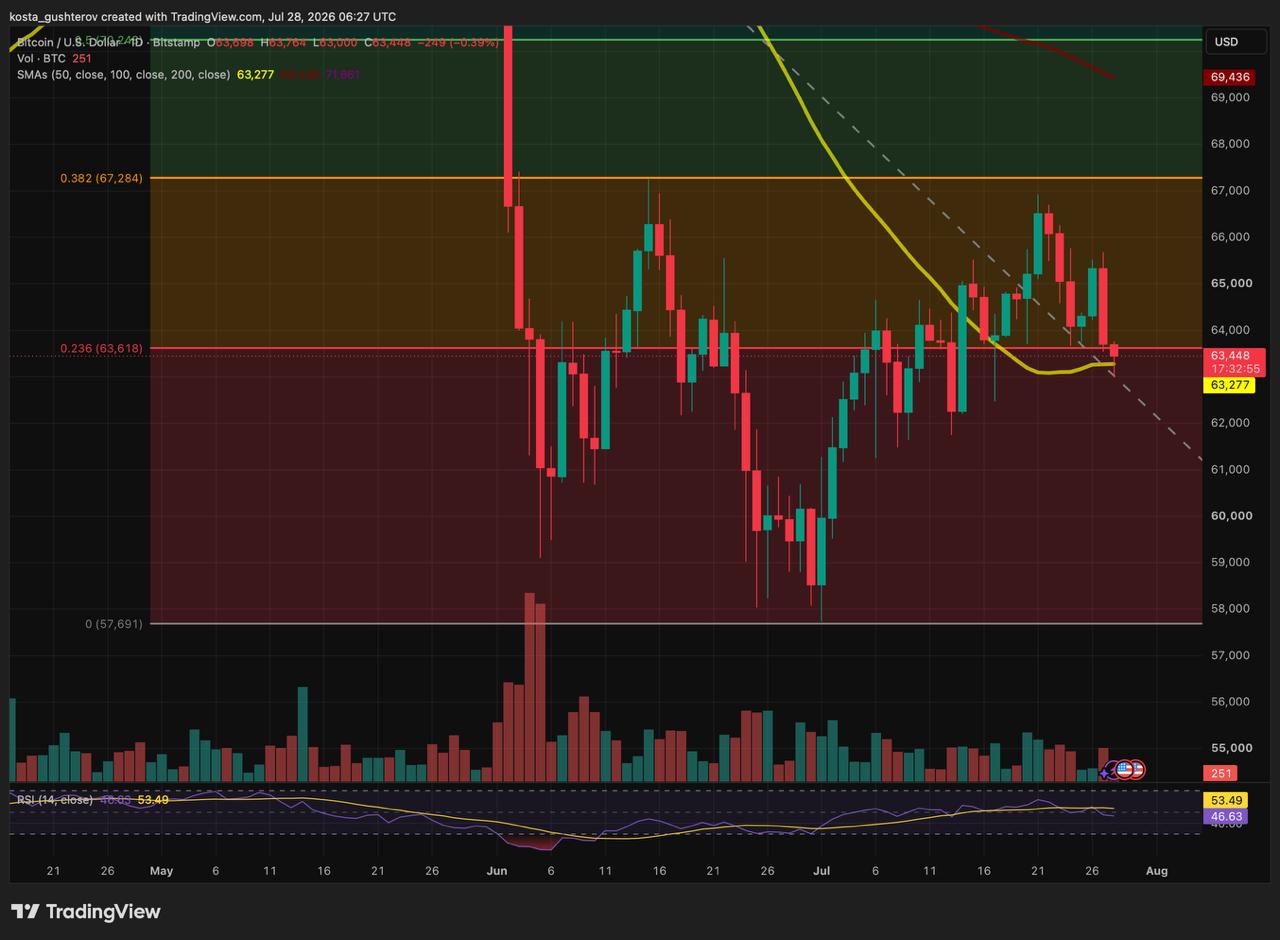
- •Bitcoin traded near its 50-day simple moving average after falling to $63,000 during the July 28 candle.
- •A daily close below $63,275 would keep the bearish setup intact and put the $62,000 area in focus.
- •US spot Bitcoin ETFs recorded three consecutive trading days of net outflows totaling about $476.9 million.
- •Bitcoin did not reach $67,370, the level needed to confirm the stronger breakout outlined in the earlier analysis.
- •CryptoQuant said exchange reserves fell by roughly 78,000 BTC over the past six months, leaving less readily available supply on exchanges.
Key Takeaways
- Bitcoin is testing the 50-day simple moving average.
- US spot Bitcoin ETFs recorded three consecutive days of net outflows.
- A daily close below $63,275 would leave $62,000 in focus.
Bitcoin traded near $63,350 at the time of writing after falling as low as $63,000 in the July 28 candle. The move placed price almost directly on the 50-day simple moving average at $63,275, a level traders often watch as a trend gauge because it can act as support during pullbacks.
The decline also means Bitcoin did not reach $67,370, the level needed to confirm the stronger breakout outlined in the July 27 analysis.
Because the current candle remains open, trading near the 50-day SMA at $63,275 does not yet confirm a breakdown. If Bitcoin can hold the broader $63,300–$63,600 support area, the recent defense would remain intact and the asset would still have a chance to recover above $65,000.
A confirmed daily close below the moving average would keep the bearish sequence in place and expose the $62,000 area. Three straight days of ETF outflows are adding pressure while buyers try to defend support, making the next daily close important for gauging whether the recent range can hold.
ETF Flows Turn Negative
US spot Bitcoin ETFs have posted net outflows for three consecutive trading sessions. The funds saw outflows of $225.18 million on July 23, $240.08 million on July 24, and $11.64 million on July 27.
That brought total outflows across the three sessions to about $476.9 million. The streak followed a week that still ended with a modest net inflow of $33.79 million, supported by stronger inflows earlier in the period.
The latest figures show that the weekly positive total did not turn into sustained buying. ETF demand weakened as Bitcoin struggled to hold its recovery above $65,000, underscoring how quickly fund flows can shift even when the broader market has recently seen fresh institutional access.
A CryptoQuant report offers a longer-term counterpoint to the recent ETF weakness. Exchange reserves have fallen by roughly 78,000 BTC over the past six months, declining from 2.783 million BTC to 2.705 million BTC and leaving fewer coins immediately available for trading.
The report’s main argument is that holders are continuing to move Bitcoin into self-custody, reducing the amount of readily available sell-side supply even as short-term demand remains weak.
That declining liquid supply does not resolve the weak spot-demand picture among short-term holders, but it could make Bitcoin more responsive if buyers return, since exchanges have less supply available to absorb that demand.
The pullback may also reflect fading regulatory optimism after the US Senate kept the Digital Asset Market Clarity Act further down its agenda.
Votes scheduled: At 6:30pm, on Tuesday, July 28th, the Senate will proceed to two roll call votes on the following:
- Confirmation of Executive Calendar #833, Walter Clayton to be Director of National Intelligence.
- Motion to invoke cloture on the motion to proceed to Cal.… — Senate Cloakroom (@SenateCloakroom) July 27, 2026
With sanctions legislation and federal nominations taking priority, a vote now appears unlikely before the final days leading into the August 8 summer recess.
Another source of pressure came from the US dollar, which climbed to a one-month high as markets continued to weigh the possibility of another Federal Reserve rate increase, according to Reuters. The Reserve Bank of Australia also left the door open to additional tightening, adding to a less supportive backdrop for risk assets such as Bitcoin.
Disclaimer: This article is for informational and analytical purposes only and does not constitute financial or investment advice. Technical levels and ETF flows do not guarantee future price movements.
Methodology: Price levels are based on the supplied daily BTC/USD Bitstamp chart captured on July 28, 2026. ETF figures are based on SoSoValue daily spot Bitcoin ETF flow data.

