Bitcoin Faces Profit-Taking Risk at $82K Ceiling as Supply in Profit Nears Historical Mean
Key Takeaways
- •More than 71% of Bitcoin's circulating supply is currently in profit, nearing the 74.7% historical mean that Bitfinex analysts associate with past bear-to-bull market transitions.
- •Bitcoin recovered to approximately $78,600 on Tuesday after an intraday low of $77,603 but remains below the roughly $82,000 upper boundary of its recent $77,200-$82,100 trading range.
- •Tuesday's swing produced about $79 million in Bitcoin liquidations, part of $264 million in total crypto liquidations in which long positions accounted for $187 million.
- •The short-term holder cost basis fell to $68,400 over the summer, so more supply is profitable at current prices than the roughly 67% recorded during May's consolidation above $82,500.
- •US spot Bitcoin ETFs recorded $31.07 million in daily net inflows and $698.42 million over seven days, while August payrolls of 162,000 and two-year Treasury yields above 4.34% keep tighter policy risk in focus.
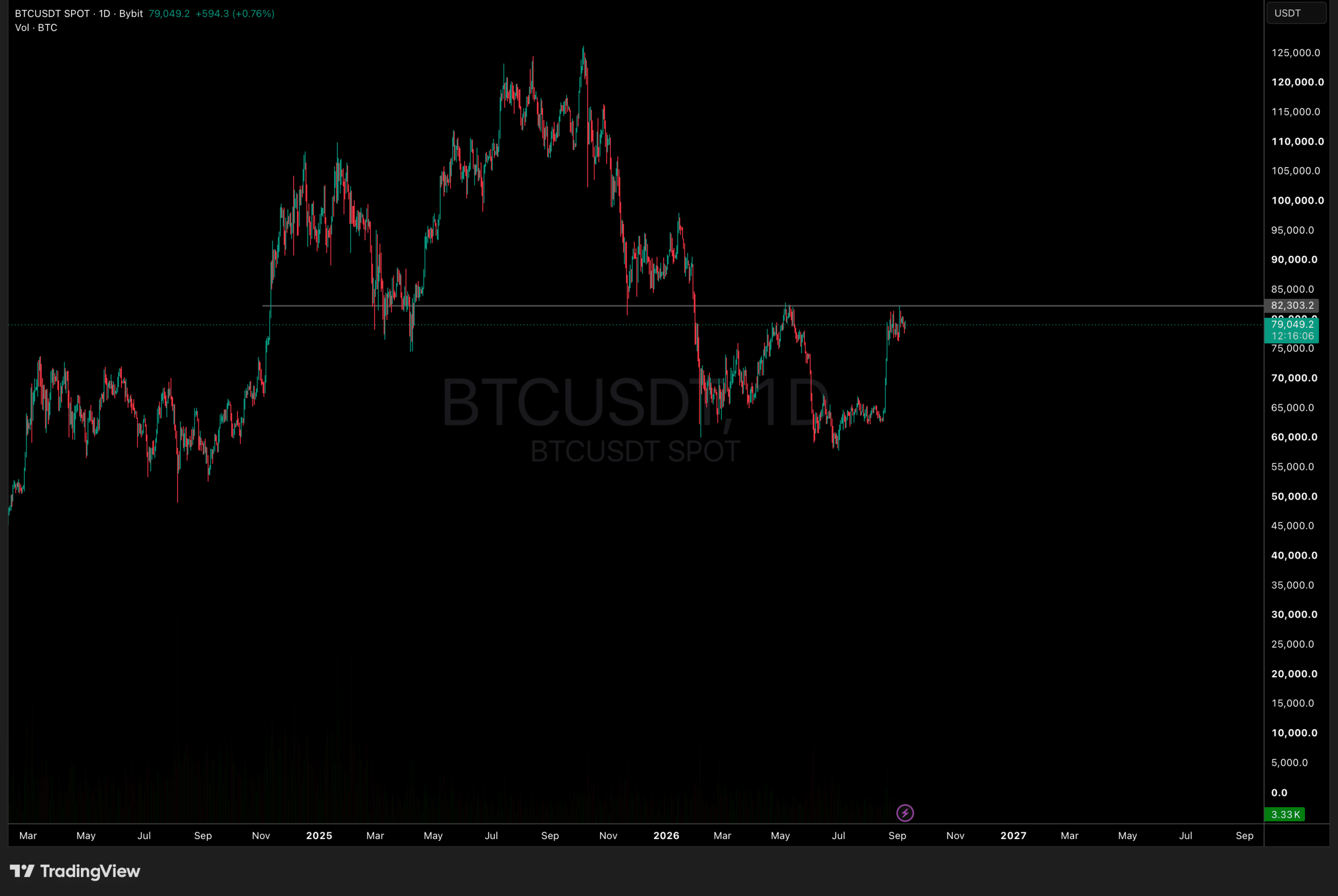
Bitcoin's push toward the upper end of its recent trading range is running into a familiar structural dynamic: an expanding share of the supply is held at a profit. According to the latest analysis from 99Bitcoins, more than 71% of Bitcoin's circulating supply now sits in profit — closing in on the 74.7% historical mean that Bitfinex analysts say has previously marked the handoff from bear market to bull market. The metric measures the share of circulating coins that were last acquired below current prices, offering a way to size how much of the market sits on unrealized gains at any given level.
Bitcoin (BTC) recovered to near $78,600 on Tuesday after slipping to an intraday low of $77,603. The bounce, however, left the asset below the roughly $82,000 level it touched the previous week, and it continues to trade within a range that has recently extended from about $77,200 to $82,100.
The setup contains a notable tension. A rising share of profitable supply can be read as a sign recovery, yet it also means more coins are sitting on paper gains near a price zone where sellers may emerge. The analysis characterizes the metric as a feature of market structure rather than confirmation of a breakout.
Bitfinex highlighted the threshold in a September 8 post on X:
With over 71% of $BTC supply in profit, we are close to reaching the important 74.7% mean. Any move above it "has typically marked the transition from bear to bull markets". Bitfinex analysts tell @TheBlockCo .
— Bitfinex (@bitfinex) September 8, 2026
A Recovery That Hasn't Cleared the Ceiling
Tuesday's session illustrated how fragile the current bounce remains. BTC fell to $77,603 before recovering near $78,600 by late morning, bringing price back toward the middle of its recent range rather than above the upper boundary established near $82,000.
The swing also coincided with substantial liquidations. Roughly $79 million in Bitcoin were liquidated, contributing to $264 million in total crypto liquidations, of which long positions accounted for $187 million. Liquidations occur when exchanges forcibly close leveraged positions that no longer meet margin requirements, and the heavy weighting toward longs is consistent with the session's dip before the recovery. The move showed how quickly leveraged positioning can be affected during a relatively contained price swing.
Bitfinex places the historical mean for supply in profit at 74.7% and says prior moves above that level have typically marked transitions from bear to bull markets. The same source, however, cautions that profit supply is not a standalone bullish signal. The measure describes the distribution of unrealized gains across supply; it does not by itself establish that price has broken out of its range.
Why the Same Price Level Now Carries More Profitable Supply
The shift becomes clearer when compared with May. According to Bitfinex, about 67% of the supply was in profit when BTC traded above $82,500 during its May consolidation. At comparable price levels now, the figure is above 71%. The contrast reflects how accumulation at lower prices has changed the profit profile of the supply at current levels.
The short-term holder cost basis fell to $68,400 during the summer, reflecting accumulation at lower prices. A cost basis of this kind represents the average price at which recently active coins were last acquired, so the decline signals that much of the newer buying took place well below current levels. At identical nominal price levels, more coins therefore show gains on paper than they did during the May consolidation. Bitfinex says this creates a deeper pool of latent sell-side liquidity when the market tests previous local highs — a structure that may help explain why attempts near $82,000 have attracted profit-taking rather than a sustained move higher.
The comparison does not determine whether the current recovery will continue or reverse. It does show that the composition of supply has changed: buyers who accumulated at lower levels may hold gains when BTC returns to the upper end of the range, and their behavior at those levels remains central to the market's near-term structure.
ETF Inflows Are the Counterweight, With Conditions Attached
If the larger base of profitable supply is a source of potential selling pressure, Bitcoin ETF inflows provide an offsetting demand signal. Onchain data cited in the report showed $31.07 million in daily net inflows into US spot Bitcoin ETFs and $698.42 million in seven-day inflows — leaving the single-day figure below the weekly total's implied daily average, a gap that frames the question of whether demand is holding at the same pace over longer windows. Bitfinex also pointed to continued ETF demand and stablecoin supply growth — expansion in the dollar-pegged tokens used for trading and settlement across crypto markets — as sources of market support.
The exchange noted that crypto market capitalization excluding Bitcoin, Ether, and stablecoins increased by $51.2 billion since the start of September and stood above its mid-August level. The measure indicates that capital conditions across the broader crypto market had improved over that period, even as Bitcoin remained inside its established range.
Those flows sit alongside a more restrictive macro backdrop. August payrolls increased by 162,000, above the 53,000 consensus estimate cited in the report. The two-year Treasury yield was above 4.34%, keeping short-term rates in focus. The August Producer Price Index and Consumer Price Index reports were due following this data, and a hotter inflation reading could strengthen the case for tighter policy.
Higher yields and tighter policy expectations can weigh on risk assets, including Bitcoin, even when ETF flows remain positive. Bitfinex framed the key question as whether investors would continue buying through the Treasury buyback and incoming inflation data. In that view, sustained buying would indicate that policy rates were less of a binding constraint, while weaker flows around those events would point in the other direction.

