Bitcoin Posts Strongest Q3 Performance Since 2021 Amid Recovery From 2026 Lows
Key Takeaways
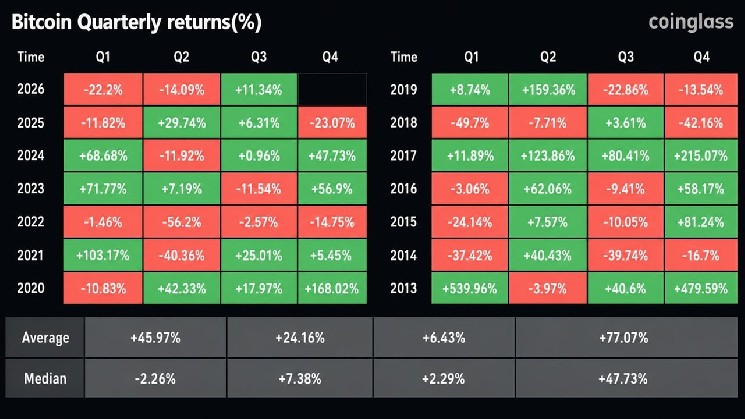
- •Bitcoin has gained nearly 11% quarter-to-date in Q3, representing its strongest third-quarter performance since 2021 when it returned approximately 25%.
- •The July rally produced a 9.8% gain driven primarily by spot and derivatives markets rather than institutional ETF inflows that fueled prior rebounds.
- •During the spring sell-off, Bitcoin dropped more than 26% over a 30-day window, leaving over half of all circulating coins underwater at the trough.
- •Bitcoin miners are operating near their production cost of roughly $63,500 following the April 2024 halving, which compressed margins by cutting block rewards from 6.25 to 3.125 bitcoin.
- •Historical data since 2013 shows August has a median Bitcoin return of approximately -7.49%, suggesting seasonal headwinds could challenge the continuation of Q3 gains.
Bitcoin Posts Strongest Q3 Performance Since 2021 Amid Recovery From 2026 Lows
Bitcoin's third quarter began on a sour note after a punishing spring sell-off but has since turned into the asset's best Q3 showing in five years. According to quarterly return data tracked by Coinglass, bitcoin is up nearly 11% quarter-to-date, marking its strongest third-quarter performance since 2021, when the asset gained roughly 25% over the same three-month period. No Q3 in the intervening years has approached either figure — a notable gap given that third quarters have typically been one of bitcoin's weaker stretches, with Q3 returns in 2022, 2023, and 2024 all finishing flat or negative.
A Bruising Spring Preceded the Rebound
The third quarter opened against the backdrop of a steep correction. During a brutal stretch in the spring, bitcoin dropped more than 19% in a single week and over 26% across a 30-day window, falling to its lowest level of 2026. At the trough, more than half of all circulating bitcoin sat underwater. Bitcoin.com News tracked the asset trading a full 50% below its October 2025 cycle high of $126,209, as bullish catalysts such as exchange-traded fund (ETF) demand — led by funds from BlackRock, Fidelity, and others that launched in January 2024 and reshaped institutional access to the asset — and institutional accumulation collided with bearish forces including macro tightening and profit-taking from long-term holders.
From that low, bitcoin has clawed back meaningfully, making the 2026 rebound notable even though the percentage gain remains smaller than 2021's.
July Drove the Quarter's Gains
The bulk of Q3's strength was concentrated in July, during which bitcoin gained approximately 9.8% — its best single 30-day stretch in roughly a year. What stood out about the July rally was what did not drive it: unlike prior rebounds fueled by heavy spot bitcoin ETF inflows, this move came largely "without Wall Street's help," indicating that buying pressure originated more from spot and derivatives markets than from a fresh wave of institutional allocation.
Rallies built on broad-based ETF accumulation have historically tended to attract sustained follow-through buying, whereas rallies driven more by short covering or thinner spot demand can unwind faster once momentum fades.
Bitcoin entered August at roughly $64,040 and has since found support in the $64,500 range, trading above $65,000 since last week within a narrow but stable band — a contrast to the sharp swings that defined the second quarter.
Mining Economics Provide a Pricing Anchor
Bitcoin's mining sector offers another lens on the market's current stress level. With the asset trading near $63,500, miners sit roughly at their production cost, meaning further downside risks pushing some operations toward break-even or worse. The April 2024 halving, which cut per-block mining rewards from 6.25 to 3.125 bitcoin, has compressed mining margins throughout the cycle, making this break-even threshold more precarious than in prior years. Historically, prices hovering near miner break-even levels have acted as a rough floor, since forced selling from unprofitable miners tends to taper off. That same dynamic, however, also caps enthusiasm about the rally extending sharply higher without a fresh catalyst.
Seasonality Headwinds Loom in August
The bigger question hanging over Q3's gains is seasonality. August has historically been one of bitcoin's weaker months. Since 2013, the average August return sits at just +1.12%, while the median return is closer to -7.49%, reflecting how a handful of strong Augusts skew the average upward despite most years finishing negative. Only two prior Augusts have posted standout gains — roughly +30% in 2013 and +13.8% in 2021 — meaning the historical base rate favors consolidation or a pullback rather than a continuation of July's strength. September has been similarly lackluster historically, suggesting the back half of Q3 rarely delivers sustained upside.
Forecasts circulating ahead of August pointed to a possible washout toward the $55,000–$60,000 range later in the quarter, driven by deteriorating valuation metrics such as the MVRV Z-score — a measure comparing bitcoin's market value to its realized value, or the aggregate cost basis of all coins — moving deeper into negative territory alongside broader macro anxiety. Should that scenario materialize, it would erase a meaningful portion of Q3's current gains before the quarter closes.
Source: Bitcoin.com News via CryptoNews.net

