Bitcoin Steadies Near $76,000 After AI-Led Selloff as Focus Turns to US Jobs Report
Key Takeaways
- •Bitcoin fell 5.3% and ether 7.3% during Thursday's selloff, which saw more than $1 billion in leveraged positions liquidated as the Nasdaq's 5.5% drop spilled over into crypto markets.
- •Spot bitcoin ETF withdrawals persisted, with Fidelity's FBTC recording roughly $200 million in outflows and BlackRock's IBIT losing $105 million to extend its streak to five consecutive sessions.
- •Traders are awaiting the U.S. October jobs report due at 8:30 a.m. EST, with economists polled by FactSet forecasting a 65,000 payroll increase that could influence Federal Reserve rate policy expectations.
- •Options positioning turned defensive, with the 1-week 25-delta skew steepening to about 15% from around 11% a week ago as traders paid up for downside protection.
- •Injective rose 14% on the week after Nasdaq approved the listing of Canary Capital's staked INJ ETF, while CoinMarketCap's altcoin season index slipped to 44/100, its lowest level since September.
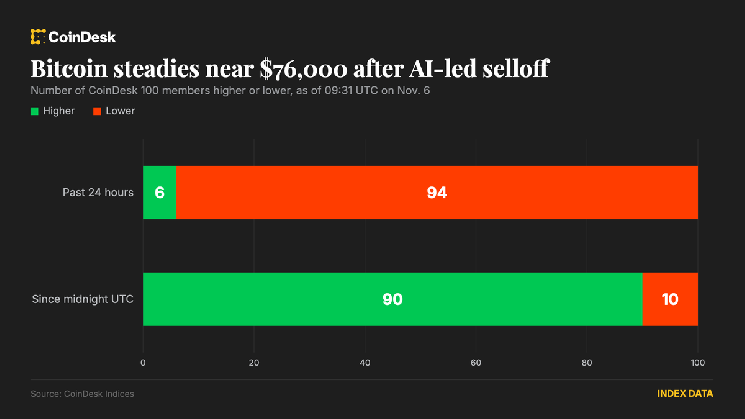
Bitcoin (BTC) edged up 0.2% to around $76,150 since midnight UTC, rebounding from a dip to roughly $75,200 near 23:00 UTC on Thursday. Ether (ETH), last quoted near $2,239, gained 0.3%, the CoinDesk 80 Index rose 0.2%, and the CoinDesk Memecoin Index led major benchmarks with a 4% gain.
The bounce followed a heavy selloff on Thursday, when the Nasdaq Composite fell 5.5% on investor fears that Democratic control of Congress will slow the AI data center buildout. The slide spread to crypto, where more than $1 billion in leveraged positions were liquidated over 24 hours, according to CoinGlass. Liquidations force-close leveraged trades when price swings exhaust trader margin, and longs took the brunt of the flush. The spillover highlighted crypto's sensitivity to swings in the AI-driven tech trade. Over that period, bitcoin fell 5.3% and ether 7.3%.
Spot bitcoin ETF flows remained under pressure. Fidelity's FBTC lost around $200 million on Thursday, while BlackRock's IBIT shed $105 million, extending IBIT's outflow streak to five sessions, according to Farside Investors. Such flows are closely tracked as a barometer of institutional demand through U.S.-listed spot bitcoin vehicles.
Traders now look to the U.S. jobs report, due at 8:30 a.m. EST (13:30 UTC), with economists polled by FactSet expecting payrolls to rise by 65,000 in October. The payrolls print feeds into expectations for Federal Reserve interest-rate policy, a macro backdrop that helps shape risk appetite across assets including crypto.
Derivatives Positioning
Bitcoin open interest rose to $22.1 billion from $21.8 billion, but 24-hour liquidations hit $1.27 billion, roughly $1.1 billion of that in long positions. The net build masks the churn underneath: leverage was flushed and rebuilt, not added. Funding rates turned volatile, briefly dipping negative on Bybit at an annualized -5% before settling between 0% and 5% elsewhere. The 3-month basis — the annualized premium futures carry over spot — held at 5.7%.
Options flow turned defensive. The 24-hour put/call volume ratio sits at roughly 51/48 in favor of puts, and the 1-week 25-delta skew — a gauge of how much more traders are paying for downside protection than upside exposure — steepened to about 15% from around 11% a week ago as downside protection attracted bids. The at-the-money term structure remains in contango, with the front end elevated near 50% on near-term stress and settling into the belly and back around 38-40% through late 2027.
On the Binance heatmap, with price near $75,100, the key cluster to watch sits just below spot in the $74,000-$75,000 band, a significant pocket of long liquidity that would come into play on a further drop. To the upside, a brighter band around $76,800-$77,000 marks the level to watch on a bounce.
Token Talk
World Liberty Financial's WLFI token, quoted at $0.04676, rose around 3.5% since midnight UTC, coinciding with the Trump-backed project's announcement that it plans more token buybacks — purchases that pull tokens out of circulating supply — partly funded by fees from the reserves backing its USD1 stablecoin. The token is still down about 10% since Tuesday's midterm elections and more than 66% this year, while the official TRUMP token hit a record low this week.
Privacy coins held up better in the selloff, with monero (XMR) down 3.2% over 24 hours against bitcoin's 5.3% drop. Zcash (ZEC) activated its NU7 upgrade early Friday, cutting the target time between blocks from 75 seconds to 25, and rose 1% since midnight UTC.
Hyperliquid (HYPE) is down around 19% from its $96 peak last week, when a deal between ICE and Trade[XYZ] to bring Hyperliquid-based perpetual futures to U.S. retail traders sent the token soaring, although optimism has since waned.
Injective (INJ), trading near $8.2333, is up 14% on the week, in which Nasdaq approved the listing of Canary Capital's staked INJ ETF, according to an SEC filing.
CoinMarketCap's altcoin season index is at 44/100, meaning fewer than half of the tracked top altcoins have outperformed bitcoin over the index's measurement window. That is its lowest point since September, as speculative sentiment continues to drop off.
This article is based on CoinDesk's market coverage.

