Weekend Altcoin Rally Stalls as Bitcoin Slips Below $79,400
Key Takeaways
- •Bitcoin fell 1.3% to around $79,300 after failing to break above $81,400, even as Nasdaq 100 futures rose 0.3% during the Labor Day holiday session.
- •Bitcoin futures open interest dropped to 670K BTC from 709K on Friday, the lowest since March 23, while perpetual funding rates approached zero, indicating leverage unwinding.
- •Futures taker flow turned bearish, with shorts at 51.6% of volume, likely driven by U.S.-Iran escalation and Fed rate concerns.
- •Deribit options traders favored $78,000 and $80,000 BTC puts expiring Sept. 25, while ether options flow was dominated by calls.
- •Bittensor led large caps with a 13% daily gain to $266, while Arbitrum fell by double digits and Jupiter dropped 9%, the day's sharpest decliner.
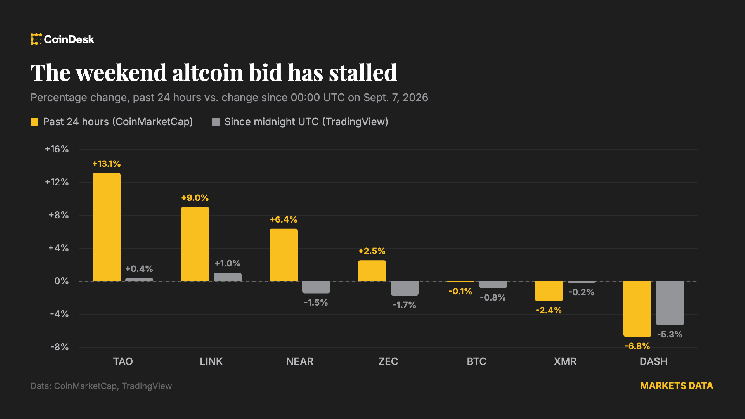
Weekend altcoin rally runs out of road as bitcoin slips
Bitcoin ($BTC) is trading around $79,300 on Monday, down 1.3% since midnight UTC and hovering near $79,394.02. The cryptocurrency spent the weekend confined to a narrow range after failing to break above $81,400.
Monday's pullback comes as U.S. equity futures climb, with Nasdaq 100 futures up 0.3% since midnight — extending last week's divergence between the two markets. U.S. equities are closed Monday for the Labor Day holiday, which typically thins trading volumes across risk assets, so price moves in the holiday session can be less indicative of broader positioning than on regular trading days.
Altcoins carried the market over the weekend and are now giving back part of their gains. Bittensor ($TAO), kaspa ($KAS), internet computer (ICP) and celestia (TIA) each rose more than 12% over the past 24 hours, though most of those moves occurred before midnight UTC. Since then, $TAO is up 0.4%, chainlink ($LINK) is up 1% at $13.26, and NEAR Protocol ($NEAR) has slipped 1.5% to $2.3548. The pattern — sharp weekend gains in smaller tokens followed by fading momentum into the new week — is a recurring feature of low-liquidity weekend crypto sessions, when thinner order books can amplify moves in both directions.
Derivatives positioning
Sentiment turns bearish: The taker buy-sell volume ratio in crypto futures is leaning short, with bearish bets accounting for 51.6% of flow — a shift from Friday's bullish reading. The likely catalyst is the weekend escalation of hostilities between the U.S. and Iran, along with fears of Fed rate increases, though those concerns appear overdone. Geopolitical flare-ups have repeatedly pushed traders toward defensive positioning in crypto futures, a market that trades around the clock and therefore reprices such news before traditional markets open.
BTC futures see capital exodus: Capital continues to exit bitcoin futures. Open interest has fallen to 670K BTC from 709K on Friday, the lowest since March 23, according to data source Coinglass. Annualized perpetual funding rates are fast approaching zero, losing their bullish bias, as seen in recent readings of 8% to 10%. Falling open interest alongside flattening funding is generally read by derivatives analysts as leverage being unwound rather than fresh directional conviction — a setup that often precedes rangebound trading.
Ether, solana mirror the move: The ether and solana markets are displaying a similar dynamic.
XRP open interest cools: Open interest in $XRP futures has also cooled, falling to 2.29 billion tokens — the lowest since Aug. 7 and down notably from a mid-month peak of 2.78 billion. The message is clear: capital is exiting, leaving XRP trading choppy between $1.35 and $1.45.
Smaller tokens buck the trend: Smaller coins are having a moment. Open interest in $WLD rose 11% alongside a 13% gain in spot price, a combination typically read as confirming an uptrend. $WLD also posts the highest 24-hour OI-adjusted cumulative volume delta (CVD) among smaller tokens — a positive reading indicating buyers have been more aggressive, trading with market orders rather than passive limit orders.
CVD splits across majors: Among major tokens, $LINK, TRX, CC, SUI and $ZEC sit on the positive side of the CVD ledger, while $BTC, ETH, $XRP, SOL, $NEAR, $XMR, ADA and others sit on the negative side.
Volatility signals calm: Bitcoin's and ether's 30-day implied volatility indexes continue to project market calm, hovering near recent lows. Low implied volatility indicates options traders are pricing modest expected swings — a backdrop against which the Sept. 25 expiry highlighted below takes on added weight as a marker of where the market sees risk concentrated.
Options flow diverges by asset: In Deribit-listed options, 24-hour volume rankings show the $78,000 and $80,000 puts — both expiring Sept. 25 — as the most popular bets, while the rest of the top five are calls. A put option is used to hedge against downside risk in the underlying asset, in this case BTC. Ether shows the exact opposite picture, with calls dominating the rankings.
Token talk
Bittensor ($TAO) led large-cap tokens over the past 24 hours with a 13% advance to $266 on $568 million of volume, though the move has slowed since midnight UTC, adding just 0.4%. $TAO is up 16.4% over seven days.
The sharpest decliner of the day is Jupiter (JUP), down 9% at $0.2514 with no visible catalyst. The Solana DEX aggregator's token has been under persistent pressure since breaking below the $0.33 support level last November.
Kaspa ($KAS) climbed 12.75% over 24 hours and 24.8% on the week to 3.418 cents, but on only $17.6 million of volume against a $947 million market cap, which makes the move look thin.
The privacy trade is unwinding unevenly. Dash (DASH) fell 5.3% since midnight to $67.56, trimming a weekly gain that still stands at 63%, while zcash ($ZEC) eased 1.74% to $1,206 and monero ($XMR) held roughly flat.
Arbitrum (ARB) shed double digits over 24 hours to 17.17 cents after nearly doubling on the week — the largest one-day loss among liquid mid-caps.
Chainlink ($LINK) was one of the few names still attracting buyers, up 1% since midnight UTC at $13.37 and up 18.6% on the week.
Source: CoinDesk
