Bitcoin Slips as U.S. Inflation Data Fails to Spark Gains; ETFs Log August's First Two-Day Drawdown
Key Takeaways
- •Bitcoin declined after the U.S. inflation data did not trigger the rally some market participants had positioned for.
- •The monthly CPI report is a key U.S. inflation measure and helps shape expectations for Federal Reserve rate decisions.
- •U.S. spot Bitcoin ETFs recorded their first back-to-back daily outflows of August after a period of steadier demand.
- •The ETFs began trading in January 2024 after SEC approval and buy or sell Bitcoin through share creations and redemptions.
- •Cboe has filed for 3x leveraged Bitcoin and Ether products, but the proposal still requires SEC review.
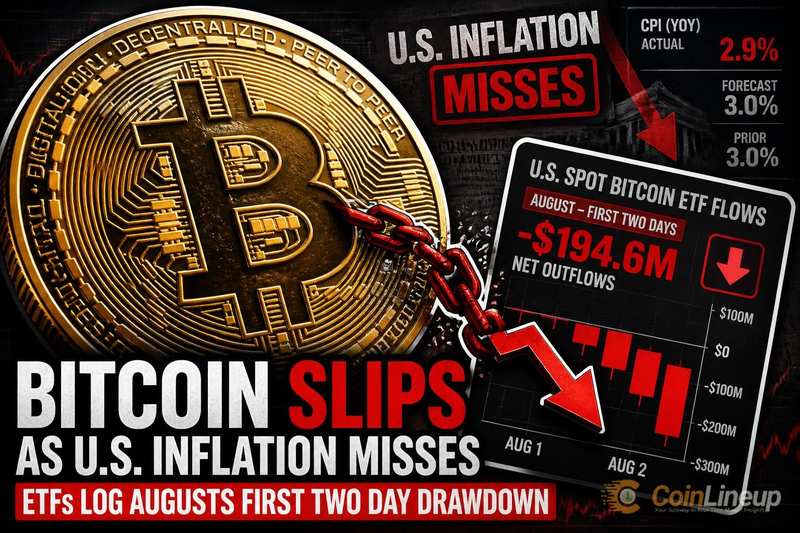
Bitcoin lost ground after the latest U.S. inflation reading failed to spark fresh gains, while U.S. spot Bitcoin ETFs logged their first back-to-back daily drawdown of August — a combination that left the market with a cautious, defensive tone.
Why Bitcoin slipped after the U.S. inflation release
Rather than rallying on the U.S. inflation data, Bitcoin eased, as the report did not deliver the upside catalyst some traders had positioned for, according to CoinDesk reporting.
The reaction hinged on the gap between macro expectations and actual price action. The monthly consumer price update from the Bureau of Labor Statistics was closely watched, but it did not produce the follow-through buying that a risk-on inflation print typically encourages. CPI is the most widely followed U.S. inflation measure, and its readings feed into expectations for Federal Reserve rate decisions — a channel through which macro data has become a recurring input for risk-asset sentiment.
A non-bullish response to a major data point matters for sentiment. When a widely anticipated macro release passes without lifting prices, it signals that near-term demand is thinner than the setup implied, leaving Bitcoin exposed to a softer drift.
What August's first two-day ETF drawdown signals
Alongside the muted price move, U.S. spot Bitcoin ETFs recorded their first two-day drawdown of the month, marking a shift after a stretch of steadier demand.
Two consecutive days of outflows stand out in August because they break the prevailing flow pattern. These funds began trading in January 2024 after SEC approval and hold Bitcoin directly, so share creations and redemptions translate into purchases and sales of the underlying asset — the mechanics behind their role as a demand gauge. Because ETF flows serve as a proxy for institutional appetite, a back-to-back reversal points to cooling short-term demand rather than a one-session blip.
That flow weakness adds a second bearish signal to the muted inflation reaction. ETF demand has been a key confirmation tool for spot direction this year, evident in moves such as Morgan Stanley raising its BlackRock Bitcoin ETF stake and Paul Tudor Jones adding BlackRock Bitcoin ETF shares during the second quarter. Both positions sit in BlackRock's fund, the largest U.S. spot Bitcoin ETF by assets under management. When those flows turn negative, the spot market loses a supportive bid.
What the inflation miss and ETF outflows mean for Bitcoin
Taken together, the two developments describe a market that declined to reward a bullish macro setup while fund demand simultaneously faded. Bitcoin weakened despite a closely watched data point, and ETF investors pulled back over two straight sessions.
The combined signal is one of caution rather than capitulation. With neither the inflation print nor ETF flows providing a bid, near-term positioning skews defensive until a clearer catalyst emerges.
The broader ETF pipeline remains active, including Cboe's filing for 3x leveraged Bitcoin and Ether products, so structural demand channels continue to expand even as short-term flows soften. Like any new ETF proposal, the Cboe filing faces SEC review, and approval would extend a U.S. crypto lineup that already spans spot and leveraged funds; leveraged products reset daily, amplifying single-day moves in either direction. For now, the market's tone rests on whether ETF flows stabilize and price reclaims momentum after the inflation-driven disappointment, with the most concrete signposts being the daily ETF flow tallies and the SEC's response to pending filings.
Disclaimer: This article is for informational purposes only and does not constitute financial or investment advice. Cryptocurrency and digital asset markets carry significant risk. Always do your own research before making decisions.

