Bitcoin Slides Toward $73,700 as ETF Outflows and $730M Liquidations Put Safe-Haven Narrative to the Test
Key Takeaways
- •Bitcoin dropped toward $73,700 minutes after October US CPI exceeded forecasts, with headline inflation at 0.4% and core inflation at 0.3% month-over-month.
- •Markets now price an 85% probability of a 25-basis-point Federal Reserve rate hike at the December 9 meeting, reversing earlier expectations that rates would stay unchanged.
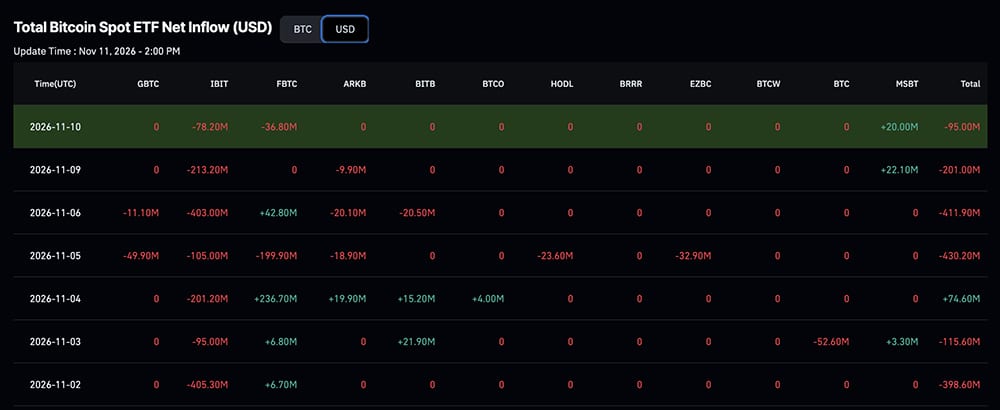
- •US spot Bitcoin ETFs recorded $1.28 billion in net outflows last week, the worst weekly performance since late June, leaving 2026 cumulative flows down $914 million, with BlackRock's IBIT accounting for $1.21 billion of the withdrawals.
- •Crypto liquidations totaled roughly $730 million, with long positions making up about 79% of closures, around 115,600 traders forcibly exited, and Bitcoin alone suffering $203 million in liquidations.
- •Bitcoin whales reduced their holdings by more than 34,000 BTC worth $2.6 billion over the preceding week, while key technical levels sit at $72,700 support and $75,000 recovery resistance.
Bitcoin slipped toward $73,700 minutes after the release of hotter-than-expected US inflation data, which reignited fears of another Federal Reserve rate hike and compounded a decline already being driven by institutional withdrawals and leveraged liquidations. The move extended mounting strain on the asset's reputation as a hedge, with price action, fund flows, and derivatives data all pointing in the same direction.
Rather than shielding investors from traditional-market turmoil, the world's largest cryptocurrency is behaving more like another risky technology stock. The latest drop followed billions of dollars in outflows from spot investment funds, and it arrived just as weakening institutional demand collided with a fresh round of forced selling among leveraged traders.
ETF Outflows Expose Softening Institutional Demand
US spot Bitcoin exchange-traded funds recorded $1.28 billion in net outflows last week, their worst weekly performance since late June, according to Coinglass data. BlackRock's iShares Bitcoin Trust (IBIT) accounted for $1.21 billion of those withdrawals, and IBIT logged a further $201 million in net outflows on Tuesday.
The withdrawals have pushed cumulative Bitcoin ETF flows into negative territory for 2026, with the funds now down $914 million on a net basis.
The reversal is significant because spot ETFs — which began trading in the United States in January 2024 — became one of Bitcoin's biggest sources of institutional demand. Their recent performance shows Wall Street growing considerably less enthusiastic about buying the dip, and it raises questions about Bitcoin's ability to attract fresh capital during periods of economic uncertainty. If institutional demand cannot absorb selling pressure, a sustained recovery becomes much harder to achieve.
Inflation Shock Triggers $730 Million Liquidation Wave
The latest inflation print delivered a painful blow to crypto traders. US headline CPI increased 0.4% in October, exceeding economists' expectations of 0.3%, while core inflation climbed 0.3%, above the anticipated 0.2%. The Bureau of Labor Statistics did not release year-over-year figures due to the October 2025 government shutdown.
BREAKING: October CPI inflation rises +0.4% month-over-month, above expectations of +0.3%. Core CPI inflation rose +0.3%, also above expectations of +0.2%. BLS will not be releasing year-over-year figures due to the October 2025 government shutdown. Inflation still appears to…
— The Kobeissi Letter (@KobeissiLetter) November 10, 2026 (source)
The report sent Treasury yields and the US dollar higher, while interest-rate futures shifted sharply toward tighter monetary policy. Markets now price in an 85% probability of a 25-basis-point rate hike at the Federal Reserve's December 9 meeting; traders had previously expected the central bank to leave rates unchanged. A higher rate path generally tightens conditions for risk assets by raising borrowing costs and making cash-like yields more competitive, and the December 9 decision now stands as the next major macro event on the calendar. In the meantime, upcoming daily ETF flow prints will offer a running measure of whether institutional appetite stabilizes.
Bitcoin struggled to hold its ground as traditional markets weakened. The Nasdaq Composite dropped 1.51%, while the S&P 500 lost 0.94% during the session. The resulting crypto liquidation wave reached approximately $730 million across markets, per Coinglass liquidation data. Liquidations occur when exchanges automatically close leveraged positions whose margins can no longer cover potential losses, converting leveraged bets into forced selling. Long positions accounted for $570 million, representing nearly 79% of all liquidations — meaning most of the forced closures hit traders positioned for gains — and around 115,600 traders saw positions forcibly closed. Bitcoin alone suffered $203 million in liquidations, including $175 million from bullish positions.
The damage extended beyond derivatives markets. Bitcoin whales also reduced their holdings by more than 34,000 BTC over the preceding week, worth $2.6 billion.
The combination leaves bulls facing three problems at once: weakening institutional demand, aggressive selling, and an increasingly hostile macroeconomic environment.
Is Bitcoin Still a Safe Haven?
The market action raises an uncomfortable question for Bitcoin bulls. If Bitcoin cannot hold its value when inflation threatens traditional markets, what exactly qualifies it as a safe haven?
Gold and Bitcoin have often drawn comparisons as alternative stores of value, but their short-term market behavior can look very different during periods of financial stress. Bitcoin remains sensitive to liquidity conditions, investor appetite for risk, and expectations surrounding Federal Reserve policy, and its latest performance reinforced that vulnerability. Rather than attracting defensive capital, Bitcoin traded alongside technology stocks as investors reduced exposure to riskier assets.
Technically, the immediate battle is around $72,700, with $75,000 remaining an important recovery level on BTC/USD charts. A sustained break below support could expose Bitcoin to another wave of selling, while a recovery of $75,000 would give bulls some breathing room.
Right now, the safe-haven narrative faces a serious credibility test. Bitcoin needs more than another speculative rally to convince investors that it can protect their portfolios when markets turn ugly.
This article was first published by 99Bitcoins.

