Bitcoin Slips Near $63,500 as Traders Look Past CPI to Fed's Next Tests
Key Takeaways
- •U.S. July inflation came in largely in line with expectations, with headline CPI up 0.1% month over month and 3.4% year over year, while core CPI rose 0.2% and eased to 2.5%.
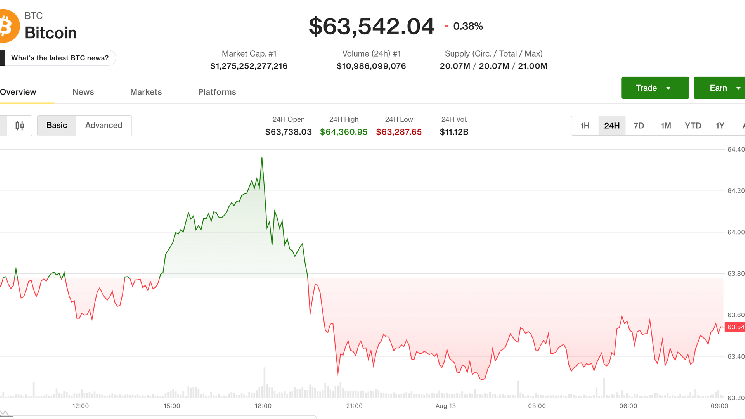
- •Bitcoin fell to around $63,500, leaving it down more than half a percent on the day and nearly 2% over the week.
- •The probability of a Federal Reserve rate hike in September fell to about 38% from 46% after the inflation report.
- •Hyperliquid's HYPE token gained more than 3% to $56, while most other major digital assets, including Dogecoin, XRP, BNB, Solana, and ether, were lower.
- •Market participants are now watching Jackson Hole, the September 4 jobs report, and the September 11 inflation release for the next policy signals.
Bitcoin Slips Near $63,500 as Traders Look Past CPI to Fed's Next Tests
Bitcoin declined to approximately $63,500 on Thursday, losing over half a percent on the day and nearly 2% on the week, as an in-line U.S. inflation report calmed market nerves but failed to provide directional momentum.
Among major digital assets, Hyperliquid's HYPE token stood out with a gain of more than 3% to $56, though it remained flat over the week. Tron edged marginally higher to just under 34 cents, up 2% over seven days. The broader market was predominantly negative: Dogecoin fell nearly 3% to 7 cents, XRP dropped over 1% to $1 (down almost 5% on the week), BNB slipped more than 1% to $610, Solana declined under 1% to $76, and ether retreated marginally to $1,880.
July's inflation figures landed almost exactly in line with economist forecasts. Headline inflation rose 0.1% month-over-month and 3.4% year-over-year, while the core measure excluding food and energy increased 0.2%, easing to 2.5%.
The data was sufficient to reduce the probability of a Federal Reserve rate hike in September, with futures markets trimming the odds to approximately 38% from 46% prior to the release. In the immediate aftermath, gold rose 1.3%, ether gained just over 1%, bitcoin advanced around half a percent, and S&P 500 futures ticked up 0.2%.
Gabe Selby, head of research at CF Benchmarks, told CoinDesk that bitcoin tends to move most sharply when inflation data forces a reassessment of the rate outlook. He noted that across the three occasions in the past nine releases where inflation came in below expectations, bitcoin gained an average of 3.25%. A downside surprise on July 14 was followed by a 4.24% rally.
"An in-line report can remove a tail risk," Selby said. "It takes a genuine surprise to create a catalyst." He added that the Fed has room to wait, citing shelter costs up just 0.1%, energy down 1.5%, gasoline down 2.9%, and some goods categories now lapping last year's tariff-driven increases.
The next key events for markets are the Jackson Hole gathering of central bankers later this month — the Kansas City Fed's annual symposium in Wyoming, where Fed chairs have historically used keynote remarks to signal shifts in monetary policy — the September 4 jobs report, and the September 11 inflation release.
Equities responded more favorably to the data. MSCI's Asia Pacific index rose nearly 1%, with Samsung Electronics and SK Hynix serving as the largest contributors. Korea's Kospi rallied almost 4%, entering a technical bull market — conventionally defined as a 20% rise from a recent trough — with a 22% gain over ten days.
The positive sentiment was not universal. Cisco fell over 4% in after-hours trading on underwhelming earnings, and Cerebras Systems, the AI chipmaker competing with Nvidia in high-performance inference hardware, dropped 17% amid declining hardware sales.
Brent crude snapped a six-day winning streak, easing after a rally that had pushed prices to $90 per barrel. The pullback followed remarks by Islamic Revolutionary Guard Corps adviser General Mohammad Reza Naqdi, who stated that Iran was preparing to conduct operations on U.S. soil under a new military doctrine.

