Bitcoin Slips Below $84,000 Ahead of FOMC Minutes as Oil Prices Fan Inflation Concerns
Key Takeaways
- •Bitcoin slipped below $84,000 during Wednesday's Asian session amid uncertainty over Federal Reserve policy ahead of the release of the FOMC meeting minutes.
- •U.S. spot Bitcoin ETFs recorded $118.8 million in net inflows on October 6, reversing the $89.8 million in outflows from October 5, according to Farside data.
- •Oil prices climbed on Wednesday as a storm nearing the Gulf of Mexico and attacks in the Middle East raised supply-disruption concerns, adding to inflation worries.
- •Investors have scaled back expectations for an October rate increase but still see a meaningful chance of further tightening by December.
- •The key technical levels are the $80,000–$82,000 support zone and $87,000 resistance, with a break below $80,000 risking a decline toward $70,000–$75,000.
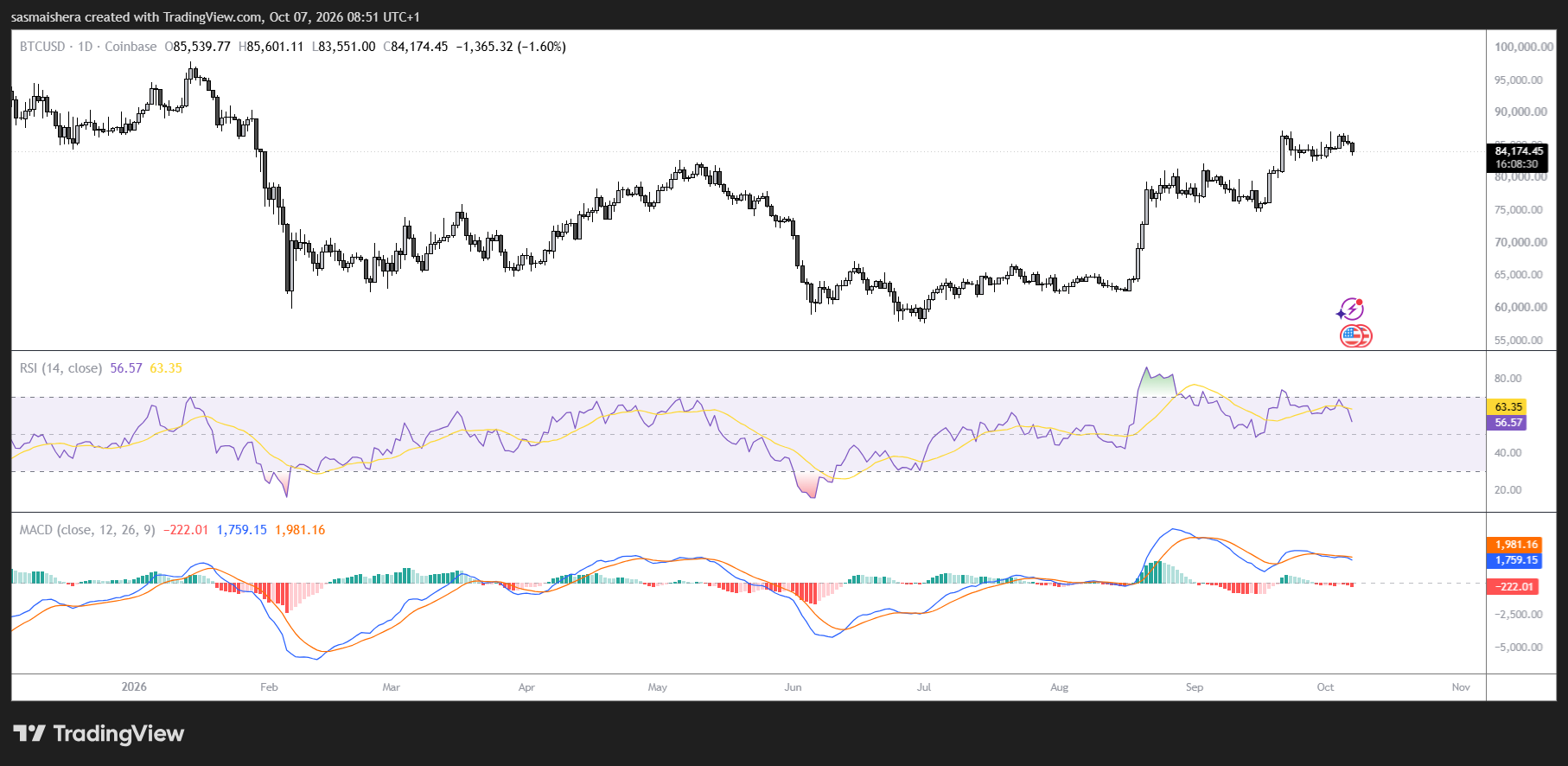
Bitcoin slipped below $84,000 during Wednesday's Asian trading session as investors awaited the Federal Reserve's meeting minutes and assessed renewed inflation risks from rising oil prices.
The pullback came despite a return to inflows into U.S. spot Bitcoin exchange-traded funds, highlighting persistent uncertainty over the direction of monetary policy. Although expectations for an October rate increase have eased, the analysis indicates that investors continue to anticipate a significant possibility of further tightening by December.
Rising oil prices have added inflation concerns ahead of the FOMC minutes, keeping interest-rate expectations in focus for both Bitcoin and gold.
ETF inflows return, but Bitcoin struggles to advance
U.S.-listed spot Bitcoin ETFs recorded $118.8 million in net inflows on October 6, reversing the $89.8 million in outflows logged on October 5, according to Farside figures cited in the report.
Spot Bitcoin ETFs, which began trading in the United States in January 2024, have since become a closely watched gauge of institutional demand, with their daily flow figures monitored for signs of shifting investor positioning. The reversal offered a supportive demand signal, but it did not prevent Bitcoin from slipping below $84,000 the following morning. The uneven flows suggest that investment demand has yet to provide consistent backing for a sustained advance. Continued inflows would strengthen the recovery case, particularly if accompanied by firmer spot buying.
FOMC minutes and oil-driven inflation risks in focus
The minutes from the Federal Reserve's latest meeting could influence expectations for the central bank's next policy steps. Such minutes typically provide the fullest public record of how officials weighed inflation and the economic outlook, and traders parse the language for clues on the timing and pace of future moves. A stronger preference for additional rate increases could pressure both assets, since higher interest rates raise the appeal of interest-bearing investments and increase the opportunity cost of holding gold or Bitcoin.
A more patient policy tone could instead provide support, but rising energy prices complicate that outlook. Oil advanced on Wednesday as a storm approaching the Gulf of Mexico and attacks in the Middle East raised concerns about supply disruptions. Energy costs feed into the inflation readings that guide central bank decisions, so if higher energy costs sustain inflation, expectations for further monetary tightening could strengthen.
Bitcoin price outlook: $80,000 support remains crucial
Bitcoin's daily chart shows the asset consolidating within an ascending broadening wedge, with immediate support located around $80,000–$82,000. Holding that zone would preserve the constructive near-term scenario outlined in the analysis, while a sustained move above $87,000 could put the $100,000 level in focus.
A break below $80,000, however, would weaken that setup and expose the $70,000–$75,000 range. Further losses beneath $70,000 could bring support around $65,000 into view.
On the weekly chart, analysts identify a longer-term support zone between $50,000 and $60,000, alongside a potential cup formation within an ascending channel. Under that bullish scenario, a future breakout above $100,000 could support an extension toward $150,000. Those levels remain conditional technical projections rather than assured outcomes.
Bitcoin's renewed ETF inflows provide encouragement, but stronger and more persistent demand would be needed to absorb selling pressure and sustain a breakout. The immediate technical focus remains on defending the $80,000–$82,000 support zone and overcoming resistance at $87,000.
Meanwhile, the FOMC minutes and energy-driven inflation concerns could influence both Bitcoin and gold through shifts in rate expectations. A failure to hold Bitcoin's nearby support would instead increase the risk of a deeper correction.

