Bitcoin Falls Below $60,000 as US Spot Bitcoin ETFs Log Another $231.6M in Daily Outflows
Key Takeaways
- •Bitcoin fell below $60,000 on November 25 and traded near $58,500–$59,200, down about 2% in 24 hours, after a rebound sparked by Nvidia's reinstatement of Jensen Huang as CEO failed to hold.
- •U.S. spot Bitcoin ETFs posted a net outflow of roughly $231.6 million on November 24, lifting November's cumulative withdrawals to about $4.71 billion — a record month — with BlackRock's IBIT accounting for much of the selling pressure.
- •The CFTC announced guidance on November 24 recognizing Bitcoin as an eligible asset for certain financial resource requirements at regulated derivatives exchanges.
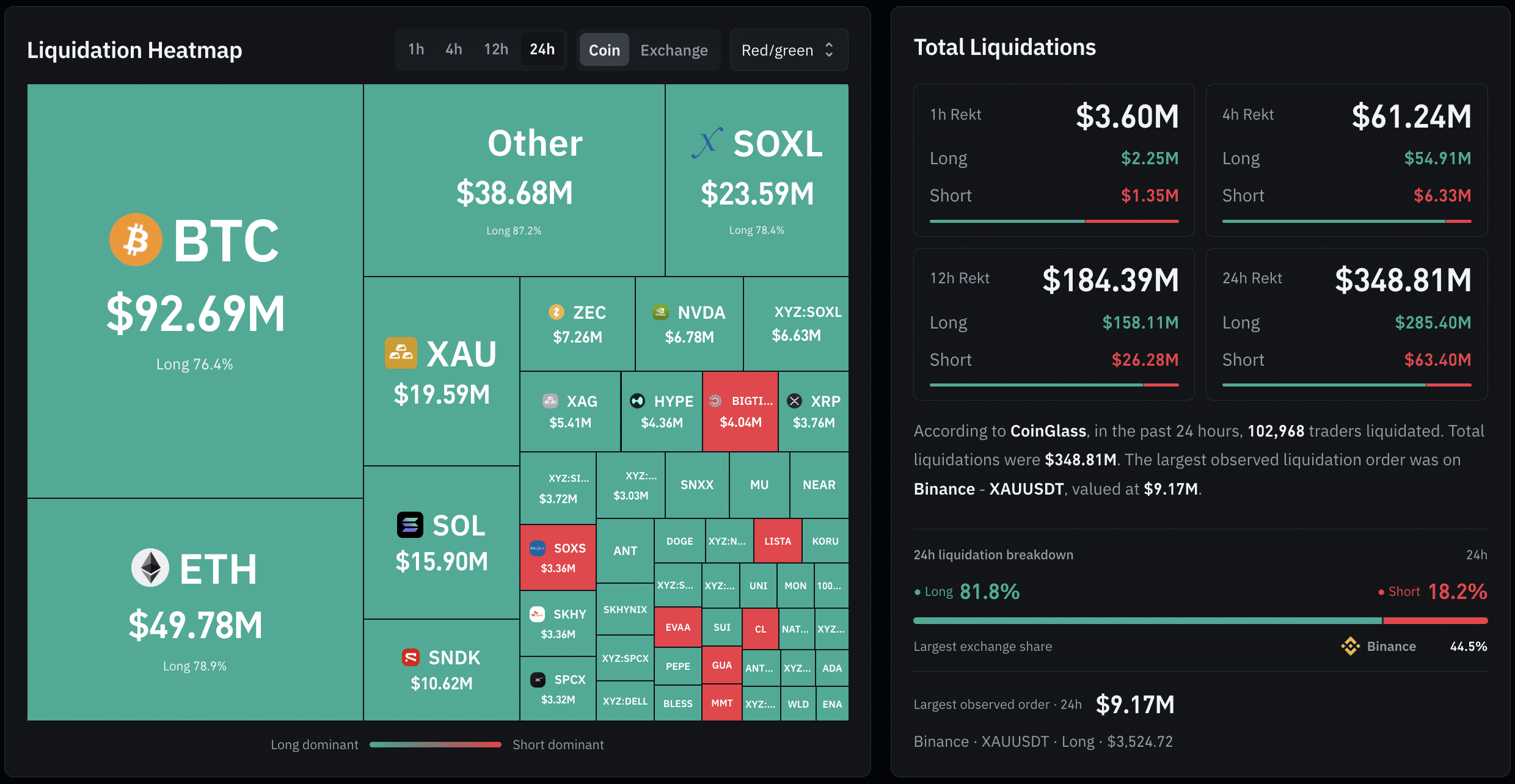
- •Crypto liquidations reached $348 million over the past 24 hours, with Bitcoin representing $92.5 million and long positions absorbing most of the losses.
- •Traders are monitoring the $58,000–$59,000 zone as immediate support, where a sustained break could open the path toward the recent low near $55,000.
Bitcoin slipped back below the $60,000 level on November 25, resuming the downward pressure that has marked recent sessions after a short-lived rebound earlier in the week. The world's largest cryptocurrency is changing hands near $58,500–$59,200, down roughly 2% over the past 24 hours, having failed to hold the modest gains it recorded at the start of the week.
The fading rally — which had been sparked by Nvidia's reinstatement of Jensen Huang as CEO — has left Bitcoin once again testing key support in a risk-off environment. With most metrics leaning bearish and no news on the horizon to boost Bitcoin's fortunes, many investors are wondering just how low BTC and the broader crypto market can go as the year heads into December.
Against that backdrop, one piece of regulatory news offered a counterweight: the U.S. Commodity Futures Trading Commission (CFTC), the federal agency that oversees the nation's derivatives markets, announced on November 24 that Bitcoin is now eligible for financial reserves at regulated derivatives exchanges, giving the market at least one small glimmer of hope amid a sea of bearish sentiment. Under the guidance, Bitcoin can be counted toward certain financial resource requirements that such venues must maintain — a narrow but notable acknowledgment from a U.S. regulator at a time when sentiment has turned sharply negative.
The development was highlighted in a post by Bitcoin News on X:
CFTC RECOGNIZES BITCOIN AS ELIGIBLE FOR FINANCIAL RESERVES AT REGULATED DERIVATIVES EXCHANGES The U.S. Commodity Futures Trading Commission has issued guidance recognizing Bitcoin as an eligible asset for certain financial resource requirements at regulated derivatives exchanges… pic.twitter.com/FnvNASihgv — Bitcoin News (@BitcoinNewsCom) November 24, 2026
Spot Bitcoin ETF Flows Remain Deeply Negative
U.S. spot Bitcoin exchange-traded funds, which began trading in January 2024 and quickly became a key channel for institutional capital into Bitcoin, continued to record heavy outflows. On November 24, the funds posted a net outflow of approximately $231.6 million. The previous session, on November 23, was even steeper, with roughly $569.7 million exiting the products.
BlackRock's iShares Bitcoin Trust (IBIT), the largest fund in the category by assets, has accounted for the majority of the selling pressure in recent days, and November is shaping up as a record month for redemptions. Cumulative net outflows for the month have reached around $4.71 billion — approaching $5 billion — per CoinGlass data, surpassing previous monthly highs.
Despite the sustained withdrawals, the suite of U.S. spot Bitcoin ETFs still holds roughly $72 billion in total net assets. The persistent outflows underscore ongoing institutional caution, even as the products remain a primary vehicle for traditional finance exposure to Bitcoin — one reason daily flow figures have become a widely tracked barometer of institutional sentiment toward the asset.
Liquidations Show Longs Under Pressure
Derivatives markets have reflected the downward pressure. Over the past 24 hours, crypto liquidations — forced closures of leveraged positions when traders can no longer meet margin requirements — have run into the hundreds of millions of dollars, currently standing at $348 million per CoinGlass, with Bitcoin accounting for a significant share at $92.5 million.
Long positions have taken the majority of the damage as price has drifted lower, consistent with the broader decline from recent local highs. Data aggregators tracking major exchanges show tens of millions in Bitcoin long liquidations in recent sessions, alongside smaller short liquidations.
Larger single liquidations in the multi-million-dollar range have appeared on venues such as Binance and OKX during sharp downward moves. The liquidation heatmap continues to show clusters of long leverage sitting just below current prices, suggesting further downside could trigger additional forced selling.
Broader Market Context and Sentiment
The crypto market remains in a state of extreme fear — the lowest band on the index — according to the Fear & Greed Index, a composite gauge that blends volatility, momentum, and sentiment data. Bitcoin's failure to hold above $60,000 after the Nvidia-related bounce has reinforced the cautious mood.
Macro uncertainty, elevated bond yields, and shifting expectations around Federal Reserve policy continue to weigh on risk assets, including digital assets.
Bitcoin's 30-day performance shows a roughly 26% decline, and the asset sits well below its earlier 2026 highs. Trading volume remains elevated on the downside, while open interest in perpetual futures has shown signs of contraction as leveraged positions are flushed out.
Key Levels and Near-Term Outlook
Traders are closely watching the $58,000–$59,000 zone as immediate support. A sustained break below this area could open the path toward the recent low near $55,000. On the upside, reclaiming and holding above $62,000–$64,000 would be needed to improve short-term sentiment and potentially attract fresh buying.
For now, record monthly ETF outflows, heavy liquidations in long positions, and fading equity-market optimism have kept Bitcoin on the defensive. Market participants will be monitoring the next set of ETF flow data and any shifts in broader risk appetite — along with follow-through from the CFTC's guidance — for signs of stabilization.
Source: 99Bitcoins

