Coldcard Firmware Exploit Drains Up to $70M in Bitcoin as Social Sentiment Hits Record Low
Key Takeaways
- •The Coldcard firmware exploit resulted in estimated losses of approximately 1,082 BTC worth $70 million across 1,196 addresses, making it one of the largest hardware wallet-related thefts on record.
- •Santiment data showed Bitcoin social sentiment fell to its lowest positive-to-negative ratio since the firm adopted its current monitoring methodology across major platforms.
- •Coinkite traced the vulnerability to a firmware build error introduced in version 4.0.0 from a March 2021 code commit and subsequently patched it in release 4.21.
- •Bitcoin maintained its price near $63,000 and held support above $60,000 despite the security incident and deteriorating social sentiment.
- •Binance founder Changpeng Zhao publicly advised cryptocurrency holders to spread funds across multiple wallets while acknowledging that no security approach is entirely risk-free.
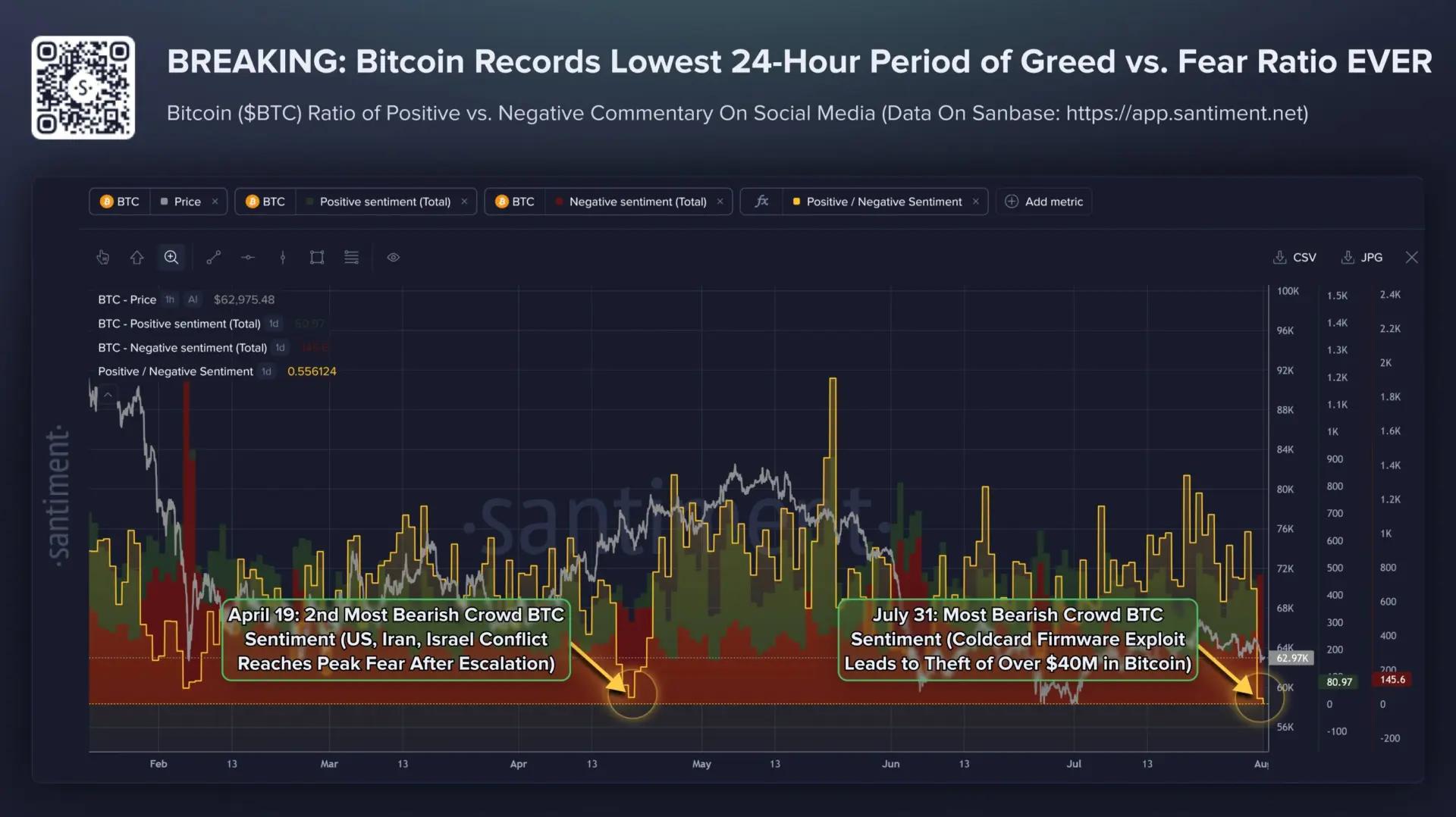
Social media sentiment surrounding Bitcoin has dropped to its most negative level on record following the Coldcard hardware wallet exploit that drained an estimated 1,082 BTC, worth approximately $70 million, from affected users.
Santiment's social sentiment readings confirmed the sharp deterioration in mood after a security incident that compromised nearly 1,200 self-custody wallets. Santiment's tracking data showed that on the first full day of trading following the exploit, the ratio of positive Bitcoin commentary to negative posts fell to its lowest point since the firm adopted its current monitoring methodology across X, Reddit, Telegram, and other platforms.
Why the Coldcard Hack Struck a Nerve
Cryptocurrency holders use hardware wallets specifically to shield assets from the operational and security threats that centralized exchanges face routinely. The widely known maxim "Not your keys, not your crypto" gained prominence after previous exchange failures left users unable to access their funds.
The Coldcard incident, however, undermined that foundational assumption. Coldcard, manufactured by Coinkite, is a Bitcoin-only hardware wallet marketed for its air-gapped security model, making a firmware-level compromise particularly alarming to the self-custody community. Large-scale thefts stemming from hardware wallet firmware flaws have been comparatively rare, with most major crypto losses historically traced to exchange breaches or smart contract vulnerabilities. Block traced the root cause to a firmware build error introduced when Coinkite shipped version 4.0.0 from a code commit dated March 1, 2021. Coinkite subsequently patched the vulnerability in release 4.21.
Bitcoin Price Resilience Despite Mounting Losses
Bitcoin's price has held steady near $63,000 as of Saturday's report. The leading cryptocurrency closed July in positive territory despite a modest pullback of approximately 1.3% over the preceding 24 hours, according to CoinMarketCap data.
Maintaining support above the $60,000 level has been viewed as a positive signal by market observers during a period when victim losses escalated significantly. Cryptopolitan first reported estimated losses of approximately 594 BTC, or about $38 million, around the time the hack initially surfaced. Those figures rose sharply over the course of the day, with Galaxy Research's most recent estimate placing the total at $70 million lost across 1,196 addresses.
CZ Weighs In and What the Market Is Watching
Binance founder Changpeng Zhao commented on the incident via X, stating that "even hardware wallets can have bugs" and recommending that holders distribute their funds across multiple wallets. He cautioned that this approach carries its own risks and that "nothing is 100%." His post garnered nearly 2,000 likes within hours.
Market participants are closely monitoring the attacker's consolidated holdings. A large transfer toward an exchange could introduce short-term selling pressure. Traders are also watching whether Bitcoin can sustain support at $60,000; a sustained break below that level could open a path toward $58,000, while a recovery to $64,000 would alleviate immediate downside risk. The incident has also renewed attention on firmware verification practices within the hardware wallet industry, where users have increasingly scrutinized whether device manufacturers can guarantee the integrity of pre-installed software.

