Bitcoin Selling Pressure Shows Signs of Exhaustion, But Cycle Bottom Remains Unconfirmed
Key Takeaways
- •Glassnode’s Seller Exhaustion Constant has fallen below 0.02, indicating that Bitcoin selling pressure is weakening.
- •The indicator remains above the sub-0.01 levels that previously marked major bear-market bottoms.
- •Long-term holders continue reducing their Bitcoin balances, and current accumulation has not offset the decline.
- •Short-term holders sold about 19,200 BTC to exchanges over the past 24 hours, according to analyst Ja Maartun.
- •Bitcoin has traded mostly between $60,000 and $65,000 since June and has underperformed major U.S. equity indexes in 2026.
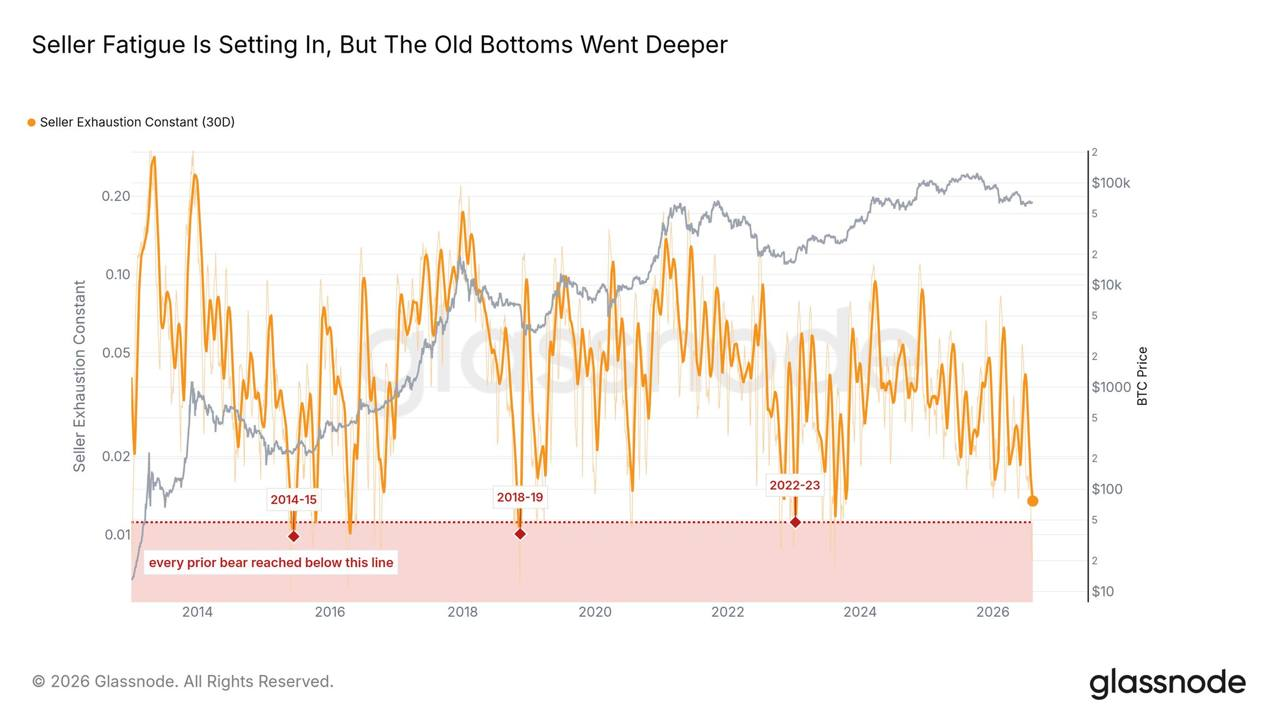
Bitcoin selling pressure is showing early signs of exhaustion as the cryptocurrency remains range-bound near $63,000, though on-chain indicators suggest sellers have not yet reached levels associated with previous market bottoms.
Glassnode's Seller Exhaustion Constant has fallen below 0.02 as selling pressure has weakened. The metric combines the volume of Bitcoin moved at a loss with the overall probability of coins being spent, providing a composite read on whether sellers capitulating underwater positions are nearing their limit. Crypto analyst Antifragile observed that prior Bitcoin bear markets pushed the indicator below 0.01 before major bottoms were established. The current reading indicates that seller exhaustion is developing but has not yet confirmed a cycle low.
Long-Term and Short-Term Holders Continue Distributing
Evidence that sellers remain active is visible in the declining Long-Term Holder (LTH) balance. According to CryptoQuant data, the LTH balance continues to trend downward despite a recent surge in accumulation.
Crypto analyst Rei Researcher noted that some long-term holders are still selling, and that current accumulation is not strong enough to reverse the decline in total BTC held by this cohort.
"The amount of $BTC aging into the Long-Term Holder cohort is still not enough to offset the coins leaving it," he said.
Short-term holders (STH) are also distributing at a loss. Analyst Ja Maartun reported that STHs moved approximately 19,200 BTC to exchanges over the past 24 hours.
https://x.com/JA_Maartun/status/2087222015669494187?s=20
Bitcoin Underperforms U.S. Equities Across Multiple Timeframes
Bitcoin's price action reflects the mixed on-chain environment. BTC has traded primarily between $60,000 and $65,000 since June, with repeated recovery attempts failing near the upper boundary. After briefly approaching $65,000, Bitcoin fell back toward $63,000 during the latest correction.
The decline has left BTC approximately 27% lower year to date, meaning Bitcoin has significantly underperformed major U.S. equity indexes during 2026. The S&P 500 gained approximately 12.8% year to date, the Dow Jones Industrial Average rose 11.9%, and the Nasdaq 100 advanced 13.7%. The Russell 2000 posted the strongest performance among the four indexes, rising approximately 22%.
The divergence has also been visible over shorter timeframes. Over the previous 90 days, Bitcoin fell approximately 20%, while the S&P 500 gained about 5% and the Nasdaq advanced approximately 1.9%. These figures indicate that capital has favored U.S. equities over Bitcoin despite volatility across technology stocks.
July CPI Report Looms as Next Market Catalyst
Attention is now turning toward the July U.S. Consumer Price Index report, scheduled for release by the U.S. Bureau of Labor Statistics on Aug. 12 at 8:30 a.m. Eastern Time.
The previous CPI report showed headline inflation increased 3.5% over the 12 months through June, while core inflation, which excludes food and energy, rose 2.6% over the same period.
The July reading could influence expectations for Federal Reserve interest-rate policy. A stronger-than-expected inflation figure could reinforce expectations for tighter monetary policy, potentially pressuring Bitcoin and other risk assets. Conversely, softer inflation could reduce pressure on the Federal Reserve to maintain restrictive policy.
CPI alone, however, will not determine Bitcoin's longer-term direction. Traders will also monitor labor-market conditions, Federal Reserve guidance, and institutional demand.
For Bitcoin, the on-chain picture remains mixed ahead of the inflation report. Seller exhaustion has increased, but the Glassnode indicator remains above levels associated with previous bear-market bottoms. Long-term and short-term holder distribution patterns suggest selling has not disappeared. This leaves the Bitcoin bottom thesis unconfirmed while BTC remains within its $60,000–$65,000 trading range.

