Bitcoin Price Drop Triggers Broad Altcoin Sell-Off While Cardano Posts Double-Digit Weekly Gain
Key Takeaways
- •Bitcoin declined from above $65,000 toward $62,000 in late July, contributing to a total crypto market capitalization drop to approximately $2.22 trillion by August 2.
- •The CLARITY Act cleared the Senate Banking Committee but faces a constrained legislative calendar and unresolved disputes, making passage before the August recess increasingly unlikely.
- •A Coldcard hardware wallet vulnerability was linked to the theft of approximately 594 BTC from hundreds of wallets, raising renewed concerns about self-custody security tooling.
- •Cardano's ADA gained 15.3% over the week, outperforming all other major cryptocurrencies, though it remains 96% below its 2021 peak.
- •Analyst Ted Pillows and Kalshi Crypto prediction market traders both flagged potential for Bitcoin to reach $50,000 if the CLARITY Act stalls and a yen carry trade unwind materializes.
A sharp Bitcoin reversal in late July erased a promising rally and dragged major altcoins lower across the cryptocurrency market. BTC fell toward $62,000 after trading above $65,000, wiping billions from its valuation within hours. By August 2, total crypto market capitalization had declined to approximately $2.22 trillion.
Altcoin capitalization also slipped to roughly $964 billion as Ethereum, XRP, Solana, and HYPE all posted weekly losses. Cardano bucked the broader downtrend, with ADA recording a double-digit weekly advance.
Traders are now contending with policy uncertainty, geopolitical tensions, wallet-security concerns, and worsening on-chain losses as they assess whether selling pressure could intensify further.
Bitcoin Selloff Deepens Market Stress
The Bitcoin price decline followed a volatile week driven by macroeconomic pressure and diminishing regulatory optimism. Bitcoin closed July with a modest monthly gain after surrendering much of its late-month advance. Recent market data placed BTC near $63,273, following an intraday low of approximately $62,414.
This is how I think $BTC will trade next.
$50,000 could happen if the Clarity Act doesn't pass and the yen carry trade unwind starts. pic.twitter.com/CDPKUVejeU
— Ted (@TedPillows) August 2, 2026
The Federal Reserve's decision to hold interest rates steady provided little support for speculative assets. A risk-off tone took hold as investors monitored escalating conflict across the Middle East. These pressures dampened appetite for leveraged positions and encouraged capital preservation.
Policy uncertainty compounded the cautious sentiment. The CLARITY Act, which would establish a federal framework defining the respective roles of the SEC and CFTC in overseeing digital assets, has cleared the Senate Banking Committee, but passage before the August recess appears increasingly unlikely. Senate leaders face a constrained legislative calendar and unresolved disputes over ethics provisions, while the bill also requires bipartisan backing. For a crypto market that has repeatedly cited regulatory ambiguity as a barrier to institutional participation, the legislative delay reinforces a wait-and-see posture among larger investors.
The Bitcoin price crash thus stems from multiple converging catalysts. Regulatory delays, geopolitical risks, and weakened confidence are interacting with adverse technical patterns. Security concerns resurfaced after reports linked a Coldcard vulnerability to the theft of approximately 594 BTC from hundreds of wallets. Coldcard is a widely used Bitcoin-only hardware wallet brand, and the incident underscored lingering trust issues around self-custody tooling even as the broader industry promotes hardware wallets as a safer alternative to exchange custody.
Cardano Defies the Wider Altcoin Decline
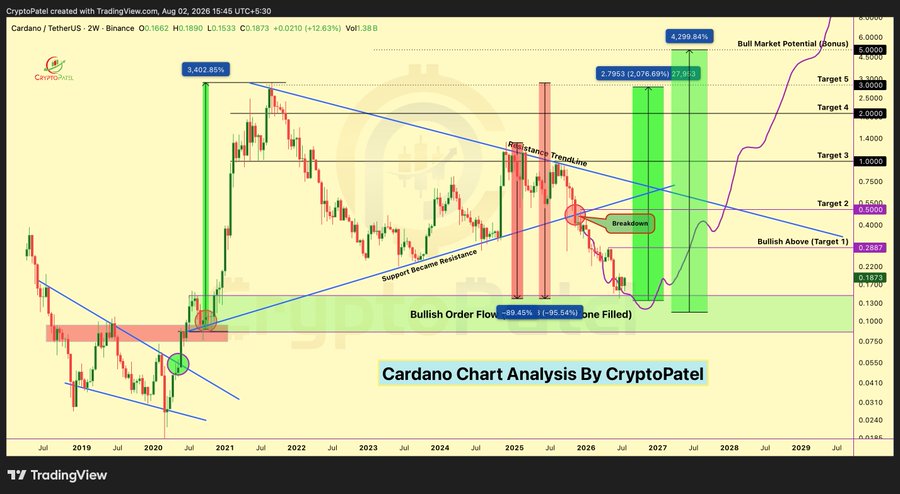
Cardano decoupled from the broader crypto sell-off, with ADA gaining ground even as large-cap tokens weakened. Current market data placed ADA near $0.1885, up 9.6% from the previous close. The weekly chart reflects a 15.3% advance, making Cardano the most pronounced outlier among major cryptocurrencies.
That strength, however, has not erased Cardano's longer-term downtrend. Analyst CryptoPatel notes that ADA remains 96% below its 2021 peak and 89% below its December 2024 swing high. The analyst identified a demand zone between $0.086 and $0.150, a range where buyers previously supported price expansion.
Cardano's price action has reclaimed the upper boundary of that zone, though confirmation would require movement to higher levels. CryptoPatel marked $0.2887 as the first bullish trigger and $0.50 as the key reversal level. A two-week close below $0.08 would invalidate the current structure.
These thresholds carry added significance as the Bitcoin sell-off keeps cross-asset correlations elevated. Ethereum, XRP, Solana, and HYPE all weakened during the weekly decline. Even assets with improving fundamentals can lose momentum when Bitcoin breaks key support and liquidity withdraws. Historically, altcoin rallies that occur during Bitcoin drawdowns tend to be short-lived unless accompanied by idiosyncratic catalysts or shifting capital flows into specific ecosystems.
Market expectations reflect continued downside concern. Analyst Ted Pillows suggested Bitcoin could fall toward $50,000, a scenario contingent on the CLARITY Act stalling and a yen carry trade unwind materializing. A yen carry trade unwind refers to investors rapidly closing positions funded by low-interest Japanese yen borrowing, which has historically triggered cross-asset liquidations affecting everything from equities to cryptocurrencies. Kalshi Crypto traders similarly forecast a $50,000 Bitcoin print at some point during 2026.
Cardano's resilience may reflect positioning within a discounted range rather than a confirmed trend reversal. The network does have upcoming catalysts, including the Leios public testnet and Midnight ecosystem development. Traders are monitoring whether ADA can sustain levels above $0.150 before attempting to challenge $0.2887. A break below $0.08 would materially weaken the bullish setup.

