Retail Bitcoin Holders Send Coins to Binance at Six-Month High While Whales Pull Back Ahead of Fed Decision
Key Takeaways
- •Retail Bitcoin deposits to Binance have risen steadily since April and now stand near $11 billion, their highest level in six months.
- •Whale inflows peaked near $6 billion in late August and have since dropped by roughly a third to about $4 billion.
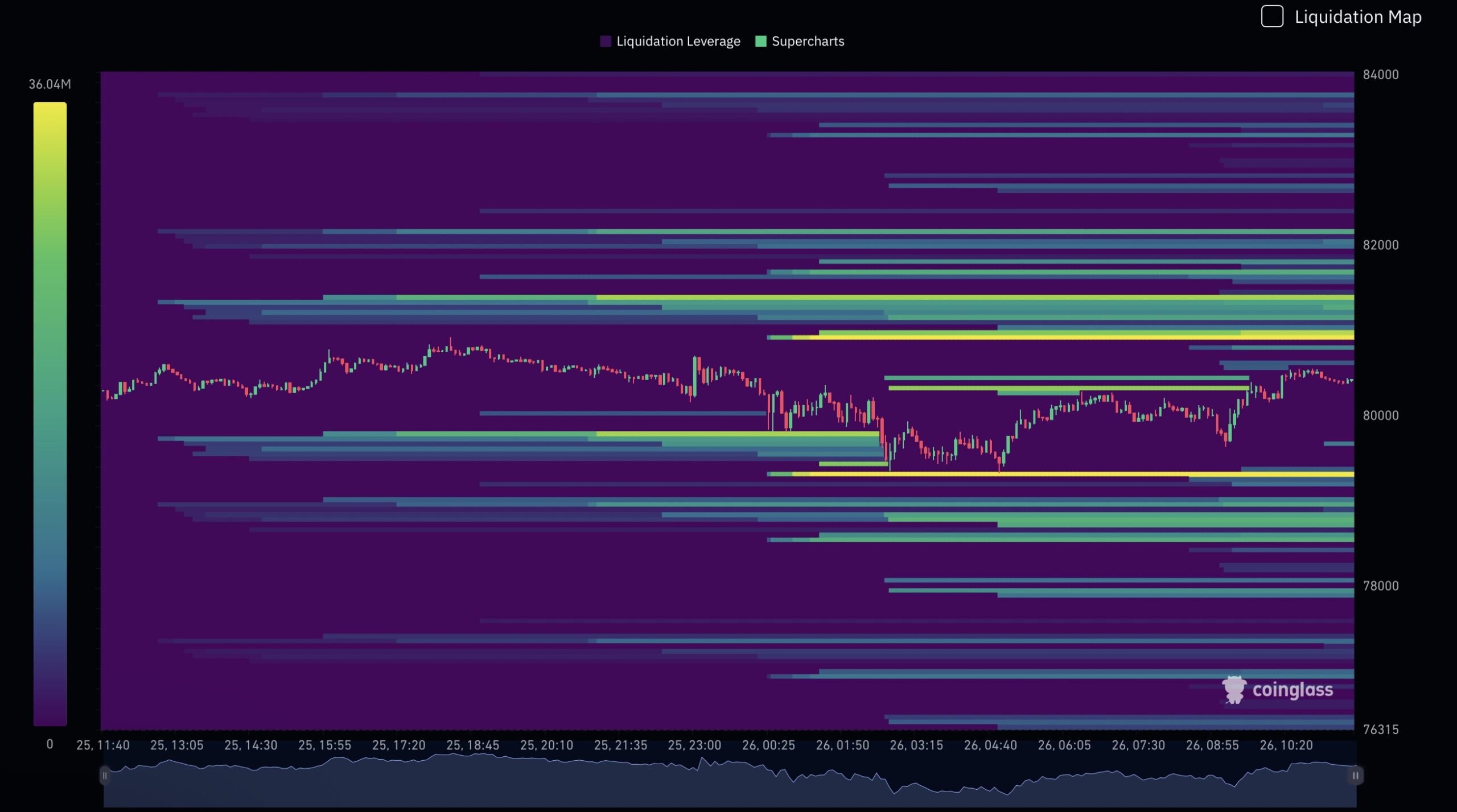
- •Approximately $820 million in crypto positions, mostly longs, were liquidated when Bitcoin dipped to $79,221, but funding rates remained positive on venues such as OKX and Hyperliquid.
- •Bitcoin closed Sunday below its 50-day EMA at $80,812 for the first time since mid-August, with support at $79,221 to $79,369 and the 200-day EMA near $76,350 as the next downside reference.
- •Lookonchain flagged $1.29 billion in shorts held by Abraxas Capital on Hyperliquid, noting they serve as hedges against the fund's spot holdings rather than directional bets against Bitcoin.
Small Bitcoin holders are moving coins onto Binance at the fastest pace in six months, while whale deposits have fallen by a third since late August, CryptoQuant analyst Darkfost wrote on Monday, October 26. The split comes as Bitcoin fights to hold $80,000 ahead of Wednesday's Federal Reserve decision, and it stands out as the most telling on-chain development of the week: the two groups are reading the same dip in opposite ways.
Bitcoin trades near $80,450, flat on the day and down 3% over the past week. Federal Reserve rate decisions are among the most closely watched macro events in crypto, since they shape expectations for the cost of money and the liquidity available to risk-sensitive markets. So what are retail investors and whales doing — and which levels will decide the next move?
Retail Inflows Hit a Six-Month High as BTC Holds $80K
CryptoQuant highlighted the divergence in a post on X on October 26, 2026:
Retail Inflows hit a 6-Month high as BTC holds $80K “BTC flow analysis shows that whales and retail are behaving in radically opposite ways right now.” – By @Darkfost_Coc pic.twitter.com/LtkUtmbt5W
— CryptoQuant.com (@cryptoquant_com) October 26, 2026
Why Are Retail and Whales Splitting?
The two cohorts reacted differently to the slide from $87,000. CryptoQuant's chart tracks how much Bitcoin each group sends to Binance — the world's largest crypto exchange by trading volume — over 30 days. Retail inflows have climbed steadily since April and now sit near $11 billion, their highest level in six months.
Whale inflows went the other way. They peaked near $6 billion in late August and have dropped to about $4 billion. In other words, since April the smaller cohort has steadily increased its exchange activity while the largest holders have scaled theirs back.
The distinction matters because coins usually arrive on an exchange for one of two reasons: to be sold, or to be traded. Rising retail deposits suggest smaller holders are nervous, or trying to trade the swings. Falling whale deposits mean the biggest holders are not rushing to sell into this dip.
The data fits last week's picture. Retail traders had largely left Bitcoin futures, according to data from CryptoQuant CEO Ki Young Ju, and are now showing up in spot instead. Small investors appear to have swapped leverage for coins on exchanges, and some of them look ready to sell.
Are Traders Still Betting on Higher Prices?
Yes, even after Saturday's flush. About $820 million in crypto positions, mostly longs, were liquidated when BTC dipped to $79,221, but funding rates stayed positive. Liquidations — the forced closure of leveraged positions when margin runs short — tend to amplify short-term swings. On OKX, longs paid shorts roughly 0.01% every eight hours on Monday morning. On Hyperliquid, funding is lower but still positive.
The market has therefore not turned bearish. Leverage remains tilted long, which can fuel a quick bounce — or another flush if $79,000 gives way.
Not every large short is a bet against Bitcoin, either. Lookonchain flagged $1.29 billion in shorts held by Abraxas Capital on Hyperliquid. Those accounts are hedges against the fund's spot holdings, not a directional call.
Where Is On-Chain Support?
Lower than the current price, but rising. CryptoQuant analyst TraderGemini noted that the trader realized price — the average cost of coins held by active traders — has turned up again.
“Historically, during bullish phases, this realized price has often acted as support when BTC corrected toward it,” the analyst wrote.
A rising cost basis for active traders means the floor under the market keeps moving up even while the price drifts lower, and dips toward it have tended to find buyers unwilling to sell below what they paid.
Which Levels Matter?
BTC closed Sunday below its 50-day EMA (an exponential moving average, a trend line that weights recent prices more heavily) at $80,812 for the first time since mid-August. Getting back above it is the first step for buyers. For sellers, breaking the weekend lows would open the path lower.
Overhead, the $81,430 to $81,850 zone is the next barrier, where the 4-hour 50 and 200 EMAs converge, and $82,850 has capped every bounce since Thursday. Below, $79,221 to $79,369 is the floor, marking the lows of Saturday and Monday.
A daily close beneath that range would point to the 200-day EMA near $76,350.
For now, the whales are waiting and the crowd is moving coins. That divergence is the on-chain story to watch into Wednesday's Fed decision. In past cycles, the whales were usually the ones who got it right.

