Bitcoin Reclaims $80,000 After US Election and Binance Hack
Key Takeaways
- •Bitcoin climbed back above $80,000, rising roughly 4% to about $80,500, as it recovered from a seven-week low reached after the Binance hack.
- •Democrats won control of both chambers of Congress in the midterms, flipping seven Senate seats and 25 House seats in one of the largest shifts in US political power in nearly two decades.
- •Crypto futures volume increased 27% while open interest rose just 3%, which Nexo read as traders adjusting existing positions rather than adding leverage, with about $469 million in leveraged positions cleared out.
- •Bitwise CIO Matt Hougan said the muted reaction to the Binance hack reflects a more mature industry, noting Bitcoin finished higher 30 days later in five of the ten largest crypto hacks on record.
- •Oil prices dropped sharply, with WTI crude falling below $93 per barrel to a three-week low on hopes of an end to the US-Iran war, a move analysts said could ease inflationary pressure and moderate rate hike expectations.
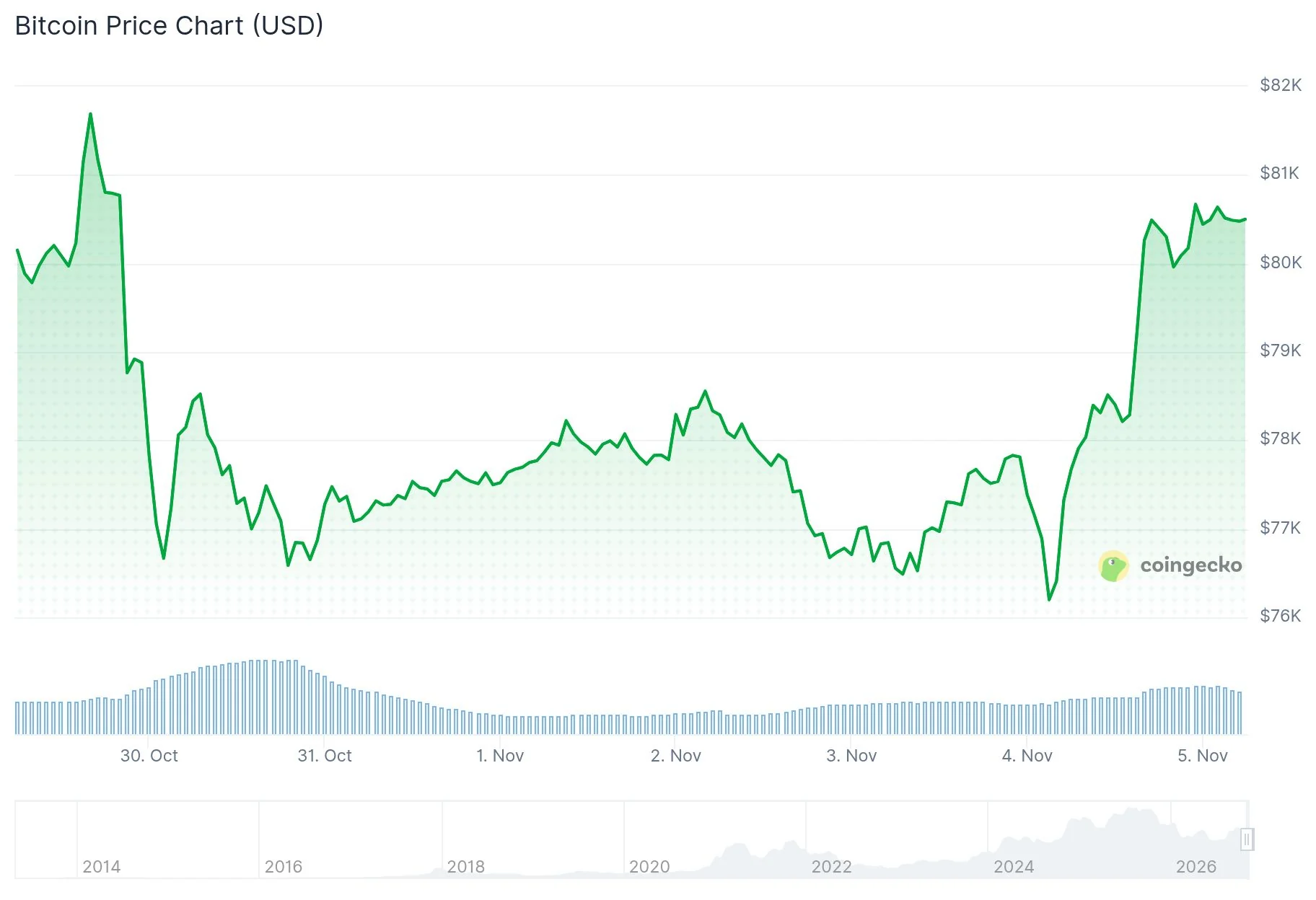
Bitcoin (BTC) climbed back above $80,000 on Wednesday, one day after the US midterm elections, recovering losses linked to a Binance hack earlier in the week. The price reached about $80,500 at the start of the Wall Street session, gaining roughly 3.5% to 4% on the day after touching its lowest level in seven weeks.
Ether rose nearly 6% to $2,433, while Solana and XRP each gained about 2.5%. Crypto futures volume increased 27%, although open interest rose only 3%.
Democrats won control of both chambers of Congress. The Kobeissi Letter said the party flipped seven Senate seats and 25 House seats, describing the result as one of the largest shifts in US political power in nearly two decades.
BREAKING: Democrats have now flipped 7 seats in the Senate and 25 seats in the House, their largest gains since 2008 and 2018, respectively. This marks one of the largest shifts in US political power in nearly two decades.
— The Kobeissi Letter (@KobeissiLetter) November 4, 2026
https://x.com/KobeissiLetter/status/2117980184754233490?ref_src=twsrc%5Etfw
US stock futures initially fell after the election results. S&P 500 futures dropped to 7,490 points, their lowest level since July 31, before rebounding to 7,690 points. The Kobeissi Letter described the initial decline as a “textbook bear trap,” trader shorthand for a drop that reverses quickly and catches sellers on the wrong side.
How Traders Positioned After the Vote
Nexo analysts said futures fell as much as 2.5% as early vote counts were reported before recovering fully. The firm said investors viewed the result as adding clarity without changing the broader growth story.
Nexo’s data indicated that traders were adjusting existing positions rather than adding leverage. Crypto futures volume rose 27%, while open interest increased only 3%, meaning Bitcoin open interest grew more slowly than the asset’s price. Volume counts the contracts that changed hands during the session, while open interest tracks positions still open, and that gap underpinned the firm’s repositioning read. About $469 million in leveraged positions were cleared out.
Market orders shifted to a slight net buying bias after favoring sellers the previous day. The most actively traded Bitcoin options were mostly calls, contracts that give the holder the right to buy at a set price.
On-chain analytics firm Glassnode said traders remained active after the pullback. It noted that volume had fallen to its lowest level since 2023 before the August spike, but remained above that August level despite Bitcoin’s recent decline. Glassnode said the data indicated sustained interest in crypto after months of low activity.
bitcoin:native traders are still here after the retrace. Before the spike in August, volume had sunk to its lowest since 2023. Despite BTC pulling back over the last weeks, volume has stayed above this August level. This indicates sustained interest in crypto after months of… pic.twitter.com/5JCw4sVTaP
— glassnode (@glassnode) November 4, 2026
https://x.com/glassnode/status/2118084798803517712?ref_src=twsrc%5Etfw
Trader Cheds Trading pointed to a weekly chart pattern. He said an inverse head-and-shoulders pattern with an ascending neckline, if completed, would produce a measured move to $125,000. Measured moves project a price target from the dimensions of the formation, so the level comes into play only if the pattern finishes forming.
$BTC measured move $125,000 if this I-HNS with ascending neck-base completes on weekly pic.twitter.com/e9jJplWClV
— Cheds Trading (@BigCheds) November 4, 2026
https://x.com/BigCheds/status/2118005308601598417?ref_src=twsrc%5Etfw
CoinShares head of research James Butterfill said a wider “relief rally,” a rebound that follows a sell-off, was possible as election uncertainty faded. However, he added that real yields, dollar liquidity and exchange-traded product flows remained more important to the market than the election itself. He also said falling oil prices could ease inflationary pressure and moderate rate hike expectations.
WTI crude fell below $93 per barrel, reaching a three-week low, and was down as much as 11.9% for the week. Brent crude approached levels below $100 for the first time since Oct. 7.
Iran’s parliament speaker, Mohammad Bagher Ghalibaf, wrote on X that voters had “said NO TO WAR.” Hopes for an end to the US-Iran war helped push crude prices lower. President Donald Trump said earlier Wednesday that the conflict was partly responsible for Republican losses.
Economist Robin Brooks wrote that oil markets had priced in too large a risk premium before the vote. He said the key question was whether the President would scale back or escalate the war with Iran.
Crypto-linked stocks also advanced. Strategy and Coinbase each gained about 6%. Strategy’s STRC preferred stock reached $100 for the first time since May. Block rose 15% after reporting earnings, while Strive gained about 12%.
Strategy Executive Chairman Michael Saylor said the case for holding Bitcoin “crosses party lines.” The Official Trump (TRUMP) memecoin fell 17%.
Bitwise and 21Shares Assess the Binance Hack
Bitwise CIO Matt Hougan wrote that the market’s muted reaction to the Binance hack showed a more mature industry. He examined the 10 largest crypto hacks in history and found that Bitcoin finished higher 30 days later in five cases and lower in five.
Hougan said Bitcoin’s roughly 4% decline after the breach was comparable with other risk assets. He emphasized that Binance was hacked, not the Bitcoin network, and that the stolen funds were held in online hot wallets, which stay connected to the internet, at a large exchange.
He identified institutional custodians, cold storage and spot Bitcoin exchange-traded funds as safer ways to hold the asset. ETF holdings are kept in offline storage and require multiple withdrawal approvals.
Matt Mena, a crypto research strategist at 21Shares, said the market had handled the event well. He wrote that the drawdown was much smaller than those seen during previous crises. Mena also said protocols continued operating while banks, payment networks and asset managers continued launching onchain products.
Mena is monitoring four issues in November. The first is whether Bitcoin holds the $76,000 to $78,000 support zone and remains above $80,000 to $82,000. The others are Binance’s withdrawal progress and proof of reserves — disclosures that let users verify an exchange’s holdings — plus credit spreads alongside oil prices and long-term Treasury yields, and the return of exchange-traded fund inflows.
Source: CoinCentral

