Bitcoin Reclaims $74,000 After CPI Sell-Off as Volatility Eases
Key Takeaways
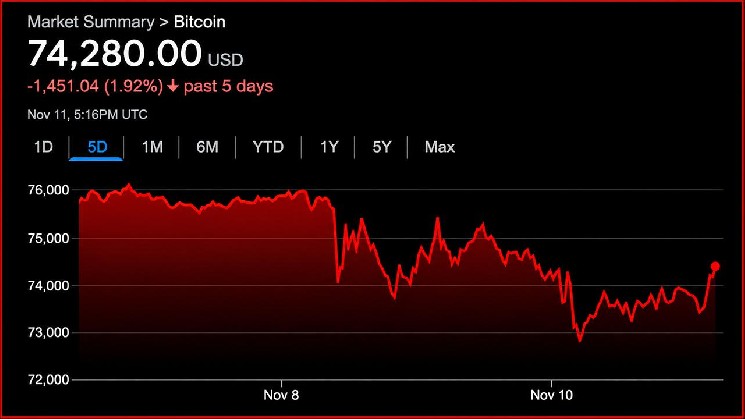
- •Bitcoin fell to $72,787 after hotter-than-expected U.S. CPI data but recovered to about $74,600, gaining roughly 2% after testing the $74,000 level four times.
- •U.S. spot bitcoin ETFs recorded $95 million in net outflows on Nov. 10, extending their losing streak to four consecutive days and pushing year-to-date net outflows past $1 billion.
- •Cryptocurrency derivatives liquidations totaled $199 million, with bitcoin accounting for more than $51 million, most of it from short positions.
- •Martin Lee of DWF Labs said ETF flows generally follow bitcoin's price rather than lead it, making them a real-time sentiment gauge rather than a predictive indicator.
- •Lee argued the dollar debasement trade can help bitcoin withstand risk-asset weakness but cannot sustain a rally without broader risk-on demand, with the year's opening price near $87,600 still overhead.
Bitcoin Reclaims $74,000 After CPI Sell-Off as Volatility Eases
Derivatives Liquidations Fall Below $200 Million
Bitcoin rebounded on Wednesday after falling to $72,787 following the release of hotter-than-expected U.S. consumer price index (CPI) data. CPI is a widely watched inflation gauge, and its monthly releases are a recurring input into market expectations for Federal Reserve interest-rate policy, making each print a reference point for risk-sensitive assets such as bitcoin. The cryptocurrency fluctuated between $73,000 and $74,000 during the recovery, even as U.S. spot bitcoin exchange-traded funds (ETFs) recorded $95 million in net outflows on Nov. 10, extending their losing streak to four consecutive days.
Bitcoin quickly reclaimed the $73,000 threshold but repeatedly lost momentum near $74,000. It tested that level four times after Tuesday afternoon’s sell-off. By 12:25 p.m. EST, bitcoin was trading at approximately $74,600, up about 2% over the day and giving it a market capitalization just below $1.5 trillion.
The relatively limited price movement coincided with a sharp decline in leveraged-position liquidations across the derivatives market. Liquidations occur when exchanges forcibly close leveraged positions after price moves against a trader — long positions are bets on rising prices, short positions on falling ones. According to Coinglass data, bitcoin liquidations exceeded $51 million, including approximately $8 million in long positions and more than $43 million in short positions.
Across the broader cryptocurrency market, liquidations totaled $199 million. Short positions accounted for more than $131 million of that amount.
ETF Outflows Add to Selling Pressure
Macroeconomic headwinds have largely driven bitcoin’s price action over the past week, but analysts have also pointed to sustained ETF outflows as an additional source of selling pressure. U.S. spot bitcoin ETFs, which began trading in January 2024 and hold the cryptocurrency directly on investors’ behalf, turned daily flow tallies into one of the most closely followed proxies for institutional demand. According to data tracked by Bitcoin.com News, year-to-date net outflows from spot bitcoin ETFs have surpassed $1 billion.
The continuing institutional outflows provide a structural explanation for bitcoin remaining below its opening price for the year, which was nearly $87,600 — a level that still sits roughly $13,000 above the midday price of about $74,600.
DWF Labs Questions Predictive Value of ETF Flows
Martin Lee, market insights lead at DWF Labs, said ETF flows may no longer be a reliable measure of institutional conviction, despite their widespread use by investors. Lee questioned their predictive value, arguing that withdrawals have historically accelerated near market bottoms, while inflows have gained momentum near market peaks.
Lee said the distinction between two sources of liquidity that supported previous bitcoin rallies may be more important to the cryptocurrency’s recovery. According to the DWF Labs executive, the dollar debasement trade can help bitcoin withstand weakness in other risk assets, but it is unlikely to sustain a rally without broader risk-on demand. As a result, bitcoin faces a liquidity challenge that ETF-flow data alone cannot explain.
“BTC can draw on two distinct sources of liquidity: the dollar debasement trade, and broader risk-on flows. It benefited from both at different points in the 2020–2022 cycle. In August, the return of the debasement narrative let it hold up while risk-on AI names corrected sharply, and it has outperformed gold over the past six months. The limitation is that debasement alone rarely sustains a rally when the broader market is risk-off,” Lee said in a note.
Citing an internal analysis, Lee said ETF flows generally follow bitcoin’s price movements rather than lead them. He argued that the data may therefore be more useful as a reflection of prevailing market sentiment than as a predictive indicator.
“They haven’t been good indicators of what we can expect price to do next,” Lee said. Under that reading, the four-day outflow streak is less a directional signal than a real-time sentiment gauge, and the observable reference points for the recovery remain the ones already in play: the repeatedly tested $74,000 level and the year’s opening price near $87,600 still overhead.
Source: CryptoNewsNet

