Bitcoin Reclaims $61,000 as Thanksgiving Rebound Punishes Short Sellers
Key Takeaways
- •Bitcoin climbed from a previous-day low of $57,209 to an intraday peak of $61,509 on Thursday, then consolidated between $60,000 and $61,000 as U.S. financial markets stayed closed for Thanksgiving.
- •The rally delivered daily gains of roughly 4% and lifted bitcoin's market capitalization back above $1.2 trillion, but weekly losses of nearly 4% and month-to-date declines exceeding 20% were not erased.
- •Short positions bore most of the market's liquidations: bitcoin short liquidations exceeded $100 million against just over $22 million in long liquidations, and shorts accounted for roughly 75% of total crypto market liquidations, which stayed below $313 million.
- •With U.S. core PCE inflation at a three-year high and the Bank of Japan signaling faster policy normalization, a Bitunix analyst said tightening monetary conditions could pressure yen carry trades and restrict liquidity for bitcoin and other risk assets.
- •Proposed Section 301 tariffs on imports from 14 economies remain in a consultation stage, but analysts cautioned that if finalized, the measures could fuel inflation, squeeze corporate margins, and complicate the Federal Reserve's December rate decision.
Bitcoin Reclaims $61,000 as Thanksgiving Rebound Punishes Short Sellers
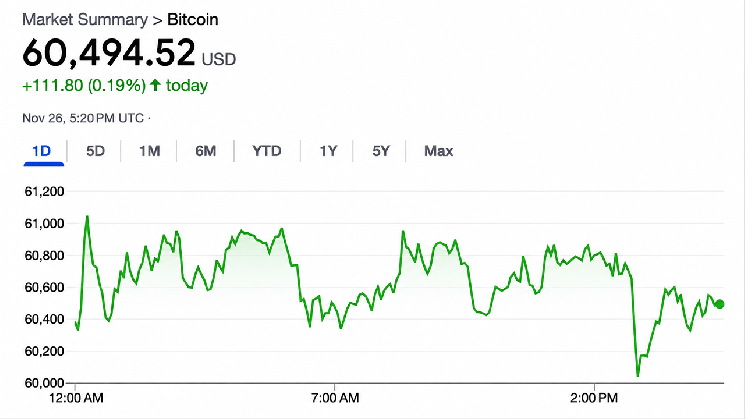
Bitcoin briefly climbed back above $61,000 on Thursday, rebounding from a slide toward $57,000 the prior day as U.S. financial markets remained closed for the Thanksgiving holiday — a contrast that reflects crypto's around-the-clock trading schedule.
Data from Bitstamp show the cryptocurrency surged from a previous-day low of $57,209 to an intraday peak of $61,509 before pulling back to consolidate between $60,000 and $61,000. Although the $61,000 level acted as resistance, bitcoin held support above $60,000 from 9 p.m. on Nov. 25 through midday Thursday.
The rally lifted bitcoin's daily gains to approximately 4% and pushed its market capitalization back above $1.2 trillion. Even so, the rebound failed to erase weekly losses of nearly 4% or meaningfully narrow month-to-date declines, which remained above 20%.
Short Sellers Absorb the Brunt of Liquidations
With prices largely trending upward, short sellers bore the weight of market liquidations. Liquidations occur when exchanges automatically close leveraged positions that can no longer meet margin requirements — in an upward move, those are typically short positions betting on a decline. Coinglass data show that bitcoin short liquidations surpassed $100 million, while long liquidations totaled just over $22 million — down sharply from the $138 million recorded 24 hours earlier.
Across the broader cryptocurrency market, total liquidations remained below $313 million, with short positions accounting for 75% of the total, or roughly $237 million.
U.S. and Japanese Monetary Tightening Threaten Crypto Liquidity
Despite the recovery, analysts warned that bitcoin remains vulnerable to renewed liquidity constraints and heightened inflation uncertainty stemming from the Trump administration's latest tariff threats. With the Office of the U.S. Trade Representative weighing new Section 301 tariffs — a provision of the Trade Act of 1974 that allows the U.S. Trade Representative to impose duties in response to unfair foreign trade practices — on imports from 14 economies, market participants fear higher import costs could fuel inflation and complicate the Federal Reserve's upcoming interest rate decisions.
In a market note, a Bitunix analyst said global markets face a combination of persistent inflation and tightening monetary policy across major economies. With U.S. core personal consumption expenditures (PCE) inflation — the Fed's preferred gauge of underlying price pressures — reaching a three-year high amid resilient economic growth and low jobless claims, expectations for another Fed rate hike in December have strengthened. Meanwhile, the Bank of Japan is signaling a faster pace of monetary policy normalization.
“The combination of U.S. and Japanese monetary tightening could reshape global funding conditions, increase pressure on yen carry trades, and create additional liquidity challenges for Bitcoin and other risk assets,” the Bitunix analyst noted. Yen carry trades involve borrowing cheaply in yen to fund higher-yielding investments elsewhere, a strategy that becomes more expensive as Japanese interest rates rise.
The analyst added that U.S. trade policy is injecting fresh uncertainty into the inflation outlook. Although the proposed tariffs remain subject to consultation rather than immediate implementation, companies may already need to reassess sourcing strategies, supply chain allocations, pricing plans and capital commitments.
“The inflation implications will depend on whether the proposed tariffs are finalized and how businesses respond,” the analyst explained. “If additional costs are passed on to consumers, tariffs could make it harder for inflation to return to the Fed's target. If companies absorb some of the costs, profit margins could face pressure instead.”
The prospect of retaliatory tariffs further clouds the outlook for international trade and corporate investment, leaving markets with two concrete markers to track: whether the proposed tariffs advance beyond the consultation stage, and how the Federal Reserve frames its December rate decision with core inflation at a three-year high.
“For financial markets, the key issue is whether trade-related cost increases become another source of persistent inflation at a time when monetary policy is already restrictive,” the Bitunix analyst concluded.

