Bitcoin Reclaims $60,000 as Cryptographic Security Concerns Resurface
Key Takeaways
- •Bitcoin traded at $60,809 on November 26, up 4.27% over 24 hours after rebounding from roughly $55,100, but remained down 1.76% over the past seven days.
- •Glassnode reported a record 7.12 million BTC, approximately 35.4% of issued supply and worth about $433 billion, held in addresses with publicly visible keys.
- •CoinGlass recorded $453 million in net outflows from spot Bitcoin ETFs on November 25, while Galaxy Research flagged $58,525 as a key daily closing level for the recovery.
- •Bitcoin Improvement Proposals 360 and 361 aim to reduce public key exposure and transition away from vulnerable signature systems, though activation would require broad consensus among developers, miners, and the community.
- •The Bank of England identified migration toward quantum-resistant cryptography as an immediate financial stability priority on November 26, even as public evidence has not established a successful attack on Bitcoin's existing signature system.
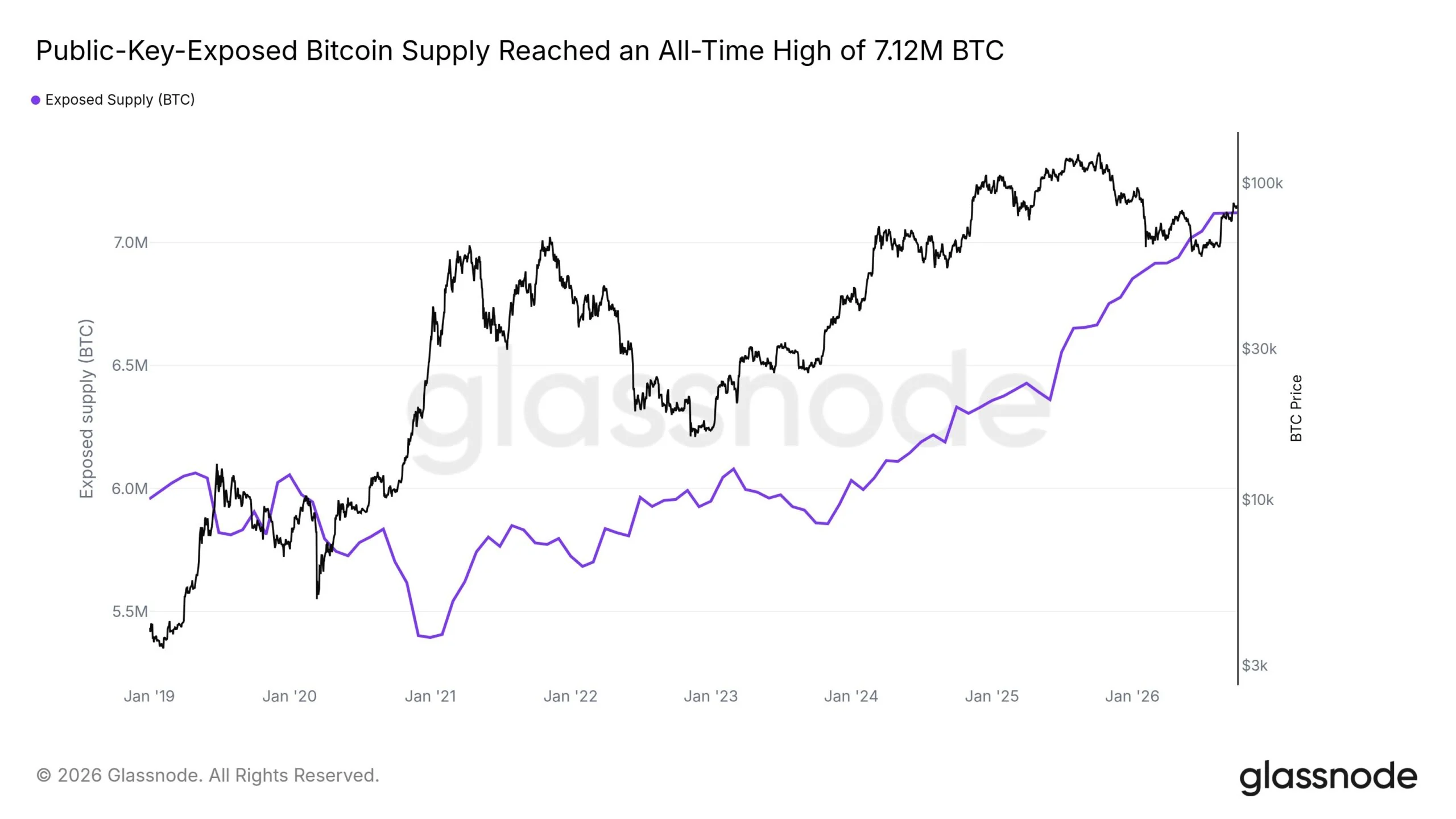
Bitcoin (BTC) climbed back above $60,000 on November 26 as renewed concerns over the network's cryptographic security resurfaced across the cryptocurrency market. Blockchain analytics firm Glassnode reported a record balance of 7.12 million BTC held in addresses with publicly visible keys, and unverified reports claiming that artificial intelligence laboratories had broken public-key cryptography drew fresh attention to these holdings. The move came despite a backdrop of persistent institutional outflows and lingering technical weakness. The analytics firm highlighted the record exposure in a post on X.
Bitcoin Recovers Above $60,000 Amid Market Pressure
According to CoinGlass data, Bitcoin traded at $60,809, marking a 4.27% increase over the previous 24 hours. The cryptocurrency registered a daily low of $57,256 and a high of $61,603, an intraday range of more than $4,000 that reflected continued market volatility. However, BTC remained down 1.76% over the past seven days.
The recovery followed a stretch of sustained selling pressure across cryptocurrency markets. Bitcoin had earlier rebounded from roughly $55,100 after heavy losses over the weekend, but it continued to trade below several previously established support levels.
Meanwhile, CoinGlass recorded $453 million in net outflows from spot Bitcoin exchange-traded funds on November 25, even as the cryptocurrency's price recovered. Spot Bitcoin ETF flows have become a closely followed gauge of institutional demand. Galaxy Research also identified $58,525 as an important daily closing level for Bitcoin, noting that a sustained recovery above recent trading highs could strengthen the cryptocurrency's short-term market position.
Bitcoin Public Key Exposure Reaches Record Levels
Glassnode's figures place the exposed balance at approximately 35.4% of Bitcoin's issued supply. The volume has grown almost continuously since late 2023, in line with Bitcoin's broader historical price appreciation, and represents roughly $433 billion at current market prices.
Bitcoin relies on cryptographic signatures to verify transactions and establish ownership of digital assets. Certain address formats reveal public keys directly, while previously executed transactions expose the keys associated with other addresses. Public key visibility alone, however, does not grant unauthorized access to Bitcoin holdings. The relevance of such exposure stems from the theoretical possibility that sufficiently advanced future computing capabilities, such as quantum computers, could derive private keys from visible public keys. That theoretical pathway rests on established mathematics: Shor's algorithm, published in 1994, demonstrated that a sufficiently capable quantum computer could solve the discrete logarithm problems underlying the elliptic-curve signatures Bitcoin uses, and no machine with that capability is known to exist. By contrast, breaking those signatures with classical computers is widely regarded as computationally infeasible with current technology.
In May, Glassnode identified approximately 1.92 million BTC with structural exposure, a product of address design, and another 4.12 million BTC with operational exposure arising from transaction practices. The latest figures show further growth in the combined exposed balance.
Security Proposals Advance Amid Price Uncertainty
Bitcoin developers continue examining network changes aimed at addressing potential cryptographic threats. Bitcoin Improvement Proposal 360 introduces an alternative output structure designed to reduce public key exposure, while BIP 361 outlines a gradual transition away from vulnerable signature systems. Bitcoin Improvement Proposals are the formal mechanism through which protocol changes are proposed and debated, and activation would require broad consensus among developers, miners, and the wider community — a review process that has historically unfolded over years.
Separately, the Bank of England identified migration toward quantum-resistant cryptography as an immediate financial stability priority on November 26, in an assessment that extends beyond cryptocurrencies to cover broader financial infrastructure. That assessment aligns with a broader standardization effort: the U.S. National Institute of Standards and Technology finalized its first post-quantum cryptography standards in August 2024, giving institutions benchmark algorithms for such migrations. Both developments reflect ongoing efforts to strengthen the security of digital transactions.
However, public evidence has not established a successful attack against Bitcoin's existing signature system. Market conditions, institutional fund flows, and technical trading levels remain the measurable factors behind Bitcoin's recent price movements, with daily ETF flow prints and analyst-flagged closing levels such as Galaxy Research's $58,525 threshold offering the most direct gauges of whether the recovery holds. The $60,000 threshold remains an immediate reference point for BTC's recovery.

