Bitcoin's Year-End Recovery Hinges on Sustained ETF Inflows and Spot Buying, CryptoQuant Analyst Says
Key Takeaways
- •U.S. spot Bitcoin ETFs recorded approximately $1.13 billion in net outflows between Nov. 17 and 19, adding downward pressure during a week of sharply lower prices.
- •CryptoQuant analyst XWIN Japan outlined three year-end scenarios from a $61,000 starting point: a $55,000–$70,000 range in a mixed market, a move toward $85,000 with sustained ETF inflows and falling bond yields, or a decline to $42,000–$55,000 under renewed monetary tightening and continued ETF withdrawals.
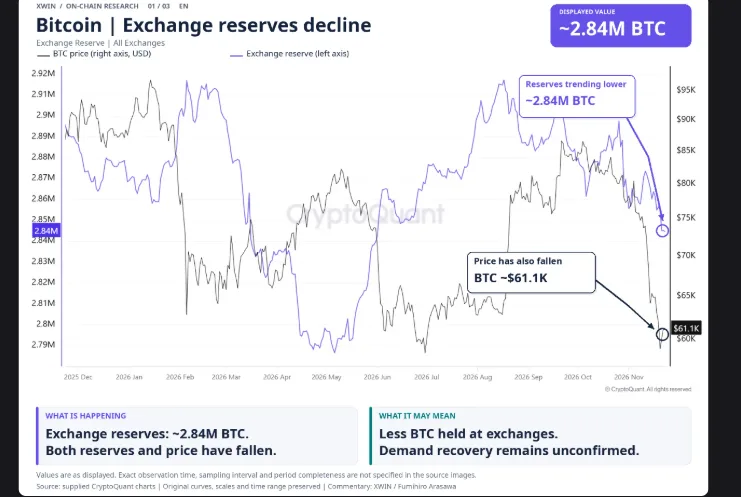
- •Bitcoin exchange reserves fell to roughly 2.84 million BTC, down from earlier November levels, while the exchange whale ratio held near 0.25, meaning the ten largest deposits account for about one-quarter of exchange inflows.
- •Miner-to-exchange transfers spiked to around 2,100 BTC during November, with mining pool Antpool responsible for roughly 97% of a 2,077 BTC reading on Nov. 10, before easing to 41.67 BTC.
- •This week's calendar features preliminary PMI readings, consumer confidence, PCE inflation, and GDP data, with U.S. stock markets closed Thursday for Thanksgiving and a shortened Friday session limiting ETF flow coverage ahead of the Federal Reserve's December 8–9 meeting.
Bitcoin climbed back toward $62,000 on Monday, Nov. 23, after dropping to near $55,000 over the weekend, but CryptoQuant analyst XWIN Japan cautioned that the rebound has yet to be confirmed by sustained buying demand.
U.S. spot Bitcoin exchange-traded funds (ETFs) recorded approximately $1.13 billion in net outflows between Nov. 17 and 19, adding to the downward pressure on Bitcoin during a week in which prices moved sharply lower. Spot ETFs hold Bitcoin directly, which is why their daily net flows are widely read as a proxy for institutional demand: sustained inflows add buying pressure, while persistent outflows signal net selling. At the same time, exchange reserves and miner transfers declined, complicating the market outlook. According to the analyst, a lasting recovery requires steady ETF inflows and renewed spot buying; a rally driven mainly by short positions closing would differ from one supported by fresh spot demand.
Beyond ETF flows, exchange whale positioning and miner transfers round out the on-chain picture in the latest CryptoQuant readings. The week's key events include U.S. PMI readings, consumer confidence, PCE inflation data, GDP figures, and Thanksgiving market closures.
Reserves and Three Year-End Scenarios
CryptoQuant's data places the latest Bitcoin exchange reserve balance near 2.84 million BTC, down from levels seen earlier in November. However, withdrawals do not reveal whether holders plan to keep their Bitcoin or move it elsewhere.
Working from a starting point of $61,000, XWIN Japan outlined three possible paths into year-end. In a mixed market, Bitcoin would remain within the $55,000–$70,000 range. Sustained ETF inflows, stronger spot demand, and falling bond yields could support a move toward $85,000. Under renewed monetary tightening and continued ETF withdrawals, the analysis instead places Bitcoin between $42,000 and $55,000.
Whale Ratio Holds Near 0.25 as Miner Flows Ease
The exchange whale ratio stood near 0.25 in CryptoQuant's latest data. The metric tracks the share of total exchange inflows coming from the ten largest deposits, meaning those deposits currently account for roughly one-quarter of the Bitcoin moving onto exchanges. The ratio has moved sharply at different points this year, with several brief spikes visible on the chart. November's reading shows continued activity from large depositors but says little about completed transactions.
Miner flows tell another part of the story. Because miners regularly sell portions of their output to cover operating costs, transfers from miners to exchanges are watched for potential signs of added sell-side supply. Bitcoin transfers from miners to exchanges jumped to around 2,100 BTC during November before dropping again. A separate November 10 reading recorded 2,077 BTC in miner-to-exchange transfers, with mining pool Antpool accounting for approximately 97% of that amount. After the spike, the latest figures cited by the analyst show miner inflows easing to 41.67 BTC.
Economic Data and Thanksgiving Set the Week's Schedule
The November 23–27 calendar begins with preliminary U.S. manufacturing and services PMI readings on Monday. Tuesday brings the Conference Board's consumer confidence report, which follows an October index reading of 91.7.
Wednesday carries several releases. October personal consumption expenditures (PCE) inflation data and the second estimate of third-quarter GDP are due at 8:30 a.m. Eastern, with new-home-sales figures following at 10 a.m. As the Federal Reserve's preferred inflation gauge, the PCE report will give markets another reading on price pressures ahead of the central bank's December 8–9 meeting.
U.S. stock markets close Thursday for Thanksgiving and reopen for a shortened Friday session. The New York Stock Exchange shuts at 1 p.m. Eastern on November 27. Bitcoin continues trading around the clock, but U.S. spot ETF activity pauses during the closure, and with fewer regular stock-market hours, ETF flow data will cover a shorter week. The upcoming reports could also change expectations for interest rates ahead of December, which in turn feed the analyst's scenarios, since the bullish path assumes falling bond yields alongside sustained ETF inflows.
Bitcoin's next moves, together with the week's economic data and ETF flow readings, will provide further evidence about the strength of the rebound and which of the analyst's three scenarios is taking shape.
This article provides general financial information, not investment advice. Cryptocurrency prices fluctuate, and market forecasts cannot guarantee future returns. Investors should conduct independent research before making financial decisions.

