Bitcoin Rebounds Above Key Technical Levels as Crypto Markets Absorb Midterm Results
Key Takeaways
- •Bitcoin rose $2,428 from an intraday low of $75,736 to a session high of $78,164, reclaiming both the 0.382 Fibonacci retracement near $76,066 and its 100-day simple moving average at $76,850.
- •The Associated Press called the Senate for Democrats late on November 3, while the House remained uncalled and no result was final until states completed their counts and certified the vote.
- •Polymarket had assigned a probability above 75% to a Democratic victory for some time, and a Paradigm analyst said the market move reflected resolved uncertainty rather than a surprise outcome.
- •On election day, Paradigm processed roughly $660 million in notional bitcoin-options blocks, with about $420 million in calls purchased against approximately $105 million in calls sold.
- •US-listed spot bitcoin ETFs recorded approximately $515 million in outflows during October and a roughly similar amount over the first two trading days of November.
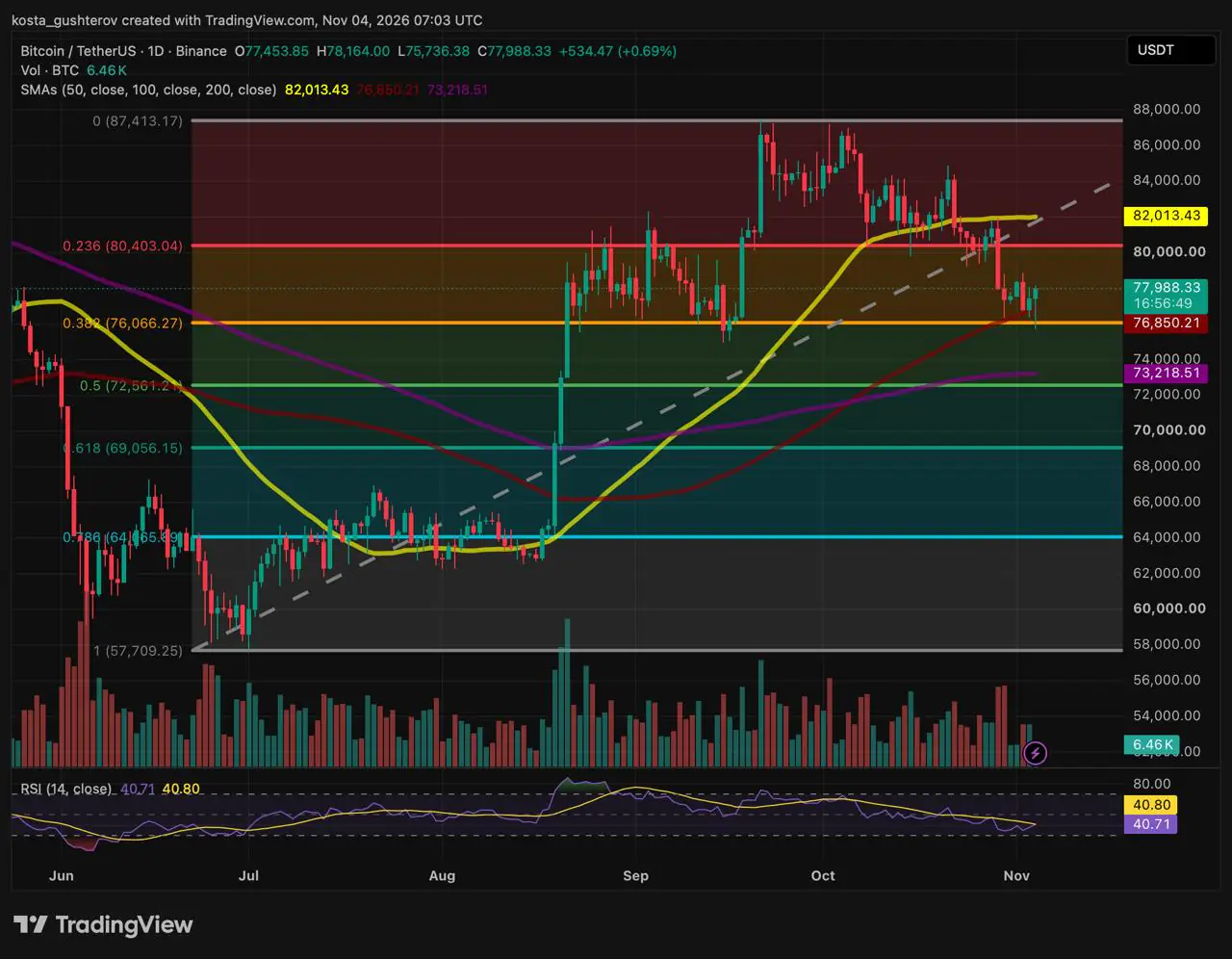
Bitcoin recovered from an intraday low of $75,736 as major cryptocurrencies traded higher over 24 hours, while traders largely anticipated Democrats’ Senate victory. The Associated Press called the Senate for Democrats late on November 3, but the House remained uncalled at the time of writing. No result was final until states completed their counts and certified the vote.
Crypto markets prepared for a Democratic Congress
A day before the vote, CNBC described the midterms as a test of whether President Donald Trump’s regulatory shift on crypto would become durable law or remain vulnerable to a future administration. The industry’s market-structure bill had already stalled in the Senate, and the election outcome narrowed the CLARITY Act’s path to the 60 votes needed for passage, according to Coindoo. Under Senate rules, most legislation needs 60 votes to close debate and advance, a threshold that generally requires support from both parties.
Analysts quoted overnight expressed similar concerns. TDX Strategies founder Dick Lo told CoinDesk that a Democratic-controlled Congress is generally viewed as less supportive of pro-crypto legislation. Nick Ferres, chief investment officer at Vantage Point Asset Management, told Reuters that the main risk from a Democratic sweep was increased regulation of the artificial intelligence and crypto sectors.
The result feared by the industry was also the outcome most traders expected. Nicolas Quatravaux of Paradigm told CoinDesk that Polymarket, a prediction market where participants trade on the outcomes of real-world events, had assigned a probability above 75% to a Democratic victory for some time. He said the overnight market move appeared to reflect the removal of uncertainty rather than a surprise result.
Mark Malek, chief investment officer at Siebert Financial, made a similar observation in comments to Reuters. Much of the outcome had already been priced in, he said, while an unexpected Republican gain would have represented the real shock.
Options activity also indicated that traders were positioned for a known result. On election day, Paradigm processed approximately $660 million in notional bitcoin-options blocks, more than twice the previous day’s total. About $420 million in calls, which gain value when prices rise, were purchased against roughly $105 million in calls sold, Quatravaux told CoinDesk.
The case for divided government
Not all analysts viewed the result as negative for crypto. With Trump in the White House and Democrats controlling at least the Senate beginning in January, Washington will again have divided government — a configuration in which one party holds the presidency while the other controls at least one chamber of Congress. Lo told CoinDesk that this arrangement makes major, market-unfriendly policy changes less likely, while Trump retains executive orders and his veto as tools.
Several strategists cited by Reuters offered a similar assessment. Tai Hui of J.P. Morgan Asset Management said the prevailing consensus was that divided government generally helps keep fiscal deficits more controlled. Jesper Koll of Monex Group questioned whether a Democratic Congress would make substantial practical changes under a president who governs largely through executive orders.
Michael Arone of State Street Global Advisors said the greater market risk was an investor overreaction to a Democratic wave, rather than the wave itself.
Market reaction remains preliminary
The initial calm should not be treated as a final assessment of the election’s impact. The House, whose majority party controls committee leadership and the flow of legislation, had not been called, certification was still pending, and other markets were also responding to the results. Reuters reported that U.S. stock futures declined while Treasury yields and the dollar fell as the results came in. Nasdaq futures subsequently recovered most of their early losses, according to CoinDesk.
Fund flows remain another open question. U.S.-listed spot bitcoin exchange-traded funds, which hold bitcoin directly, recorded approximately $515 million in outflows during October and roughly the same amount during the first two trading days of November, according to SoSoValue data. The extent to which the election result had already been priced in will become clearer after the vote counts are finalized and subsequent fund flows indicate investor positioning.
Bitcoin moves back above the 0.382 Fibonacci level
Bitcoin’s daily Binance candle opened at $77,454 and stood at $77,988 at 07:03 UTC. That represented a 0.69% gain on the session and a 2% increase over 24 hours, with nearly 17 hours remaining before the candle closed.
The session initially moved lower. Sellers pushed Bitcoin below its 100-day simple moving average — the average of the previous 100 daily closing prices — at $76,850 and through the 0.382 Fibonacci retracement near $76,066. Fibonacci retracement levels are standard percentage levels of a prior price range that traders commonly watch as potential support and resistance. The price wick reached $75,736, approximately $330 below the Fibonacci level, before buyers entered the market.
From that low, Bitcoin rose $2,428 to a session high of $78,164 on volume of 6.46K BTC. The move returned the price above both the 0.382 retracement and the 100-day SMA.
Momentum had improved but had not yet reversed. The daily 14-period relative strength index, a momentum indicator measured on a 0-to-100 scale, stood at 40.71, slightly below its signal line at 40.80 and still under the midpoint of 50. As a result, the rebound had not produced an RSI crossover.
The session’s range left technical levels on both sides of the current price. If buyers maintained control, Bitcoin would need to remain above the 100-day SMA at $76,850 and move through the session high of $78,164. The first test would be the 0.236 Fibonacci level near $80,403, close to the round-number level of $80,000. The next level would be the 50-day SMA at $82,013, described as the main overhead trend ceiling. The top of the range was near the 0 level at $87,413.
If the rebound failed, a daily close below the 0.382 Fibonacci level near $76,066 and the session low of $75,736 would reverse the recovery. The first demand zone would consist of the 200-day SMA at $73,219 and the 0.5 Fibonacci level near $72,561. Deeper support was near the 0.618 Fibonacci level at $69,056.
Even after the rebound, Bitcoin remained below its 50-day SMA, while the top of its Fibonacci range was approximately 12% above the current price.
Major altcoins post 24-hour gains
CoinMarketCap data showed that the largest cryptocurrencies were all trading higher over the previous 24 hours at the time of writing. The data was recorded on November 4 at 07:22 UTC, with rankings ordered by market capitalization.
Zcash and Monero, the two privacy coins included on the list, were well ahead of the other assets. The remaining large-cap cryptocurrencies traded within a relatively narrow performance range, while TRON recorded the smallest gain.
The original Coindoo report carried the headline “Bitcoin Price Defends Key Level as Crypto Rides Out Midterms.”

