Bitcoin Rebounds Toward $60,000 as Arthur Hayes Warns of $50,000 Test
Key Takeaways
- •Bitcoin dropped more than $7,000 in 15 hours to a cycle low of $55,260 before rallying roughly $5,500 in eight hours to reclaim the $60,000 level.
- •Total cryptocurrency liquidations reached $2.7 billion over 24 hours, reportedly the 11th-largest such event on record, including $360 million in short positions liquidated during the rebound.
- •BitMEX co-founder Arthur Hayes said Bitcoin had decisively broken below its previous local low and that $50,000 would be the next significant test if the Nasdaq continued to fall.
- •Bitcoin exchange-traded funds recorded $124.43 million in net outflows on November 20, led by $72.38 million from Fidelity's FBTC, though cumulative net inflows since launch remain at $53.39 billion.
- •Bitcoin lost nearly 17% over one week and about one-third of its value over one month, while Strategy ended the week down about 30% and Coinbase closed approximately 20% lower.
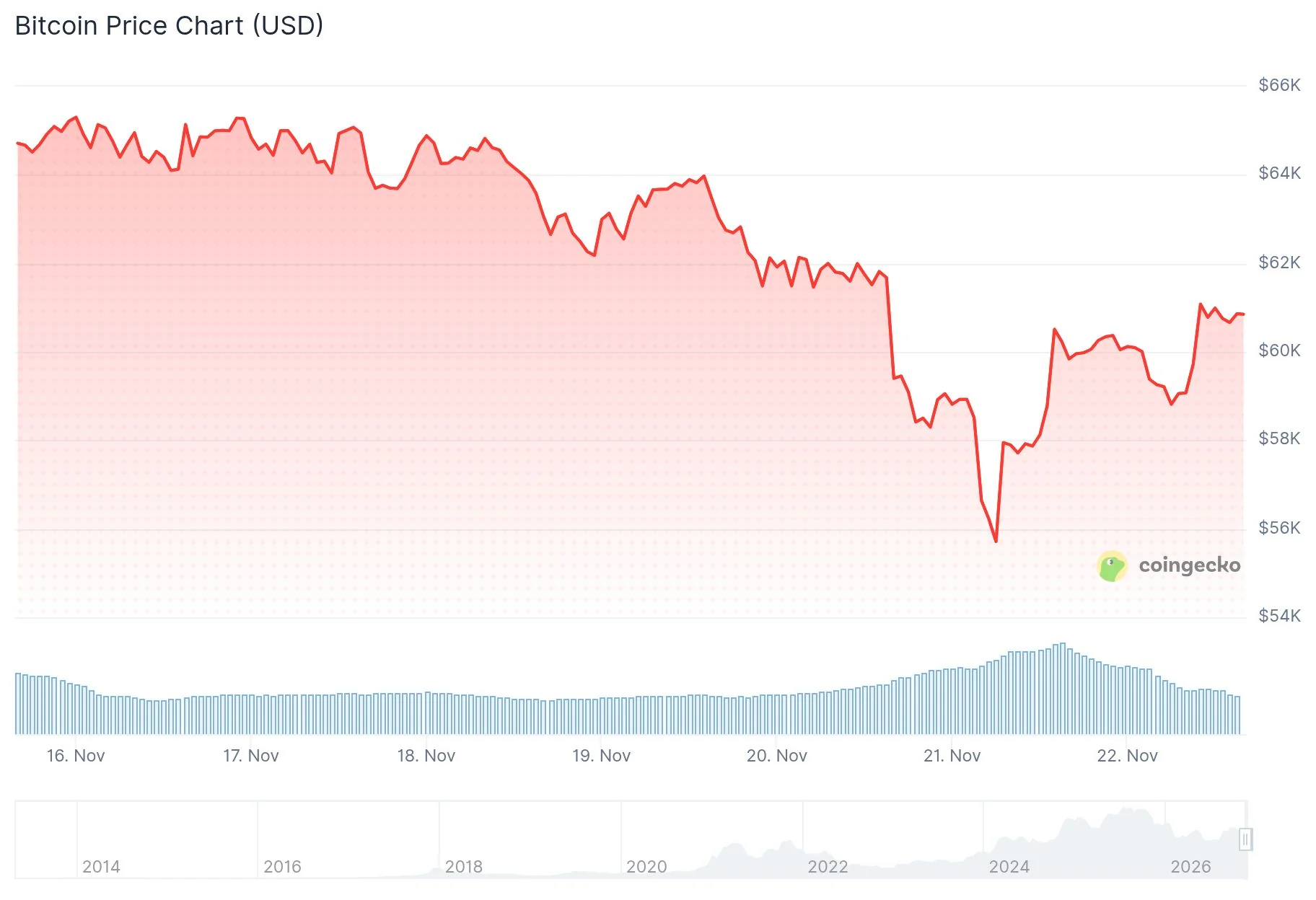
Bitcoin (BTC) traded near $59,747 on November 22 after rebounding from a low of about $55,000. The recovery followed a sharp selloff that pushed the price below $56,000 on November 21. Ethereum traded near $1,680, XRP near $0.93 and Solana near $70, while the total cryptocurrency market value rose 1.4% to $2.03 trillion.
Bitcoin fell more than $7,000 in 15 hours to reach a cycle low of $55,260. It then gained $5,500 over eight hours and reclaimed the $60,000 level. Short sellers absorbed much of the subsequent move, with $360 million in short positions liquidated. Total crypto liquidations reached $2.7 billion over 24 hours, reportedly making it the 11th-largest such event on record. Liquidations — the forced closure of leveraged positions once margin requirements are no longer met — hit whichever side is crowded as price moves against it, which is why longs dominated during the slide and shorts during the rebound.
Earlier in the decline, Coinglass data showed $2.54 billion in liquidations affecting 360,995 traders. Long positions accounted for $2.27 billion, or 89.4%, while short positions totaled $270.23 million.
Arthur Hayes Highlights Nasdaq Risk and $50,000 Level
BitMEX co-founder Arthur Hayes said on X that Bitcoin had decisively broken below its previous local low. He added that $50,000 would be the next significant test if the Nasdaq continued to fall.
$BTC just decisively broke below the previous local low. If Nasdaq keeps puking, $50,000 will be the next real test. pic.twitter.com/vn0VSpuWAz — Arthur Hayes (@CryptoHayes) November 21, 2026
The post is available at https://x.com/CryptoHayes/status/2124246356110037230?ref_src=twsrc%5Etfw and
Hayes’s weekly chart showed a low of $55,130 and a decline of about 7.6%. The Nasdaq Composite, the tech-heavy US equity benchmark at the center of Hayes’s warning, fell approximately 5.3% during Friday’s session.
In a separate X post, Hayes urged traders not to try to identify the exact market bottom. He said buyers should wait to purchase at a higher price and with greater conviction once a bailout begins.
It’s really hard, I succumb often. But resist the urge to try and pick the bottom. You might be right, you might be wrong. Buy it higher with more conviction once the bailout begins. Over to you Warsh the Weasel and Buffalo Bill Bessent. Let’s go Brrrrr. — Arthur Hayes (@CryptoHayes) November 20, 2026
The post is available at https://x.com/CryptoHayes/status/2123894151557390519?ref_src=twsrc%5Etfw.
Hayes referred to Treasury Secretary Scott Bessent and Fed Chair Kevin Warsh, who took office in May. He did not specify when a bailout might occur or who would receive it.
On October 2, Hayes said problems at artificial-intelligence companies or among data-center borrowers could lead to a government bailout. He said he hoped new money would flow into crypto. On November 11, he said he was adding crypto positions ahead of Anthropic’s IPO, while keeping them small to medium so he could exit quickly.
Five days later, Hayes identified ether, zcash, NEAR and Venice’s VVV token as his “Four Horsemen.” In a November 19 update, he said the market had disliked the $ANT debut and that he had taken a loss. He wrote that the Four Horsemen had been decapitated and that he would wait before going long again.
Chart Levels and ETF Flows Provide Mixed Signals
On the four-hour chart, resistance was near $60,000, with the former consolidation area around $64,000 above it. Support was near $56,000, followed by another level around $52,000.
The relative strength index (RSI), a momentum indicator on a 0-to-100 scale where readings below 30 are conventionally labeled oversold and above 70 overbought, stood at 42.53, having risen from oversold territory but remaining below the midpoint. The MACD line was at minus 1,263.42, above its signal line at minus 1,457.88, while the histogram read 194.47.
Bitcoin had lost almost 17% over one week and nearly one-third of its value over one month. Strategy (MSTR), a major corporate holder of Bitcoin, ended the week down about 30%, and Coinbase (COIN), a leading crypto exchange operator, closed approximately 20% lower.
Bitcoin exchange-traded funds recorded $124.43 million in net outflows on November 20 — a day on which withdrawals from the funds exceeded new deposits. Fidelity’s FBTC saw $72.38 million in outflows, Grayscale’s GBTC lost $32.84 million and its smaller fund shed $12.89 million. BlackRock’s IBIT reported no net flow.
Sosovalue data showed cumulative net inflows of $53.39 billion and total net assets of $74.72 billion, meaning money added to the products since launch still exceeds what has been pulled out despite the recent outflows. Daily trading value reached $4.70 billion.
Source: CoinCentral

