Bitcoin miners lag as exchanges and stablecoin firms outperform
Key Takeaways
- •The average gain among 10 miners and closely related companies was 1.8%, trailing Bitcoin’s 22% rise by 20.2 percentage points.
- •Core Scientific and TeraWulf underperformed Bitcoin by 27% and 24%, respectively, as both expand into AI and high-performance computing.
- •August’s average Bitcoin mining hash price was $34.63, 32% below the 2025 monthly average, while transaction fees contributed only 0.70% of block rewards.
- •Coinbase said 88% of its second-quarter net revenue came from sources outside Bitcoin spot trading, and its crypto trading-volume share reached 10.3%.
- •Circle reported $73.3 billion of USDC in circulation at the end of the second quarter, up 19% year over year.
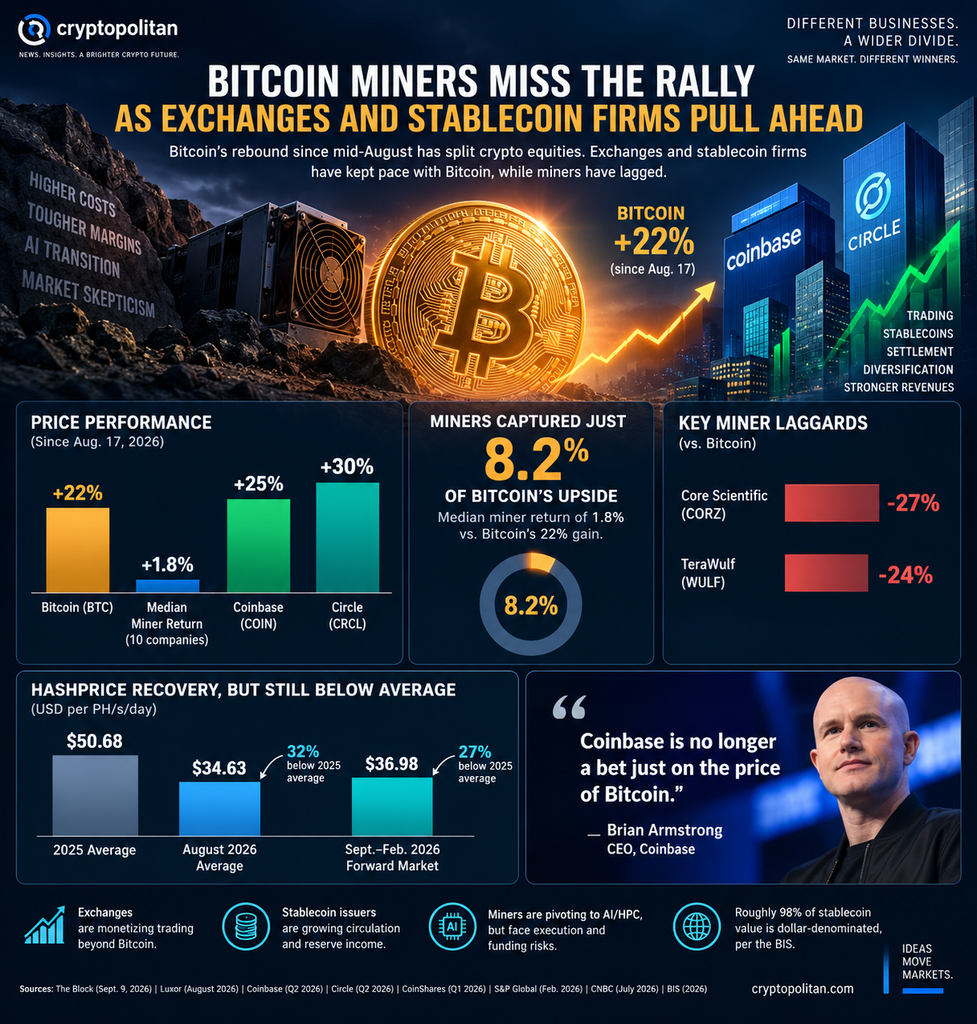
Bitcoin’s recovery since mid-August has split crypto-related companies into clear outperformers and underperformers. Since Aug. 17, Bitcoin has gained almost 22%, with exchanges and stablecoin-linked companies broadly following the move. Mining companies, however, have not kept pace.
A Sept. 9 Data & Insights analysis by The Block found that Canaan was the only mining company to outperform Bitcoin. The other 10 miners and companies operating closely alongside them produced an average median gain of 1.8%, leaving them 20.2 percentage points behind Bitcoin’s 22% increase.
The difference is even more pronounced when measured against Bitcoin’s return. Based on a Cryptopolitan calculation, the average miner captured only 8.2% of Bitcoin’s upside, returning 1.8% while Bitcoin rose 22%. For investors who had viewed miners as a leveraged way to gain exposure to Bitcoin, that relationship has weakened significantly.
AI-focused miners face the widest gap
Some of the largest underperformers are miners that have moved aggressively into artificial intelligence and high-performance computing. Core Scientific and TeraWulf trailed Bitcoin by 27% and 24%, respectively.
The shift is also changing how the market values mining companies. S&P Global Market Intelligence’s Visible Alpha estimates project that high-performance computing will account for about 71% of 2026 revenue at IREN and Core Scientific, and 70% at TeraWulf.
AI-related expansion carries a different set of risks, however. A late-July CNBC report on the crypto-stock rally said Cipher Mining fell 8%, Riot Platforms declined 5%, and MARA Holdings dropped 3%, even as Coinbase, BitGo, and Figure gained. Compass Point analyst Michael Donovan said financing AI build-outs would require companies to raise capital without significant dilution or expensive debt.
Mining economics remain weak
Mining economics improved in August, but remained well below levels considered acceptable. According to Luxor’s August Hashrate Lookback, Bitcoin rose 24.5% during the month, while the USD hash price increased 24.4%, from $31.63 to $39.33 per PH/s/day.
The improvement began from a depressed base. The average hash price in August was $34.63, still 32% below the 2025 monthly average of $50.68. Transaction fees represented just 0.70% of block rewards, marking the 14th consecutive month in which fees failed to exceed 1% of rewards.
The futures market also offered little indication of an immediate improvement. Luxor’s contracts for September through February averaged a hash price of $36.98, approximately 27% below the 2025 average.
As a result, even if Bitcoin remains strong, miners need higher fee payments, lower network difficulty or reduced power costs to improve their margins. Those measures also provide the clearest operating indicators for assessing whether a Bitcoin rally is translating into stronger mining results.
Exchanges and stablecoin issuers monetize broader activity
Exchanges and stablecoin issuers increasingly have an advantage over miners: they can generate revenue from activity that does not depend directly on producing Bitcoin.
In its Q2 results, Coinbase said 88% of net revenue came from sources outside Bitcoin spot trading. Its share of crypto trading volume reached a record 10.3%, while average USDC holdings across its products reached $20 billion.
CEO Brian Armstrong summarized the company’s changing profile by saying, “Coinbase is no longer a bet just on the price of Bitcoin.”
Circle reported $73.3 billion of USDC in circulation at the end of the second quarter, a 19% year-over-year increase, along with $701 million in total revenue and reserve income.
These companies’ reported trading volume, stablecoin holdings, circulation and reserve income therefore offer different measures of activity from the hash price, transaction fees and power costs that determine mining economics.
Miners are pursuing diversification as well. CoinShares estimated more than $70 billion in cumulative AI and HPC contracts across public miners, with listed operators potentially generating as much as 70% of their revenue from AI by year-end. Cryptopolitan has tracked the shift, including MARA’s $1.5 billion acquisition of Long Ridge and IREN’s $3.4 billion NVIDIA cloud contract.
Across the broader crypto market, the divergence indicates that businesses monetizing trading, stablecoins and settlement infrastructure are being valued differently from mining companies, which remain capital-intensive operations exposed to both commodity and AI execution risks.
The BIS notes that roughly 98% of stablecoin value is denominated in dollars. As stablecoin payment and settlement rails expand, they could strengthen crypto’s role in global dollar settlement.
