Bitcoin Faces Reported 87% Fed Rate-Hike Odds as Treasury Buybacks Draw Attention
Key Takeaways
- •Markets are reportedly pricing about an 87% probability of a 25-basis-point Federal Reserve rate hike at the FOMC meeting on Wednesday, September 16, though the figure has not been verified against the original probability provider.
- •On August 19, the Treasury increased longer-dated bond buybacks from $2 billion to $4 billion per operation for the period from September 9 through November 4.
- •Rebecca Patterson of the Council on Foreign Relations argued the buybacks are "more signal than substance," saying their immediate yield-lowering effect would be absorbed by broader supply-and-demand forces.
- •Bitcoin traded at $76,833 on September 14, down 0.55% over 24 hours, with a market value of approximately $1.54 trillion and 24-hour trading volume of about $16.8 billion.
- •The Crypto Fear & Greed Index stood at 57, in "Greed" territory, on September 14, and any lasting liquidity benefit from Treasury operations depends on confirmed cash flows rather than announcements alone.
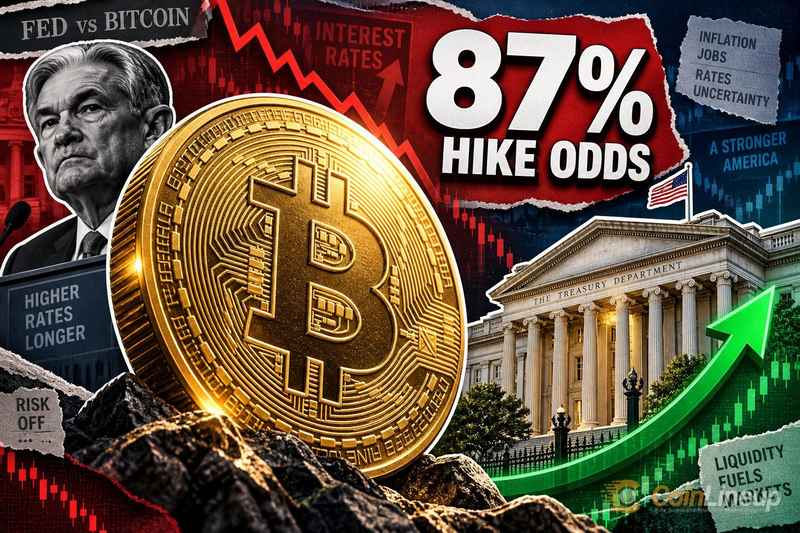
Traders are focused on two questions this week: whether the Federal Reserve will raise interest rates and whether U.S. Treasury actions can help sustain Bitcoin’s rally. According to unconfirmed reports, markets are pricing in roughly 87% odds of a rate hike on Wednesday, September 16. However, the figure has not been independently verified against the original probability provider.
The reported probability is circulating without confirmation from a primary source. Separately, the Treasury has doubled the size of some bond buybacks, although one expert described the move as “more signal than substance.” Whether Treasury activity supports Bitcoin liquidity will depend on confirmed cash flows rather than announcements alone.
What the Reported 87% Fed-Hike Odds Mean for Bitcoin
A rate increase makes borrowing more expensive and can put pressure on risk assets such as Bitcoin. The unconfirmed market-implied odds point to a 25-basis-point increase at the Federal Open Market Committee’s meeting on Wednesday.
A market-implied probability is a bet or pricing signal, not a final policy decision. The Federal Open Market Committee, the Federal Reserve’s rate-setting body, confirms a policy change only when it meets, meaning the implied odds can change before the announcement.
The New York Fed explains that the FOMC sets the monetary-policy stance and directs the central bank’s trading desk to implement it. Its primary tool is the federal funds target range, and the committee holds eight scheduled meetings each year.
If traders have already priced in a rate hike, Bitcoin may show only a limited reaction when the decision is announced. Larger moves often result from surprises relative to expectations. Earlier market developments have shown Bitcoin struggling as Federal Reserve projections changed alongside shifting rate-hike odds.
Bitcoin traded at $76,833 in a market snapshot on September 14, down 0.55% over 24 hours. That price does not confirm the strength of any earlier rally and does not establish whether the Federal Reserve has affected Bitcoin in either direction.
Bitcoin’s market value was approximately $1.54 trillion, while 24-hour trading volume stood at about $16.8 billion. The Crypto Fear & Greed Index, tracked by Alternative.me, was 57, classified as “Greed,” on September 14. The reading indicates optimism but does not prove that traders expect Treasury actions to rescue the rally.
How Treasury Decisions Could Affect Bitcoin Liquidity
The Treasury manages government borrowing and cash, functions that are separate from the Federal Reserve’s interest-rate responsibilities. The department communicates debt-management changes through its quarterly refunding process, which takes place near the middle of each quarter. The Treasury describes the process as including consultations with the Treasury Borrowing Advisory Committee and meetings with primary dealers.
As a result, such changes are generally communicated to markets rather than introduced without notice.
One recent Treasury decision drew attention. A Council on Foreign Relations analysis by Rebecca Patterson reported that, on August 19, the Treasury increased longer-dated bond buybacks from $2 billion to $4 billion per operation for the period from September 9 through November 4.
Bond buybacks can reduce yields, which may sometimes benefit risk assets. Patterson wrote that the announcement immediately pushed yields lower but argued that its effect would ultimately be absorbed into broader supply-and-demand forces.
“Ultimately, buybacks are more signal than substance.” — Rebecca Patterson, CFR senior fellow, August 20, 2026
The buybacks therefore do not, by themselves, demonstrate that Federal Reserve policy has become easier or that the Treasury is providing a direct rescue for Bitcoin. Any lasting liquidity effect depends on how the operations are funded and where the resulting cash flows go.
What Could Sustain or Stall Bitcoin’s Rally
Three broad outcomes illustrate the uncertainty. In a supportive scenario, the Federal Reserve could prove less restrictive than markets feared, allowing financial conditions to ease. Treasury operations would contribute only if confirmed data showed that reserves were actually increasing.
In an adverse scenario, a hawkish surprise or tighter liquidity could reduce appetite for risk assets. Bitcoin could come under pressure even while the buybacks continued, particularly because Patterson’s analysis suggests that their market impact may fade as broader supply-and-demand forces take over.
In a mixed scenario, the rate hike could already be fully reflected in prices, while the Treasury’s effects arrive too late or remain too small to have a material influence. Bitcoin could then be driven by other market flows, as it previously held near support during ETF outflows.
For market participants, the relevant indicators include the Federal Reserve’s actual decision compared with expectations, movements in the U.S. dollar and Treasury yields, and confirmation from Bitcoin’s price and trading volume. Whether Treasury activity can support the rally remains an open and conditional question.
This article is for informational purposes only and does not constitute financial or investment advice. Cryptocurrency and digital asset markets carry significant risk. Readers should conduct their own research before making decisions.

