New Fed Data Flags Elevated Financial Leverage as Bitcoin Rallies to $86,000
Key Takeaways
- •Bitcoin touched $86,000 on Sept. 21, more than 10% above the prior Sunday close, as positive spot taker flow, rising volume and short liquidations fueled the advance, with futures open interest and long-paid funding above Glassnode's high bands and options open interest near $41 billion.
- •A Federal Reserve staff working paper's Financial Vulnerability Index shows financial leverage at 0.83 inside its elevated band, alongside an aggregate index of 0.65, valuation pressure of 0.77 and funding risk of 0.62, while household and business borrowing sits lower at 0.26.
- •The FVI is designed to capture slow-building structural vulnerability rather than coincident market stress, and the paper's historical model shows the same business-cycle shock produced deeper declines in consumption and long-term investment in high-FVI periods.
- •Fed analysis estimated large hedge funds held $4 trillion in gross Treasury exposure and $3 trillion in repo borrowing as of September 2025, including roughly $830 billion in cash-futures basis trades and $305 billion in swap-spread trades.
- •A transmission of repo funding stress into weaker crypto demand and leveraged Bitcoin liquidations remains a scenario the cited evidence has not observed, and the dataset ending in 2025:Q4 leaves unclear the vintage of the chart's 2026-labeled readings, while the paper does not represent the Board's views.
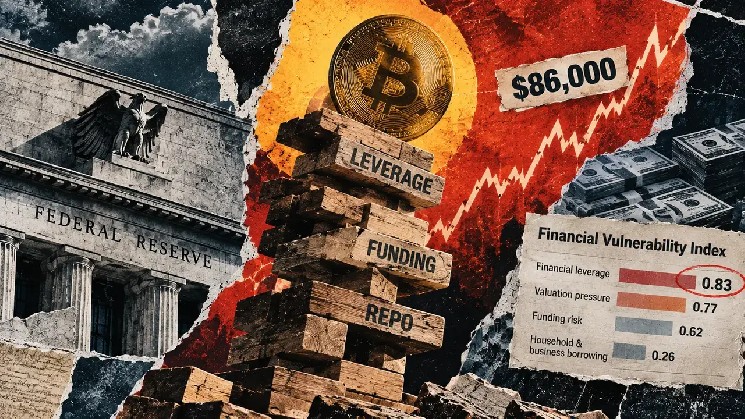
Bitcoin's latest rally and the Federal Reserve's new financial-risk gauge are describing two different time horizons. Bitcoin ($BTC) reflects demand and positioning in today's market, while the Fed's measure tracks structural weaknesses that could magnify the next shock.
The Financial Vulnerability Index (FVI) is designed to capture slow-moving vulnerability rather than coincident market stress. In Figure 2 of the working paper, the final financial-leverage annotation reads 0.83, inside the “elevated” band of its historical distribution. The aggregate index is labeled 0.65, valuation pressure 0.77 and funding risk 0.62 — all described as “notable.” Household and business borrowing sits lower at 0.26. The gauge sits within a broader Fed monitoring toolkit that also includes the semiannual Financial Stability Report, though staff working papers on their own do not carry the Board's policy weight.
The chart labels the four components Q1 and the aggregate index Q2, with 2026 as the last axis mark. Separately, the working paper states that its dataset and several estimation samples end in 2025:Q4, without explaining whether those endpoints are later-vintage observations, nowcasts or a labeling issue. That confines any safe description to Figure 2's quarter labels and values, without assigning them a verified 2026 observation date.
The distinction between vulnerability and current conditions explains the apparent split. Conventional financial-conditions indexes rise as credit tightens and visible stress emerges. The FVI, by contrast, can build through calmer periods as leverage and risk-taking accumulate.
Bitcoin's current move has drivers of its own. On Sept. 21, $BTC touched $86,000, more than 10% above the prior Sunday close, as spot taker flow turned positive and volume rose. Short liquidations helped Monday's leg higher. Futures open interest and funding paid by longs were above Glassnode's high bands, options open interest stood near $41 billion, and options were pricing less movement than the market ultimately delivered.
How funding stress could reach Bitcoin
A June analysis “Decomposing Hedge Funds' U.S. Treasury Exposures,” estimated that large hedge funds held $4 trillion in gross Treasury exposure and $3 trillion in repo borrowing — short-term secured funding pledged against Treasury collateral — as of September 2025. Its proxy estimates included roughly $830 billion in cash-futures basis trades, which exploit the gap between Treasury futures and cash bond prices, and $305 billion in swap-spread trades, which position around the spread between interest-rate swaps and Treasuries.
The Fed's separate review of government bond-backed repo markets found that short-term funding, dealer intermediation, collateral reuse and low haircuts can carry stress across funding, cash and derivatives markets. Higher margin calls or tighter dealer capacity could force liquid-asset sales, weaken crypto spot demand and liquidate leveraged $BTC positions. That cross-market sequence remains a scenario, however; the cited evidence has not observed the full chain. Its preconditions are nonetheless observable in real time: whether futures open interest and funding paid by longs stay above Glassnode's high bands, how estimated hedge-fund repo borrowing evolves from its September 2025 level, and whether the Fed later clarifies the vintage behind the FVI's 2026-labeled readings.
The working paper's historical model shows why the vulnerability reading matters. In high-FVI periods, the same modeled business-cycle shock produced deeper declines in consumption and long-term investment than in low-FVI periods. The index is therefore best read as an amplifier gauge: it describes the system's capacity to turn a shock into wider damage, while Bitcoin's immediate path remains tied to flows, liquidity and positioning.
The working paper reflects its authors' analysis and does not indicate concurrence by the Federal Reserve Board.
Source: CryptoSlate

