Bitcoin Rallies Toward $70,000, Wiping Out $1.9 Billion in Crypto Liquidations
Key Takeaways
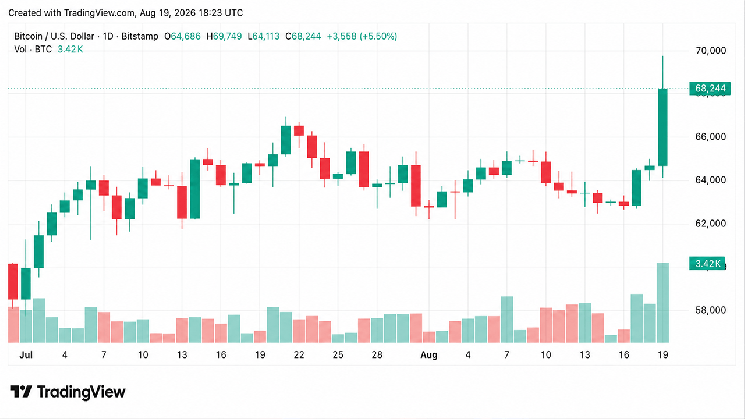
- •Bitcoin rose to near $70,000 after reports that the U.S. Treasury was increasing bond buybacks to $4 billion per operation.
- •The cryptocurrency later held above $68,200 and remained more than 6% higher on the day.
- •Bitcoin’s advance triggered $1.1 billion in short liquidations in 24 hours, while total crypto liquidations exceeded $1.9 billion.
- •The S&P 500, Dow Jones Industrial Average and Nasdaq composite showed only a limited reaction to the Treasury announcement, while gold climbed above $4,490 an ounce.
- •Strategy’s MSTR surged alongside bitcoin, briefly rising more than 11% before easing back to around $103.
Bitcoin Rallies Toward $70,000, Wiping Out $1.9 Billion in Crypto Liquidations
Bitcoin Rally and Consolidation
After coming just short of $70,000 on reports that the U.S. Treasury was doubling bond buybacks to $4 billion, bitcoin appeared to consolidate above $68,200. Round-number levels such as $70,000 often act as focal points for traders, and attention now centers on whether bitcoin can hold that range as the market digests the scale of the Treasury’s expanded program. Even so, the leading cryptocurrency was still up more than 6%, making Aug. 19 one of its strongest days of the month so far.
Before the U.S. Treasury’s announcement, bitcoin had been climbing gradually, supported by momentum that began after Strategy said it had paused bitcoin sales. The cryptocurrency then continued to advance and had reclaimed $65,000 just hours before what the Trump administration described as its most consequential move. After the announcement, bitcoin added nearly $5,000 as investors reacted strongly to the Treasury’s intervention.
Bitcoin’s move toward $70,000 briefly pushed its weekly gains above 10% and lifted its market capitalization to $1.4 trillion. In derivatives markets, the sharp rise liquidated $1.1 billion in short positions on bitcoin in 24 hours, compared with less than $35 million in long positions. Liquidations occur when exchanges force-close leveraged positions that can no longer meet margin requirements, and when shorts are closed out en masse, those positions are bought back — a dynamic that can amplify fast moves higher. Such one-sided episodes are a recurring feature of crypto derivatives markets, where leverage runs heavier than in traditional equities. Across the broader cryptocurrency market, total liquidations topped $1.9 billion, with short bets accounting for $1.74 billion.
The Treasury announcement had a much more limited effect on Wall Street. The S&P 500, which reached a new milestone last week, was nearly unchanged with a 0.34% gain. The Dow Jones Industrial Average and Nasdaq composite showed a similar reaction, indicating the move did not excite equity investors to the same extent it did bitcoin traders. Gold, however, rose on the news, climbing above $4,490 per ounce for a daily gain of more than 3.5%.
The sharp contrast between bitcoin’s rally and the muted response in U.S. equities to the Treasury’s more aggressive buyback program points to a broader macro reading: markets may be pricing in faster and more disorderly dollar debasement. As long-end buybacks expand from $2 billion to at least $4 billion per operation — a move analysts have described as unprecedented intervention in the FX and rates complex — bitcoin has traded like a high-beta hedge against fiscal slippage, while equities have treated the same liquidity injection as a temporary volatility dampener rather than a structural shift.
That divergence suggests investors are drawing different conclusions from the same policy move. Assets linked to monetary dilution, such as bitcoin, appear to be front-running the implications of expanding Treasury support, while equities are reacting more cautiously to what they see as a short-term reprieve in yields rather than a longer-term currency erosion story.
Commenting on the Treasury move in a post on X, financial commentary outlet The Kobeissi Letter said the government action reflected the need for lower interest rates. “The reality is that the US government needs lower interest rates more than anyone,” the outlet posted, noting that the U.S. spent $1.4 trillion on interest alone over the prior 12 months — a tab that has climbed alongside total federal debt, which has passed $37 trillion.
Citing rising long-term borrowing costs, The Kobeissi Letter added that annual interest spending is projected to reach “$1.7 trillion per year” by November 2028, and said that “borrowing costs have more than doubled since 2020.”
Bitcoin’s surge also lifted Strategy’s MSTR, which posted one of its sharpest intraday rallies in weeks. The stock climbed from just under $95 to nearly $107, a move that briefly put it up more than 11% before it cooled to around $103. Strategy, formerly MicroStrategy, holds the largest corporate bitcoin treasury of any publicly listed company, which is why its stock has long traded as a high-beta proxy for the cryptocurrency. The move again highlighted how closely MSTR continues to track bitcoin’s momentum, with traders piling in as the top cryptocurrency accelerated higher.

