Bitcoin’s $55,000 Weekend Low: Hedge or Warning?
Key Takeaways
- •Bitcoin dropped below $60,000 on Friday for the first time since July and bottomed at $55,130 on Binance early Saturday, roughly 4.5% under its July low.
- •QCP proposed the decline was largely a substitute hedge against technology-stock risk during a weekend with closed equities markets and thin liquidity, rather than a crypto-specific problem.
- •Most of Bitcoin's weekend rebound occurred before Nasdaq futures reopened, indicating selling pressure had lost momentum rather than risk simply moving into another market.
- •U.S. spot Bitcoin ETF outflows reached a fifth straight day, bringing the streak since Nov. 17 to $2.37 billion, with BlackRock's IBIT accounting for roughly 82% of the total.
- •Nvidia's reinstatement of Jensen Huang as CEO lifted the Nasdaq 6.5% and drove Bitcoin to about $64,600 intraday, but the cryptocurrency gave back most of the gain to finish near $61,240.
Bitcoin recovered to nearly $61,000 before Nasdaq futures reopened, but its weekend rebound did not fully validate the hedging explanation proposed by trading firm QCP. The firm said in a Nov. 23 note that Bitcoin's slide was largely a hedge against broader risk, amplified by thin liquidity, rather than evidence of a crypto-specific problem.
The move came as IBIT recorded its largest daily outflow, Nvidia news drove Bitcoin briefly to $64,600, and demand for downside protection reached its highest level since mid-July.
Why Saturday's selloff could have been a hedge
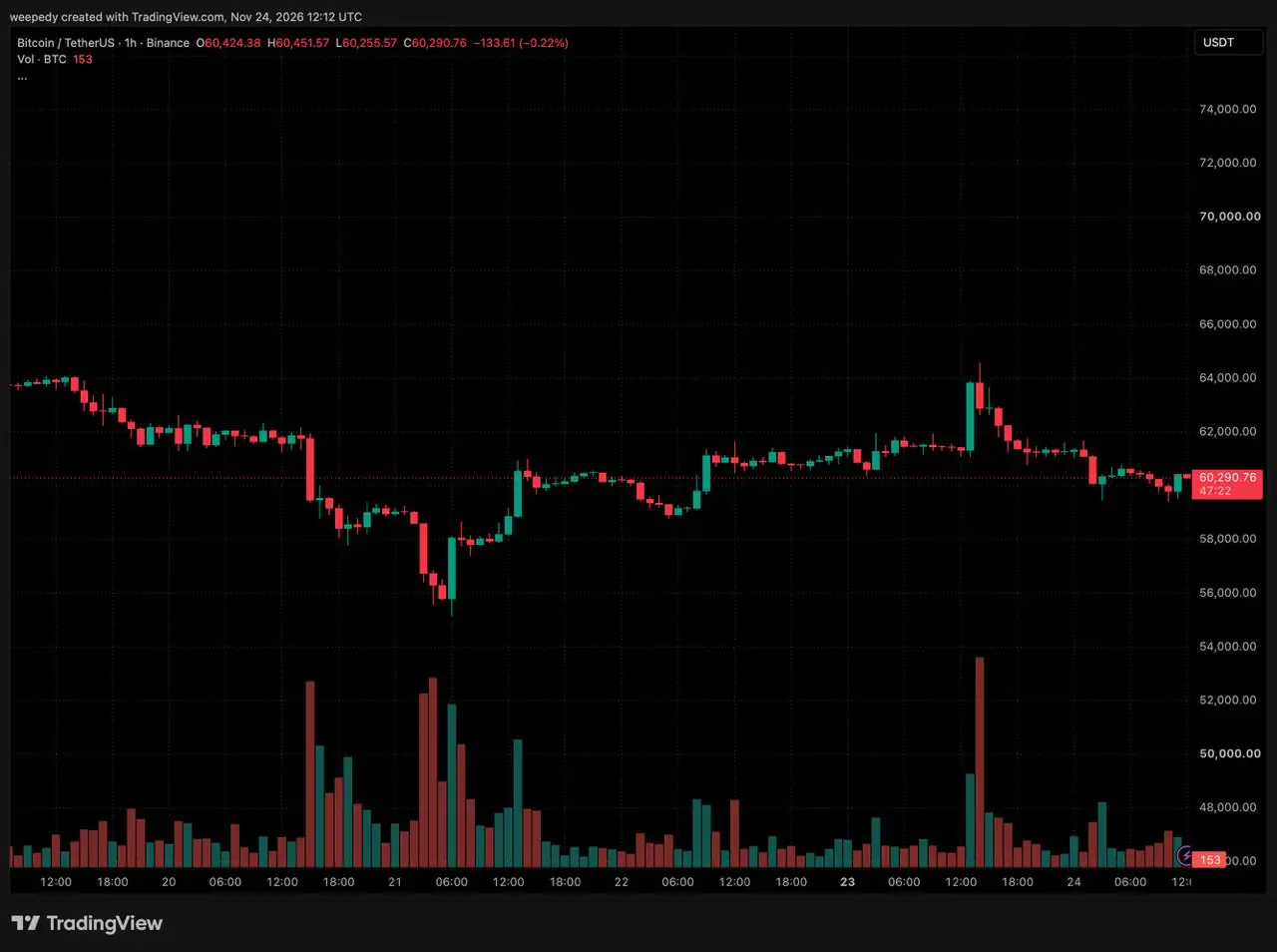
Selling began during Friday's U.S. session, when Bitcoin dropped below $60,000 for the first time since July and ended the day near $58,952. The decline continued during early Asian trading on Saturday, reaching a low around 06:00 UTC when Bitcoin touched $55,130 on Binance. That was about 4.5% below its July low near $57,700.
The decline occurred when traders had limited alternatives for managing risk. U.S. stock markets were closed, while CME's E-mini Nasdaq-100 futures were not scheduled to reopen until 23:00 UTC on Sunday. A fund concerned about technology stocks over the weekend could sell Bitcoin, which trades around the clock, as a substitute hedge. If many funds followed that approach in a thin order book, Bitcoin could fall more sharply than crypto-specific news alone would warrant.
Bitcoin rebounded before Wall Street reopened
If Saturday's decline had been primarily a hedge, that position might have been expected to unwind when futures trading resumed. Traders could have moved their protection back into Nasdaq contracts and repurchased Bitcoin. The price action did not follow that sequence.
Bitcoin moved back above $60,000 by Saturday afternoon UTC, only a few hours after reaching its low. After falling toward $59,000 early Sunday, it climbed to approximately $61,000 by Sunday morning and remained near that level when Nasdaq futures reopened that evening.
Almost all of the recovery took place while crypto was the only one of these markets trading. Futures hedges could not yet be shifted, stocks could not be purchased, and U.S. spot ETF shares could not change hands. Hedgers may still have closed Bitcoin positions, but they did so before futures reopened. That timing points to selling pressure losing momentum rather than risk simply moving into another market.
QCP's main supporting evidence came after the reopen. During Asian hours on Monday, Bitcoin advanced toward $62,000 even as Nasdaq futures continued to decline. If Bitcoin had been responding to the same concerns affecting technology stocks, the two markets would have been expected to move together. Instead, they diverged, supporting QCP's view that Saturday's decline was not driven by a crypto-specific problem. Public price data cannot identify who was buying, however, so the conclusion is based on timing and does not establish which traders were involved.
Selling pressure had eased by Sunday
Positioning data through Nov. 22 helps explain how Bitcoin rebounded without new buyers from traditional markets. On-chain analytics firm Glassnode's Week 48 Market Pulse tracks cumulative volume delta, which measures the running balance between aggressive buying and selling.
In spot markets, the measure improved to negative $120.9 million from negative $170.8 million a week earlier. In perpetual futures, where leveraged traders operate, it recovered to negative $486.5 million from approximately negative $1.5 billion. Sellers still had the advantage in both markets, but their selling was considerably less aggressive.
Leverage had also declined. Futures open interest — the total value of outstanding futures contracts — fell 12% during the week to $29.3 billion, its lowest level since early March. Fewer leveraged positions leave less room for forced liquidations, which can otherwise turn a decline into a broader cascade.
Options traders continued to hedge. The 25-delta skew, which measures the premium traders pay for put options that profit from a decline compared with comparable call options, rose to 17.4% from 14.4%. It was the highest reading since mid-July. The data showed traders buying protection rather than simply selling coins, consistent with a market facing concern but not panic.
Nvidia changed the test for Monday's trading
At approximately 14:00 UTC on Monday, about 30 minutes before the U.S. market opened, Nvidia's board reinstated Jensen Huang as chief executive. Chief Financial Officer Colette Kress had been running the company on an interim basis.
The board said it had consulted senior U.S. government officials and established an independent committee to examine reports that Huang had been the target of a foreign intelligence effort. The decision affected the broader technology sector.
The Nasdaq Composite opened at 24,270, 7.3% above Friday's close, and finished 6.5% higher at 24,090. Nvidia closed up 31.48%. Bitcoin moved above $63,000 within an hour, supported by heavier Binance volume than at any point during Saturday's selloff, and later reached approximately $64,600.
The gain did not hold. Bitcoin fell back below $62,000 by 17:31 UTC and ended the U.S. session near $61,240, roughly where it had started the day.
That made Monday's stock rally a limited test of QCP's argument. Equities rose on company-specific news rather than because concerns surrounding the weekend had clearly eased. As a result, a stronger Nasdaq could not establish whether the risk Bitcoin may have been hedging against on Saturday had passed. Bitcoin's round trip showed that it joined a rally triggered by external news rather than demonstrating an independent recovery.
ETF investors remained net sellers
QCP identified two flow conditions for a lasting recovery: ETF flows becoming consistently positive after four consecutive days of outflows, and Bitcoin holding its value during U.S. trading rather than only during Asian hours. Monday met neither condition.
According to Farside Investors, a data provider that compiles daily flow figures for U.S. spot Bitcoin ETFs, a fifth consecutive day of redemptions brought the outflow streak that began on Nov. 17 to $2.37 billion. Selling was concentrated in BlackRock's fund. IBIT represented approximately 82% of the total, and its Friday redemption was the largest single-day outflow in Farside's records for the fund. On Monday, IBIT recorded more than $500 million in outflows for a third consecutive session.
Fidelity's FBTC was the only fund to record inflows on Monday. Grayscale's Bitcoin Mini Trust recorded its largest outflow of the run, at $61.1 million.
Bitcoin nevertheless ended Monday about 11% above its weekend low. Net ETF redemptions mean fund shares were exchanged back into coins that had to be sold somewhere, leaving buyers outside the U.S. funds to absorb that supply. Daily flow totals do not show when redemptions occurred during a session, so they cannot be directly linked to Bitcoin's decline from $64,600.
Monday's results against QCP's checklist
QCP's conditions for a durable Bitcoin recovery produced mixed results:
- Technology stocks stabilize: Met for the day, but the move was driven by Nvidia news rather than easing macroeconomic risk.
- ETF flows turn consistently positive: Not met, as outflows continued for a fifth session.
- Bitcoin holds up during U.S. trading: Not met, because the Nvidia-driven gain faded before the close.
- Implied volatility falls below 40: Still elevated in QCP's note; no Monday closing reading was published.
The weekend and Monday presented different signals. Saturday's decline was consistent with QCP's hedging argument: Bitcoin fell most sharply while it was the only major risk asset trading and later rose even as Nasdaq futures declined.
The rebound also has a simpler explanation. Selling pressure lost momentum before traditional markets reopened, and Bitcoin held much of its recovery even after ETF investors returned as significant sellers. Monday's U.S. session was less supportive, with both of QCP's flow conditions failing.
By midday Tuesday, Bitcoin was trading near $60,290 on Binance, approximately 9% above Saturday's low but below Monday's close. QCP said it expected implied volatility to remain high and crypto to stay under pressure until there was greater clarity from the Federal Reserve or progress on geopolitical issues.
This article is for informational purposes only and does not constitute financial, investment, or trading advice. Cryptocurrency prices are highly volatile, and past performance does not indicate future results. Views attributed to third parties are their own. Readers should conduct their own research and consult a qualified financial adviser before making investment decisions.

