Bitcoin Pulls Back as US-Iran Tensions Rise and Fed Rate Hike Odds Jump
Key Takeaways
- •Bitcoin traded at approximately $77,935 on Monday, retreating from a weekly high of about $81,330.
- •CENTCOM strikes on Iranian targets attempting to mine the Strait of Hormuz killed two people, and Iran has vowed revenge, heightening geopolitical risk.
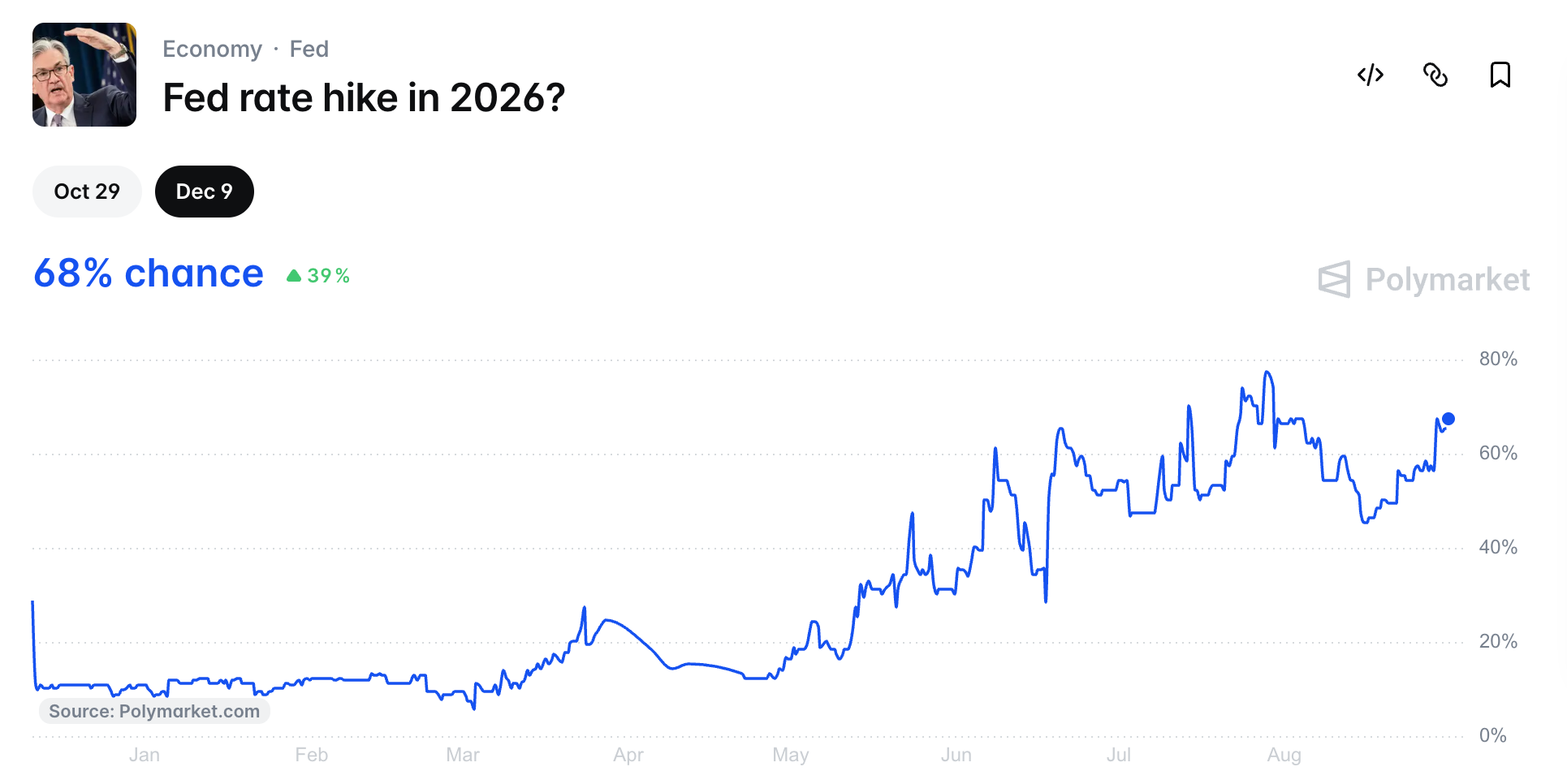
- •Polymarket odds of a Federal Reserve rate hike jumped to 68%, the highest since August 2, following Kevin Warsh's Jackson Hole speech on fighting inflation.
- •Brent crude crossed $90 per barrel on Monday, and US PCE inflation remained above 3% in July, complicating the Fed's policy outlook.
- •Michael Saylor indicated Strategy may resume buying Bitcoin later this year, while the daily chart shows a potential bullish flag pattern targeting $85,000.
Overview
Bitcoin's price has wavered over the past few days, pulling back slightly on Monday amid rising tensions between the United States and Iran and a jump in the odds that the Federal Reserve will hike interest rates later this year. BTC also reacted to a large ETF outflow on Friday that ended a two-week inflow streak. It was trading at $77,935 on Monday, down from the week's high of $81,330.
The confluence matters for crypto holders because Bitcoin has increasingly traded like a risk asset: when investors anticipate tighter monetary policy or geopolitical shocks that feed inflation, liquidity tends to flow out of speculative assets first. Spot Bitcoin ETFs, which channel institutional money into BTC, have amplified that sensitivity—so a swing from inflows to outflows can move price quickly.
Bitcoin Price Falls as US-Iran Tensions Rise
BTC retreated as investors embraced a risk-off sentiment following the latest US strikes against Iranian targets. In a statement, CENTCOM said it launched strikes against military targets that were attempting to lay mines at the Strait of Hormuz. The strikes killed two people, and Iran has vowed revenge.
The Strait of Hormuz is one of the world's most important oil chokepoints, and any disruption there feeds directly into global energy prices and, in turn, inflation expectations.
A further wave of tit-for-tat attacks would pose risks for Bitcoin and other risk assets because of the impact on inflation. Data released last week showed that US personal consumption expenditure (PCE) inflation remained above 3% in July, and inflation has stayed above the Fed's 2% target for the past five years.
That situation could worsen as crude oil prices rise. Brent crossed the important resistance level of $90 on Monday, and the rally may continue for the foreseeable future.
Iran has an incentive to escalate. Reports indicate the Iranian military has reconstituted its weapons, moving to newer systems that are said to be faster and capable of manoeuvring as they approach their targets (WSJ). Meanwhile, reports suggest US weapons stockpiles are at significantly low levels as midterm elections approach, which Tehran may read as giving it more room on the escalation ladder.
Federal Reserve Rate Hike Odds Are Rising
Bitcoin is also reacting to rising odds that the Federal Reserve will hike interest rates following last week's speech at the Jackson Hole Symposium. In that speech, Kevin Warsh discussed steady inflation in the US and the need for the central bank to curb it, hinting that the bank would use all of its tools to bring inflation down. One such tool would be an interest rate hike—a move that would irk President Donald Trump.
Higher rates typically weigh on Bitcoin because they raise the opportunity cost of holding non-yielding assets and tighten liquidity conditions that had supported crypto's earlier rallies.
Odds that the Fed will hike interest rates jumped to 68% on Polymarket, the highest level since August 2, and this trend could continue, especially if US-Iran tensions escalate.
The risk, however, is that the US economy is no longer growing as it did in the past. The economy lost 23,000 jobs last month, and second-quarter growth, excluding AI investments, was weak. That leaves policymakers facing a familiar dilemma: tightening to fight inflation risks deepening a slowdown, a backdrop that historically has made asset prices more volatile in both directions.
On the positive side for Bitcoin, Strategy has reduced its selling, instead leaning on selling its shares to raise capital. In a statement, Michael Saylor said "we're back" (X post), possibly hinting that the company was planning to resume buying. In a recent statement, Saylor suggested he would start buying later this year once the preferred shares stabilize. Strategy has been one of the largest corporate holders of Bitcoin, so shifts in its buying behavior are watched closely as a signal of large-treasury demand for BTC.
Bitcoin Price Prediction: Technical Analysis
The daily chart shows that BTC has pulled back in recent days, moving from a high of $81,331 to the current $77,915. Its highest point this month coincided with the highest level in May, so this retreat may be part of profit-taking after hitting a major resistance.
The coin is slowly forming a bullish flag pattern, composed of a vertical line and a horizontal channel. There is therefore a likelihood of a strong bullish breakout, potentially to $85,000. This view would be confirmed if the price moves above the key resistance at $81,330.
Traders will be watching upcoming economic data and any further US-Iran escalation as the key catalysts that could confirm or invalidate this setup.
Source: The Market Periodical
